ike film-maker and journalist Poppy Jay's previous (excellent) documentary, Young, British and Anti-Abortion, her latest offering should come with a warning and blood pressure medication for all women watching. Some men, too, I'm sure, but you'll forgive me if I can't quantify the proportion.
In Young, British and Tradwife, Jay interviews three women in the UK who are advocating the lifestyle that first took off as a social media phenomenon in the US (where the evangelical Christianity and social conservatism with which it is enmeshed are stronger influences than here). Each of the trio has been chosen with care and balance to represent slightly different manifestations of the movement.
First up is Megan, at the gentler end of what Jay acknowledges to be a spectrum. The Bible's exhortation for wives to be subservient to husbands, Megan says, is best understood as part of a relationship in which you are both expected "to lay down your lives for each other" – in other words, give selflessly, maximally and by implication equally to your life together. She runs an Instagram account that involves content using her children and makes money from sponsorship deals, the only way the couple can afford for her to stay home with the kids. Before she had children, she founded a kombucha business with a friend. After them, she "handed the reins" to her husband, Joseph. I would like to have heard from the friend about how the business is doing now, and whether Megan sees any connection between the ambition and talents that led her to start that company with the Insta account she has built up today, but we are slightly left hanging as Jay moves on to bigger game.
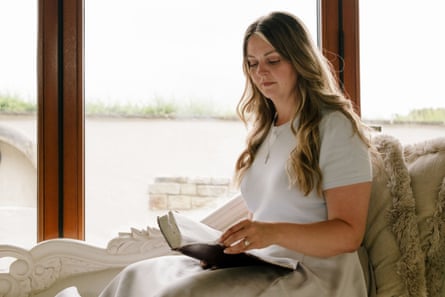
Laura Zachary is a born again Christian who married Zion six months ago and appears to delight in posting provocative content about her chosen lifestyle. "A lot of women got upset when I told them I treat my husband like he's Jesus," runs the most infamous of her videos. Women think it is freedom not to cook or clean for a man, but Laura is here to tell us that it is simple laziness. She notes that the more people disagree with her and engage with her account, "the more you get paid!" but Jay doesn't push her on how much of her spiel, therefore, is a business decision and what the moral implications of that might be. Nor does she interrogate what Laura means when she refers to Zion taking "things I don't like about myself" off my shoulders. Is she subservient to him, you wonder, simply because she is still in the early, loved-up stage, because she has some kind of traumatic past – or because she has found a lucrative seam to mine?
The biggest hitter, in televisual terms, is Molly, mother of seven children and wifely helpmeet to Christian nationalist theologian Aaron ("Christian chivalry in a feminist age will be seen as misogynistic … because it requires on some level limiting the agency of women"). Her life has been this way for longer than TikTok has existed and she hasn't heard of most of the tradwife leading lights. Shown one, she says it makes a mockery of her life.
Jay spends a few days living in with the couple, mostly arguing with Aaron ("I'm the king, and she's my queen … she doesn't get to usurp the throne") and then Molly stays with Jay in her London flat for a few days. They have a pleasant enough time, agreeing that women cannot – whatever they have been told – have it all, though Jay's attitude to non-marital relationships causes a freezing of the atmosphere. Molly says she wanted to be a journalist and never thought she would get married or have children. Jay cannot discern whether meeting Aaron (at 19) enabled her to admit she really did want to get married or that she had to let her career ambitions go. What is a mask and when it eats the face is the perennial fascination in these interviews.
In many ways, it is a hugely frustrating watch – mainly because you want to see 12 hours of close interrogation of each wife and each husband (separately) by a trained psychotherapist, and in-depth interviews with parents and friends who knew them before and after marriage and who have no compunction about burning bridges if they need to. But this, of course, is not possible. This is an hour that is designed to provoke further thought and inspire, hopefully, more detailed investigations. Jay – a formidable presence and fearless in her questioning of the men, though perhaps too careful with the women – does great work in showcasing the different facets of the movement and hinting at all the complicated possible motives.
Can you be a feminist stay-at-home mother, wife and Christian? Can you get married as a Christian and not become caught up in patriarchal norms? Are patriarchal norms ever not harmful? Ever useful? Why? Why not? Is there an institution on earth that is good for women? Where is it and could you give me the keys?
Now – especially as the movement is starting to fall apart in the US, with increasing numbers of high-profile members divorcing, and stories of abuse and coercion behind the scenes – we need deeper dives.