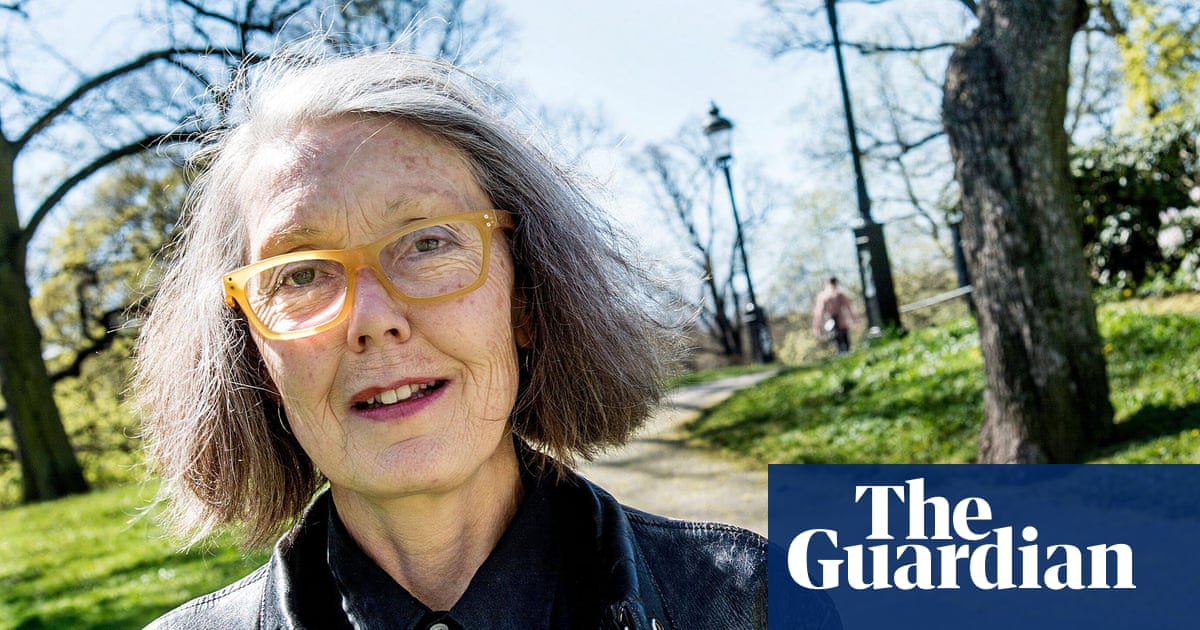
t is preposterous to agree to write a short piece on Anne Carson's work. The task is impossible, akin to that of solving the mathematical problem of dividing zero by zero. If one had the power to solve it, perhaps one would have some confidence in attempting to write about Anne Carson's work. Attempting, I say, not succeeding. In attempting to do so, I shall emphasise that all words fall short in extreme situations, which not only include unfathomable losses (of children, in my case) but also include articulating anything about Anne Carson's work.
One could start with Carson's words. "Words, if you let them, will do what they want to do and what they have to do." (Autobiography of Red) But to let the words exist in their own desires and yearnings and frustrations and confusions, to let the words scream with inarticulable pain or tell a riddle with a twinkling smile or make love to one another – how many of us have achieved that kind of mastery of words? But, oh no, mastery is the wrong word here. Only the minor and the greedy and the power-thirsty writers want to be the masters of the words. Carson does not subjugate or manipulate her words. She lets them be; and lets herself be led by the words – hers, and the ancients' translated into unforgettable English by her.
And what extraordinary words they are! Say, let's suppose every person in the world could be viewed as a formation of some words – a poem, a story, a play, a novel, an earnest and muddle-minded op-ed, a loud slogan, or a much repeated and tired cliche, or, simply, a line of ellipses, or some white space (if we include words in this game, we must also include punctuations and silences).
In a gathering of a vast number of word formations, those written by Anne Carson would surely be easily recognisable. The fact that they exist at all is a miracle, because many rules have been bent or broken to make them possible. Nevertheless, they are not anarchists or revolutionaries. They are both mortal and immortal because they know their priorities ("Love is not conditional. / Living is very conditional."– The Beauty of the Husband). They are compelling because they are compelled ("I know / you find me extreme / in my grief. / I bear it hard. / But I tell you I have no choice. / It compels. I act because it compels" – Elektra, translated by Carson). They, beings unto themselves, are defiant ("That which is known, attained, possessed, cannot be an object of desire." – Eros, the Bittersweet). Their concerns are vast and undefinable; one blunders if one uses words like philosophical or metaphysical, tragical or dramatic.
For those who were less fortunate, written by a lesser mind, there is no worry because any encounter with Anne Carson's creations expands, deepens, mystifies and clarifies our minds; a paragraph from her is enough for a long meandering in a less visited landscape, a line is enough for one to understand oneself better.
I teach Anne Carson from time to time, but to say one can teach Anne Carson is also preposterous. One hands her work to the next generation, trusting that there are bound to be kindred spirits among them. I have done this for the past 20 years, and like to watch the first encounter of young, inquisitive minds with Anne Carson. Some of them, like me, will remain her lifelong readers. Some will find her work the only words to read in life's extremities.
This morning, when the news came out that Anne Carson is the newest Nobel Laureate, I immediately moved all of Anne Carson's books from my bookcase to my desk, intending to spend a morning with them. Then I realised that the most important book of hers for me – Grief Lessons, her translation of four Euripides plays – was missing. It was likely misplaced because I taught it in a recent semester. After our older son Vincent died in 2017, I spent a winter reading that book. Then I read it again after our younger son James died. To say Carson's words are life-sustaining is an understatement. What is infinity divided by infinity? Or, infinity subtracted by infinity? Or, zero multiplied by infinity? Reading Carson gives one the perspective and the courage to live in an often inexplicable life.
It is joyful news to see Anne Carson recognised with the Nobel prize. Sometimes there comes the good news that is right just. But that is only as simple as knowing one plus one makes two. The recognition underlines the infiniteness of Anne Carson's genius, but to get a better sense of that genius, one only needs to turn to any page of any one of her books.