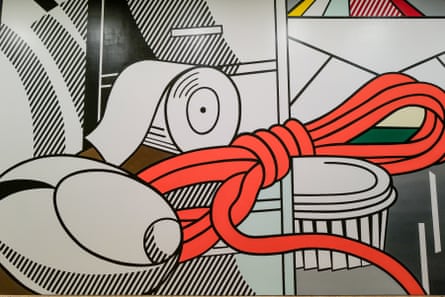
hen the American artist Roy Lichtenstein created his monumental Greene Street Mural in 1983, he took inspiration from the Bayeux tapestry for its serial storytelling technique. But whereas the embroidery depicting the Norman conquest continues to delight after nearly 1,000 years, Lichtenstein's site-specific mural was destroyed after six weeks, in accordance with his wishes.
More than four decades later, however, the monumental Greene Street Mural is to mesmerise art lovers once more. This week a 96ft (29-metre) recreation of the work will span the entire entryway to Roy Lichtenstein: Like New, the first major New York retrospective of the pop artist's work in 33 years, at the Whitney Museum of American Art.
"He was very interested in the Bayeux tapestry," guest curator Alex Da Corte says via Zoom. "This was a huge part of his research, and how he was thinking about his early work pre-pop in that the tapestry contained a serial storytelling, a comic-style frieze or broadside, which is essentially what Greene Street Mural becomes. It's tied to this idea of the frame-by-frame and a kind of serial mode of storytelling that we understand very well now through scrolls and so many photographs."
The exhibition boasts more than 130 works spanning six decades, from early 1940s studies to unfinished canvases that Lichtenstein left in his studio at his death in 1997. The museum's connection to Lichtenstein dates back to 1965, when his work was first featured in a Whitney annual exhibition.
It was the artist's widow, Dorothy, who championed pairing an in-house curator, Meg Onli, with an active contemporary artist, Da Corte, to conceive a contemporary retrospective that would innovate beyond a mere conventional survey.
Known for his immersive installations that critique visual media and consumer culture, Da Corte had a long interest in pop art. He recalls: "You ask yourself, what do you think of an artist so ubiquitous as someone like Roy? Where is there a gap? What could be discovered? What is new there?"
If the public remembers Lichtenstein primarily as a cool ironist who lifted images from romance comics and chewing gum wrappers, Like New exposes a more rigorous and complex artist. At the heart of the exhibition's thesis is Lichtenstein's lifelong obsession with an obscure academic mentor: Hoyt Sherman, a professor at Ohio State University.
Lichtenstein studied under Sherman in the 1940s before returning to teach alongside him. Across his career, until his death in 1997, Lichtenstein repeatedly cited Sherman as his single greatest influence. Yet Sherman's radical teaching methods had been underplayed in previous museum retrospectives.
To understand Lichtenstein's mechanics, Onli and Da Corte travelled to the Ohio State University archives to examine Sherman's curriculum and psychological experiments.
Sherman was a pioneer in optics and visual perception, building specialised laboratory environments known as "flash labs". In these pitch-black classrooms, mechanical devices would flash images of still lifes or geometric forms for fractions of a second. Sherman instructed students to draw what they had seen in complete darkness, training their minds to process spatial form, figure-ground relationships and visual memory holistically rather than sequentially.
Da Corte explains: "Hoyt Sherman's teaching methods were eccentric and not to be overlooked. He employed a whole bunch of optical theorists who were working at the time, curious about how we see things – going all the way back to Aristotle and [Leonardo] da Vinci, as well as early 20th-century contemporaries."
This casts Lichtenstein's output in a fresh light: rather than simply copying mass media, he was exploring sophisticated questions of optics and perception through popular imagery. Da Corte says: "We are used to seeing the pop of it and taking it for what it is – recognising that it's an appropriated image – and then not wanting to excavate a meaning beyond that.
"But Roy spoke about a very conceptual practice born out of Hoyt Sherman's teachings on optics and perception. How curious that you go 50 years citing one professor over and over again? There must be more than meets the eye."
This challenges the persistent criticism that dogged Lichtenstein throughout his career: accusations of plagiarism, uncredited copying and lazy appropriation. During the height of pop art in the 1960s, critics frequently questioned whether Lichtenstein's practice constituted legitimate fine art or commercial theft. Life magazine ran an article in 1964 asking: "Is He the Worst Artist in the U.S.?"
For Onli and Da Corte, these critiques are narrow and fundamentally misunderstand Lichtenstein's practice. In Like New, visitors can peruse original sketchbooks, source clippings and preliminary drawings alongside comic book panels by illustrators such as Tony Abruzzo and William Overgard, showing how often Lichtenstein reworked rather than simply reproduced his sources. He created complex visual composites, re-engineering line weights, cropping compositions and shifting colour fields to agitate the viewer's eye.
Onli reflects: "When we look back, there have been critiques lobbed not only at him, but at people like Warhol as well – quite a few pop artists who used appropriation as a strategy in the 1960s. There's been critique of how much Lichtenstein could shift his images.
"You get a chance to see in this exhibition, through his sketchbooks and clippings, original drawings from comic book artists he referenced. Roy was often making composites. It's quite reductive to say he just lifted an image directly from a comic book; oftentimes, many different sources went directly into one composition."
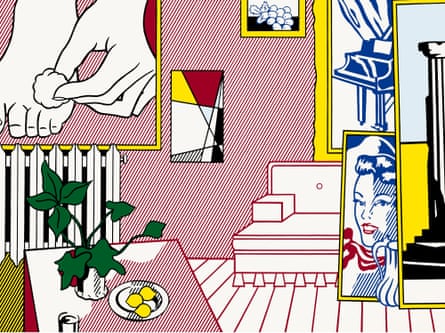
Onli notes that Lichtenstein's citational habit extended across the entire trajectory of art history. Early studies from 1942 show him copying historical paintings, a habit that evolved into major series referencing Claude Monet's Rouen Cathedral, Pablo Picasso's cubist figures, Henri Matisse's interiors and Piet Mondrian's grids.
Onli emphasises: "All of us who go to art school begin our training through copying. Every single person begins their training through looking at the great masters and making riffs on that. Lichtenstein really plays with that throughout his entire career."
Da Corte draws a direct parallel between Lichtenstein's techniques and traditional printmaking or comic production, noting that visual art has always been fundamentally collaborative and iterative.
"From the Renaissance or before, this idea of tracing and making a cartoon is part of art practice. Anyone who works in comics knows no one does it alone; it's a collaborative process. The ways in which he's altering things becomes the real focus of the work. The subject of the work is not about what it appears to be or that it has been lifted, but how it's been changed, what has been lost or actually erased."
Da Corte adds that Lichtenstein's subtle adjustments embedded a quiet, personal humour into the work. He says: "Every painting requires analysis from the viewer. In his familiar images, he's embedding himself with the kind of humour you would have if you were keeping a diary.
"The way he engages with the found object or ready-made is not dissimilar to [Marcel] Duchamp, taking something and adjusting it slightly. It appears both completely banal and also agitates. Roy was a humorous guy, known to be funny and deeply liked, but a funny guy."
One of the most spectacular curatorial feats in Like New is the historic reconstruction of Lichtenstein's landmark 1962 debut exhibition at the Leo Castelli Gallery on East 77th Street, a moment that helped herald the arrival of pop art. The Whitney has constructed an architectural facsimile of Castelli's intimate gallery space, scaled up by 15% to accommodate contemporary museum crowds while preserving the impact of the original hanging.
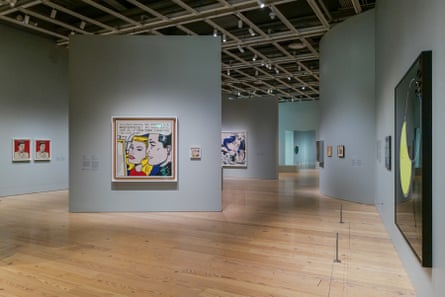
Two of the paintings in this ensemble have not been viewed by the public for more than 30 years. Onli comments: "What you have a chance to see is the sheer ambition of Lichtenstein early in his career. These paintings are huge for that room – it's not a contemporary hang. We studied historical photos to understand how he was hanging these works, what the eye level was."
The curators hope that reassembling the Castelli show will remind contemporary viewers that what now seems universally accepted was once considered profoundly radical and dangerous to the art establishment.
Onli notes: "It was a very controversial show. Lots of people hated it; some people loved it. When Ivan Karp and Leo Castelli mounted that show, collectors were saying to the gallery: 'If you continue showing that work, we're not coming here any more; this isn't real painting, it's not on the level.' Even though we look back and see it as something celebrated, it wasn't easy. That choice to continue in the face of criticism, to home in on something deeply conceptual and seemingly simple, took a lot of guts."
The 1962 suite showcases works such as Look Mickey (1961), Masterpiece (1962), and Girl with Ball (1961) – canvases where Lichtenstein threw down the gauntlet to abstract expressionism, replacing painterly angst with flat, commercial clarity.
It is also the first Lichtenstein retrospective to include his murals. Greene Street Mural was originally painted in 1983 for Castelli's 142 Greene Street space in Soho. Lichtenstein stitched together a vibrant assemblage of his own artistic lexicon: Ben-Day dots, cartoon hands, pyramids, composition notebook covers, tropical folding screens and references to Picasso and Matisse.
Onli says: "We used aspects of Lichtenstein's deadpan humour throughout the show. When Leo Castelli originally asked him to paint for the Greene Street space in 1983, Roy said: 'Leo, I don't really know what I would do.' Then he thought about it and said: 'Well, I'm going to have to use every image I've ever worked with before.'"
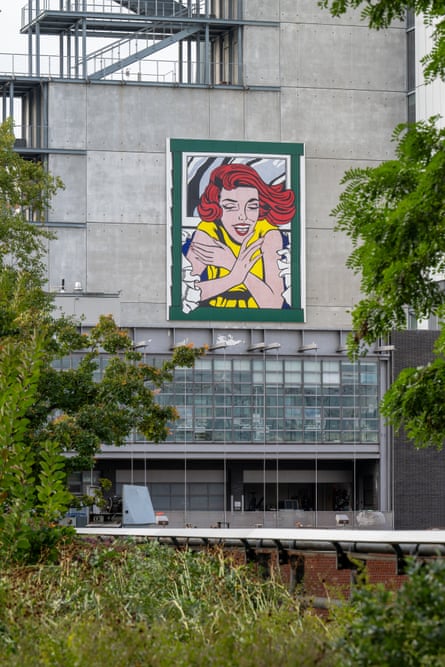
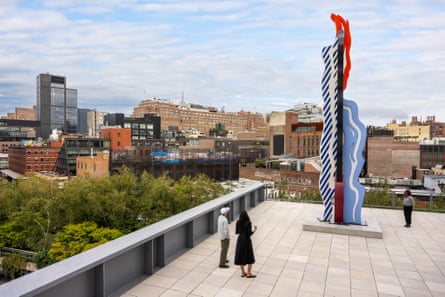
She adds that the show has four murals in total. Every inch of them, including the outdoor presentation of Girl in Window (1964), has been painted entirely by hand by Da Corte's studio team, preserving the crucial tactile tension that defines Lichtenstein's work.
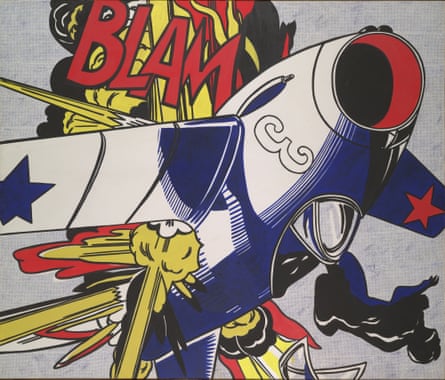
Onli emphasises: "One thing we wanted to stress is that Roy's work was so emphatically handmade. When you see it in photographs, it looks super slick and machine-made. Even in 1965, Roy joked, oh, the reason my work has been successful is because it translates well into fax machines. But throughout the entire show, all of these works have been done by hand. It has a very, very different feel than how we understand images today through AI or digital processes."
Indeed, in 1968, as mass media expanded rapidly across television, print and advertising, Lichtenstein was already talking about his famous Ben-Day dots in relationship to data. He had been reading Scientific American magazine, fascinated by how visual information could be broken down into discrete units, transmitted across distances and reassembled in the viewer's mind.
Onli says: "When we think about where he looked in time, we think about him so tethered to print culture. But by 1968, he's already talking about his dots in relationship to data. He's reading Scientific American, interested in how his dots could represent ideas of transmission and data. A lot of that had been papered over."
Onli notes that younger visitors coming to the Whitney today arrive without mid-century debates around commercial art versus high culture. "Younger generations are coming to the show without the baggage that was brought to this work in the past regarding appropriation.
"I remember saying at one point to artist Louise Lawler that we all live in a moment now in which the provenance and authorship of an image no longer matters. What does it mean to approach someone like Lichtenstein today for people who are deeply interested in how an image can be decontextualised from its source and recontextualised in art space? His practice feels incredibly young, fresh and – as our title says – like new."
Da Corte sees Lichtenstein's work as a crucial survival guide for contemporary artists overwhelmed by the endless deluge of digital media. "Right when he was making these works in the 1960s, the world as he knew it was being inundated with images, products and objects. Pop artists were trying to make sense of how they were being advertised to and what it looked like.
"If you ask any young artist now what their dilemma is, the dilemma is that there's too much stuff. There are so many images in the world, so much to contend with. How do you participate meaningfully? What do you make of all these things? Roy echoes that exact puzzle of images. He shows young people that you can actually take those images that wash over you every day and make something meaningful out of them."
Asked to speculate on how Lichtenstein – who died in 1997 just as the internet was entering mainstream culture – would react to today's world of smartphones, social media and artificial intelligence, the curators offer a nuanced picture of an artist always intrigued by technological advancement.
Da Corte suggests: "I feel like he would have been a peer of David Hockney and embodied this way of being in the spirit of advancement. He existed in a sweet space right between television becoming normative and the advent of the internet. He accepted technology but he also never loved the subject matter he was dealing with. Comic books were not his actual love; he was attracted to things he had distance from."
Onli concurs, pointing to Lichtenstein's 1990s experiments with virtual holograms, early computer design and influences from Italy's avant garde Memphis Group. "Whether he would like where we are today, I have no idea, but Lichtenstein would absolutely be responding to the visual culture of the moment. When you're making a show for a person you've never met, you hope there are moments that speak to the humour of his work. Alex and I wanted something that is incredibly elegant and serious, while maintaining that deadpan sense of humour."
-
Roy Lichtenstein: Like New is on display at the Whitney Museum in New York until 10 May 2027