idway through my conversation with Magali Reus, we are interrupted by a courier. They've arrived at the artist's studio to deliver an important package – one of the final components of a sculpture being finalised for Reus's show Swimming By Night at the Perimeter in London.
The studio is filled with such sculptures, all in various stages of completion. Reus likes to take everyday, often disposable, items – pizza boxes and sardine tins among them – and recreate them on a larger-than-life scale. One of them – vast looming fish hook lures made to look like uncanny cupcake cases or severed skeletal limbs – looms nearby, resting against a studio wall.
Born in the Netherlands and now based in London, Reus has shown in institutions across Europe and the US over the last few years, with her sculptures often responding to the specific details of buildings such as the Kunstverein Freiburg in Freiburg im Breisgau, Germany, and Kunsthalle Wien in Vienna, Austria. Her practice comments on our world of overconsumption and the fast disposing of objects that have served their purpose. "Our understanding of objects is one of a quick transaction," she says.
Reus tells me that when someone is first confronted by her sculptures, her hope is that they will seem simultaneously familiar and alien. Often, her work takes objects that would normally be briefly used then thrown away, and turns them into something more physically robust and imposing.
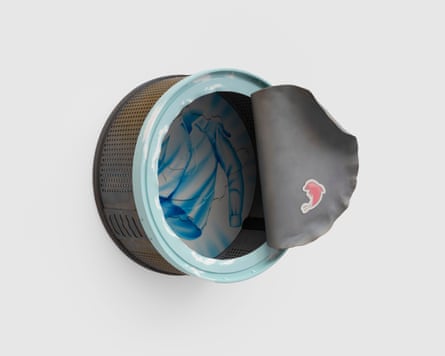
At first glance, works from her series Subs are made to look like discarded pizza boxes – but their aluminium construction and meticulously ripped and hand-hammered edges reveal something much less disposable. "We live in a world of extreme overproduction, consumption and waste," Reus says. Inside the "pizza boxes" that make up Subs are images of discarded Christmas trees, objects that have a brief, but meaningful, space in our lives.
"In December, we gather around it, decorate it and sing beside it," says Reus. "For a brief period of time it is a totemic, almost monumental presence in our home. By January, it lies forlorn in the street or has been thrust headfirst into a bin."
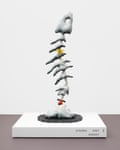
Even when she's describing these objects, Reus imbues them with a sense of humanity that is at odds with their disposable nature. There's a deliberateness in the way that the work is slowly made: sheet metal is bashed into shape; multiple layers of paint are applied to resin. "The transformation," Reus says, "changes the way that people relate to the object or the image."
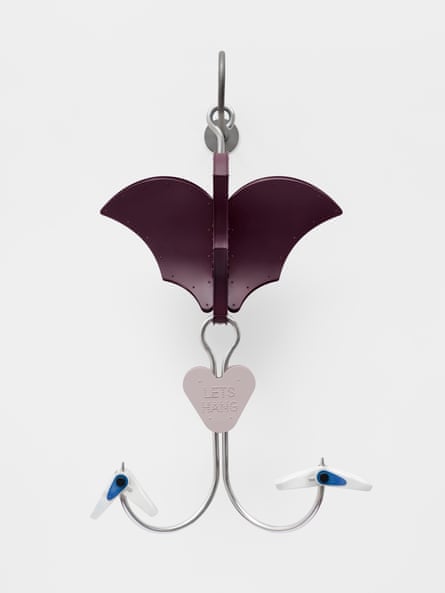
Reus tells me that her aim is to give them "autonomy as objects", allowing these things to occupy a new space, serving a purpose other than the one that might be foisted on them. These objects then become, to borrow the artist's phrasing, "active agents," rather than passive things to be manipulated or cast aside by people. At the centre of Rig (All Eyes On) is a recreation of a candy heart, blown up in size, with the words "Let's Hang" emblazoned across it. This object, in its normal context, would be smaller and much more fleeting, dissolving on the tongue of whoever might consume it.
Reus wants these objects to "refuse to serve us, [establishing] their own parameters". She tells me that people don't often clock the fact that her pizza boxes are made from aluminium rather than cardboard. "I like listening to and allowing the material to dictate how things come together," she says.
Reus's world might seem surreal, sharp and dangerous around the edges. But the more time you spend surrounded by it, the more the artist's real aim comes into focus: allowing people to slow down and reimagine the world around them.