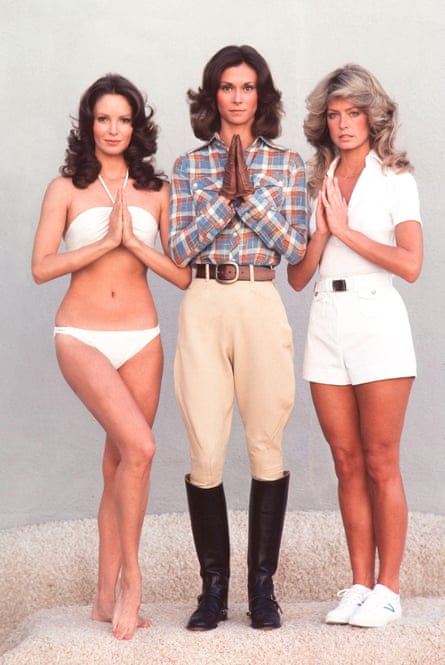
or a TV show that only ran for five years, Charlie's Angels packs a punch like a bikini-wearing big-hair-flicking private investigator. "We never thought we'd be talking about it 50 years later," says Jaclyn Smith, the only original Angel to make it to the end of the show's run. Smith, 80, has now written a memoir, I Once Knew a Guy Called Charlie – she is not, you gather, the type of actor to want to distance herself from her defining project.
As I read her book, and speak to her over Zoom, she comes across as sensible, hardworking and optimistic. Also lucky: loving and supportive parents, agents who seem to appear from nowhere and offer her work, an early hit show, a gift for making friends and getting over heartbreak. Even when she was diagnosed with breast cancer more than 20 years ago, terrifying as it was, it was caught early and successfully treated. Her positive outlook seems to extend to the excesses of US TV in the 1970s and 80s (drug use on set only gets a brief mention); her three ex-husbands get off fairly lightly; and any difficulties – her OCD, the men who stalked her at the height of her fame – are not dwelled on.
Smith wanted to be a dancer. By the late 50s, she was attending a dance school in Houston, where she grew up, which was run by Patsy Swayze (mother of Patrick, who would go on to be a successful actor, but was then around seven and, Smith says, "an absolute doll"). She describes an idyllic childhood – happily married parents and a Methodist minister grandfather who was a steady and reassuring presence. Her dad was a dentist and "gave me my work ethic"; her mother was a "goddess of love – she just made you feel No 1". Smith recalls: "Whatever I am happened in that secure family they provided for me – morals, ethics, values." Downtime was spent at the family farm in Texas: "Two hundred acres with the San Marcos river running through it. It was life at its best."
But her childhood was also when her compulsive behaviour started. "It became sort of a form of prayer for me – it's probably the way my brain works – but that all came about protecting loved ones," she says. She would pray obsessively, thinking it would keep her grandfather safe; later, she would do the same when her two children were born, and she says it still flares up in times of stress.
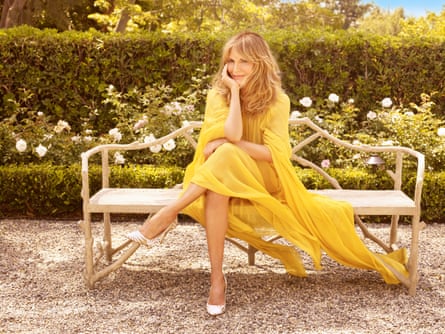
After leaving school, Smith convinced her parents to allow her to go to New York to train as a dancer. Her father insisted she live at the women-only Barbizon hotel, one-time home to Sylvia Plath, Grace Kelly and Joan Didion among many other notable women. "There were such strict rules there," she says. "You couldn't wear slacks in the lobby. I was in hose and a dress and a pair of heels. And boys could not go above the mezzanine."
It must have been exciting to have been a young dancer in New York in the late 60s? "Very competitive," says Smith. But also a lot more accessible than it is now. "There were open calls for Broadway shows, whereas today you have to have a social media following, an agent, a manager, everything. When I started, you'd read about auditions, and it would be a mass cast call, and maybe you'd make it, maybe you wouldn't."
Offers for roles in shows started coming in, and Smith – beautiful, classy – was also in demand for lucrative advertising work. While her peers were protesting, taking drugs or embracing early 70s counterculture, Smith married the actor Roger Davis – famous, she writes, for his role in Dark Shadows, the "daytime vampire-themed soap opera".
"I just didn't get into it," she says of New York's bohemian scene. "Did I go to a discotheque and dance? Yeah, I loved it, but no, I didn't walk on the wild side ever. I was a hard worker."
Perhaps also a little square. When she turned up to audition for Hair, she wore a blue leotard, with pink tights and hair in a neat bun. Smith laughs at her naive Texas primness when trying to convince producers she could be in a taboo-breaking hippie musical: "I looked like I had come from another planet."
Sexual harassment was usual. "I experienced it. I think every actress does," says Smith. "You can walk away. You can say, 'Hey, I don't need that movie. I don't want it if this is what it requires.'" Were there ever expectations that certain were expected? "Yeah, there was some of that, but you can say no. I think I was never, ever desperate about a career. Maybe that's because where I came from with my parents, and I knew I could make my own way." She says she would have been offered a bigger part in one early film if she'd done a nude scene (she refused), and was dropped from another after she got married. Because she was expected to be single, or available? "I guess. But I wanted to be cast not because I was single, but because I was right for the part."
Her first marriage didn't last; neither did her second to another actor, Dennis Cole. But her career zipped along – small parts in successful series such as the police drama McCloud, and TV movies. She got her first regular job opposite Robert Wagner in the crimefighting caper Switch. It was Wagner who recommended her to producers Aaron Spelling and Leonard Goldberg, who were putting together a new show featuring three female detectives.
Smith was the last to be cast in Charlie's Angels, as calm and empathetic Kelly Garrett, and was offered the lowest fee – $3,000 an episode, compared with her original co-stars Farrah Fawcett ($5,000) and Kate Jackson ($10,000). Jackson was a more established star, but Smith demanded to be paid at least the same as Fawcett, whom she reasoned had done a similar level of work to her. "My agent said, 'Are you sure? We have a good feeling about this series.' I stood my ground, and I got it." She would have walked away, she says. "It wasn't about money. It was the fact that we'd done the same thing, and I thought that was only fair." (By the fifth season, Smith was earning $100,000 an episode.)
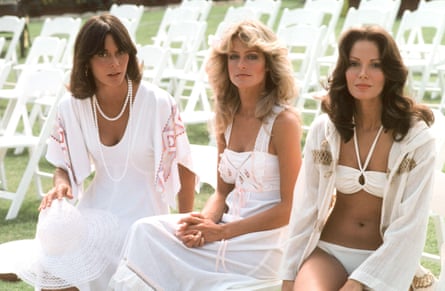
The show was an instant hit when it was first broadcast in 1976. "I was excited because I knew it was different – three women instead of three men, chasing danger instead of being rescued from danger." It was often ridiculous – the three private investigators, working for a mysterious Charlie who only appeared via speakerphone, would go undercover to catch criminals as, Smith writes, "stewardesses, beauty pageant contestants, singers, magicians' assistants, Ice Capades skaters, football players, jewel thieves, Keystone Cops, toy makers, tennis champions and exotic dancers". In one episode, Kris Munroe (played by Cheryl Ladd, replacing Fawcett, who left after the first season), wrestles an alligator.
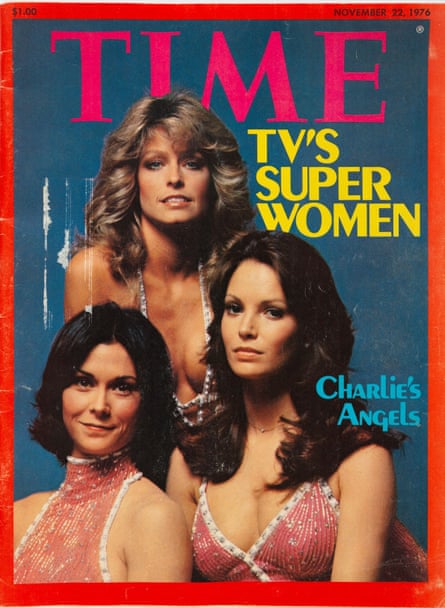
People questioned why they had to do all of this looking like supermodels, or criticised the show for objectifying women. "I thought it was silly," Smith says. "We were not controlled by Charlie. We were working hard, courageous, we went about our job. Usually women on TV then were nurses, mothers, wives. We went into a territory that only men occupied. We got that bad guy and took him down. Also, it was fun and it was escapism. Pretty clothes, pretty locations, fast cars, thin girls taking down a 200lb man … come on. It was just having fun."
Did she ever think they shouldn't be in bikinis so often? Smith laughs. "I think we did say to Aaron, 'We don't want to be in a bikini unless we're near water.'" But it looks so innocent, she says, "compared to today. Our characters were loyal, chaste, involved in the friendship part of it … we never really had love affairs. It was always the sisterhood."
The original three Angels got on instantly, says Smith, even though inevitably the media tried to create rumours of rivalries and conflict. "Definitely no jealousies," says Smith. "We loved one another. It was a fellowship, a sisterhood, a team." They became lifelong friends (Jackson is godmother to Smith's daughter). "We held each other up during breast cancer, during different things." Although Fawcett only did one season, Smith says, "I adored Farrah. What you saw was what you got. She was beautiful, had fun, liked to laugh and had great humour." Fawcett died in 2009, but "we were close until the end of her life".
Having two co-stars go through the strain of becoming famous overnight helped them all, she says. The show had to employ bodyguards for the three Angels, and Smith was a victim of stalking. "I had many restraining orders after Charlie's," she says, describing one man who climbed over a security fence during a shoot and claimed to be her husband. He later turned up at her house. "When you're in someone's living room every week, I guess they feel they know you."
By the fifth and final season, Smith, the only original lead, wasn't finding it as fun. It was the 1980s and the Angels had to be even more glamorous. Drugs, especially cocaine, were also on set, she writes, "with some people using it constantly". It took her time to realise, she says. "I was innocent to drugs, but then you tune in to it because people slow down and can't perform." Was it common for big TV shows to have drug use? "I think it was," she says, but she doesn't approve of it. "It just takes out your spark." She stayed distant from it all. "I just went about my business, then went to my trailer, and as long as we got our show, everything was fine."
Charlie's Angels ended in 1981. Smith would later have cameos in the 2000 film reboot, starring Cameron Diaz, Lucy Liu and Drew Barrymore, and the 2019 follow-up film. After the show ended, she believes she was typecast as glamorous, but frivolous.
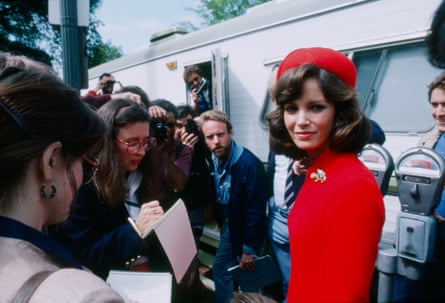
By 1981 she was in her mid-30s and had to fight to play the first lady in the TV biopic Jacqueline Bouvier Kennedy. "They didn't want a Charlie's Angel playing Jackie Kennedy," she says. She is of the generation of actresses who struggled to find decent roles past 40, but by then Smith had two young children – with the cinematographer Tony Richmond, her third husband.
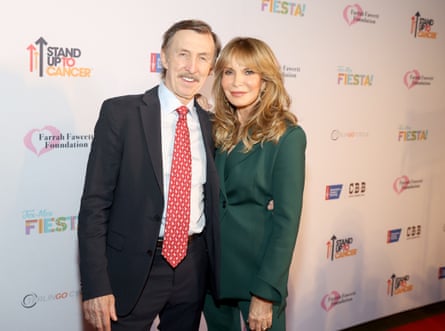
As well as parenting, she had a lucrative fashion line and interiors brand, one of the earliest celebrity branding successes. Life, she says, has "been a pretty smooth ride. Yeah, there's been things along the way, mainly marriages." Smith has been with Brad Allen, a heart surgeon, since 1991. She spent decades trying to recreate her parents' happy marriage. "Finally got it," she says.