etflix's new four-parter on Mike Tyson is one of the strangest sports documentaries it has ever released, or maybe just one of its strangest documentaries full stop. The streamer has form in sporting hagiographies – tales told with questionable distance from their subjects, and all the objectivity of cold war agitprop. Tyson is different, though: not only is it lopsided, but it also feels deeply icky. And that's before Donald Trump arrives to defend its subject – a great catch for the programme-makers but a wholly baffling cameo that makes you wish he would stick with geopolitical meddling and golf.
It ends – spoiler alert – with the former boxing champion taking the hallucinogenic drug DMT (or as he calls it, "the toad", after the animal that produces it), while sobbing and inviting the show's director to join him. Its episodes are peculiar, sometimes compelling, and – as many viewers will surely feel – truly irresponsible.
It starts uncontroversially enough, recounting the extreme poverty and precarity of Tyson's upbringing, when he would rob other kids for their wallets and chains. Now when he goes back to Brownsville, Brooklyn, he is mobbed by adoring fans. Tyson had a talent for knocking people out in his youth, which would later pique the interest of the coach Bobby Stewart, whom he met during a stint in a juvenile detention centre. At 13, Stewart put Tyson in front of the fabled manager and promoter Cus D'Amato, who told him that he would be heavyweight champion of the world one day; Lennox Lewis, an early sparring partner, says: "[Tyson] just ran over to me and took my head off!" A dazzling pro career followed, despite many tragedies – not least the loss of D'Amato, who died in 1985. But Tyson was on the brink of big titles and big fame. As he puts it: "It was awesome being young and having all of that attention."
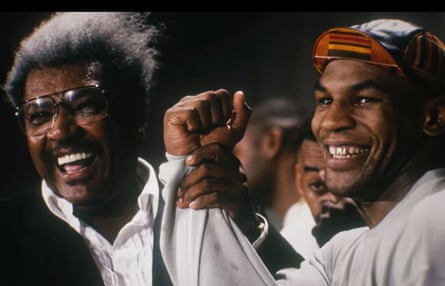
But Tyson the docuseries isn't content with being a professional fable. It also delves into the man's past in a way that feels grubby and careless. Much is made of his short-lived marriage to the actor Robin Givens, whose mother told the journalist Wallace Matthews that Tyson was beating her daughter (Givens declined an interview request from the programme-makers). Tyson, says Matthews, didn't deny attacking her but said he didn't hurt her and that "we fought". (Here, Tyson says: "I know people say she can't fight you, you're Mike Tyson – but we fought.")
Givens was later to deny that her husband had beaten her. As for rumblings, after her denial, of assault and battery towards his then wife, Tyson says "it's a bunch of bullshit". There's archive footage of Tyson telling the broadcaster Barbara Walters that he grabbed his wife but never hit her, while Givens is shown telling her that the union was "pure hell" and "torture". In the present, Tyson calls Givens "a fucking bitch". Headlines flash up on screen, among them: "Iron Mike dreamed of love, but all he got was [a] package of strife". The episode ends with a disclaimer and mention of a website with resources for survivors of sexual violence.
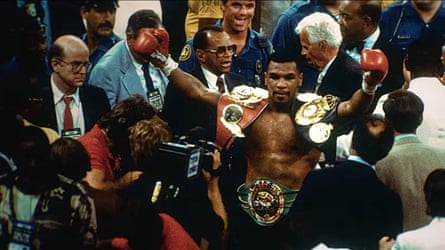
An instalment on his rape conviction is no better, with Tyson – who denies that he sexually assaulted the then 18-year-old pageant contestant Desiree Washington – laughing about his reputation for being handsy. There are a few voices who don't entirely discredit Washington, but many more who express scepticism that Tyson could have been guilty of the crime for which he was convicted and served three years in prison.
Trump – a man who, at least, has some apparent experience in this area – says "[Tyson] is very truthful, and I think the truth hurt him in this case". The media, he adds, was "rough on Mike, but it just made Mike harder. They're rough on me, and I'm the president!"
Interviewees talk about Tyson not as an athlete with a troubling past but as someone akin to Nelson Mandela. Tom Patti, a friend and former boxer, says: "You can knock him down, you can say bad things about him, you can take away his freedom, but guess what? [He's] still here." The same warning plays at the end of that episode.
Sure, there's much on the drugs and booze and the inadvisable face tattoo, and even the son (Miguel, now 24) who calls his dad a "deadbeat". Tyson calls himself "a spoiled brat" for how he acted in the ring, when he bit Evander Holyfield's ear not once but twice. And there is deep, horrifying tragedy in the form of the death of Tyson's young daughter, Exodus, who perished in an accident aged four. But Tyson the docuseries is an exercise in not taking due accountability, and swerving your opponent's punches. Tyson ends by talking about how "special" he is. Certainly, it takes a singular figure to star in a programme this gross.