striking example of site-specific theatre, TS Eliot's Murder in the Cathedral was first performed in 1935 at Canterbury Cathedral. This was the location, in 1170, for its pivotal event: the killing by Henry II's knights of Archbishop Thomas Becket during a dispute over the powers of church and state.
Subsequently, audiences have been more likely to enter a production via a church nave than a theatre aisle. The latest host venue is St John the Divine, opposite the Orange Tree theatre, whose boss, Tom Littler, co-directs with Francesca Ellis.
David Suchet's Becket, in gilded vestments, preaches from the pulpit. Dozens of candles on the altar and lining a marbled walkway between pews (design by Rob Jones, lighting by Peter Mumford) cast shadows on the walls around stained glass windows.
The overall classiness of the show is extended by a programme essay by an actual former archbishop of Canterbury, Rowan Williams, covering Eliot's concern with whether priests, in 1930s England and Germany, served or resisted politicians.
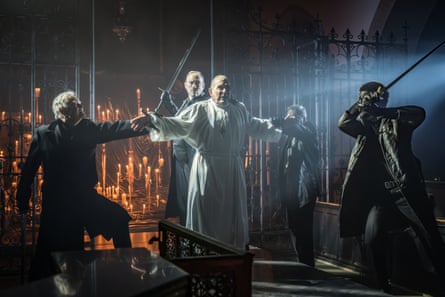
No staging can disguise the eccentricities of a text that begins classically with a Greek-like chorus of Canterbury women (Eliot's four swollen to a dozen by a community ensemble) but concludes with a precociously postmodern coda where the slaughtering quartet engage the audience in an emergency seminar about whether the churchman deserved it.
Like Pinter heavies in black leather jackets and polo sweaters, Jyuddah Jaymes, Ben Caplan, Nick Sampson and David Yelland memorably double the murderous knights with the four tempters who offer Becket varieties of earthly and heavenly riches. Less successfully, the women's choruses are musicalised (composer Orlando Gough) more than Eliot indicated, muffling some of the poetry in a piece with lines ("Human kind cannot bear very much reality") directly rehearsing Eliot's Four Quartets.
His verse dramas often feel more written for page than stage; of seven plays, only this one is regularly revived and his biggest theatrical hit was, inadvertently, the musical Cats. Becket is a role with difficult rhythms for an actor. Initially listening to lengthy speeches by women, priests and tempters with minimal responses, the character then speaks unbroken for six pages.
Always a meticulous actor, Suchet makes each gesture and syllable precise and shows the making up of Becket's mind in the responsive phase and then brings the clarity and verbal relish of the best Shakespearean soliloquies to the Christmas Day sermon in which the turbulent priest accepts that he must be killed.
Eliot, raised in the austere Unitarian church in St Louis, seems, on converting to Anglo-Catholicism in 1927, to have been enthralled by its tradition of martyrs and the play challenges each age with the balance between conviction and fanaticism, belief and futile sacrifice. If everything in churches were as dramatic and atmospheric as this, Becket's current successor would not have to worry about declining congregations.