feel for film critics, I really do. Tom Cruise's latest film Digger put them in an impossible position: you can't really talk about it without spoiling what makes it, in my eyes, a masterpiece. Or completely terrible as many, critics have argued over the last week, without being fully free to say why.
That is not their fault: media screenings around the world opened with a plea from Warner Bros to not spoil the film's central reveal. This seems like it may have been a misstep, because curiosity and Cruise alone were clearly not enough to get bums on seats. Digger is now projected to lose around $150m, after taking a paltry $20m globally in its opening weekend. Warner Bros is trying to make the best of a bad situation, first crowing about the stinker reviews – "insufferable" and "smug" have been repeated a lot – then pivoting to a new sell: the Yanks don't get it, so it must be good.
Which is a shame, because I think Digger is a remarkable film and I am going to spoil the reveal to say why – so stop reading here if you don't want to know.
Despite the marketing, Tom Cruise isn't really playing Digger Rockwell, a fictional, swaggering oil tycoon who is tasked with saving the world after his oil rig explodes in Greenland, causing an enormous glacier to hurtle towards Europe and guaranteed climate disaster. Cruise plays Curtis Markson, an actor who is portraying Digger onstage in a didactic, satirical play decades after the rig really exploded and left the world in ruins. The big-budget play, titled Fossil Fools, is directed and adapted by Hannah (Sophie Wilde) and funded by Rockwell's nephew Kenny (Jesse Plemons), in what seems to be a tiny act of philanthropic penance to offset his family's terrible legacy.
I have seen Digger twice already, and I think it is brilliantly audacious. Alejandro G Iñárritu's film is the best fictional work about the climate crisis that I have seen yet, because it is also about the inability of art to speak to this moment truthfully. It is about perception and reality. And it is about our inability to distinguish the two, and how that leaves us vulnerable to the loudest, most charismatic voices in a room.
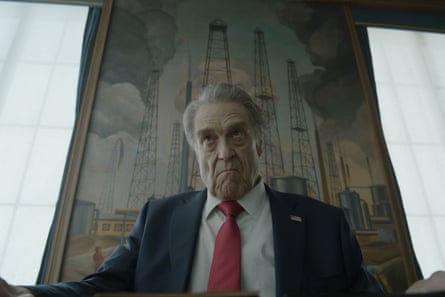
Cruise's Curtis Markson is frustrated by Fossil Fools, complaining that he is being made to play a "cartoon" version of Rockwell so Hannah can "make some statement". Fossil Fools is objectively terrible: the grotesque and pathetic US president (John Goodman) constantly moans about having "cancer of the asshole" for laughs, while his top brass, all gorillas, demand the chance to bomb the glacier and "blow that frozen cunt up". One literally eats popcorn while watching Europe go underwater. And when Digger finally stands before the world to answer for his crime, he pins the blame on them; it was their demand for oil that lead to disaster, all so they could have "two-day delivery of shit you don't need". "You want freedom to live your unsustainable lives," he shouts. "You love oil. Let's cut the bullshit."
The real Digger Rockwell was a "composed, frightening, seductive psychopath", but Curtis is being ordered to play him like a rootin'-tootin' clown in a ten-gallon hat. "What the fuck is happening? What are we doing?" he shouts at Hannah. The two argue it out: is this meant to be a satire? Is it a farce? Is it revenge on Digger? Or is it just a bad telling of a true story, one that was never meant to go beyond the "shitty little theatre in London" where Kenny first saw it, then saved it with his big wallet and his guilty conscience?
But then Kenny steps in to deliver a speech that, in my eyes, embodies the film's true point. "It really doesn't matter. Satire, comedy, farce, drama – it doesn't matter," he tells Curtis and Hannah. "You're both right. We're all right. Now what?"
"Now what" is what stayed with me. I don't think many of us need a film to tell us that climate change is a terrifying, maddening thing to live through, or that political bloviating will probably block viable solutions, or that greed is degrading us and the planet. But I do love that a blockbuster film packed with enormous stars has posed the question: what does art mean at the end of the world? And, if we are honest with ourselves, do we just want art that tells us the truth, or reinforces what we already think?
Iñárritu's answer is the latter; we'd probably settle for a middling play with a bad title if it gave us two hours of distraction and someone to blame. We like our US presidents stupid and laughable, not stupid and terrifying. A play written at the literal end of the world, the literal end of the world, would very likely be didactic, plodding and annoying. Did you see Don't Look Up? We are not above Fossil Fools.
Art will never be the thing that saves us from existential threat, Digger argues – but it can give us catharsis. In the end, Curtis plays Digger as a clown and gets a euphoric standing ovation. Then an alarm goes off, signalling some horrifying reality outside – and the audience put on their gas masks and file out the theatre.
It is almost poetic that so many critics are arguing that all of Iñárritu's metatextual postmodern faff is a lazy defence against the criticism they want to dish out: the acting/script/accent in Fossil Fools is supposed to be bad, so we can't say Digger is bad! But I don't think this is quite honest and it seems like every single critic has found plenty of creative ways to say Digger is bad. So many reviews seem unable to distinguish between what is Fossil Fools and what is Digger; perception and reality. Perhaps the one truth we can settle on is: you should probably go see it yourself.