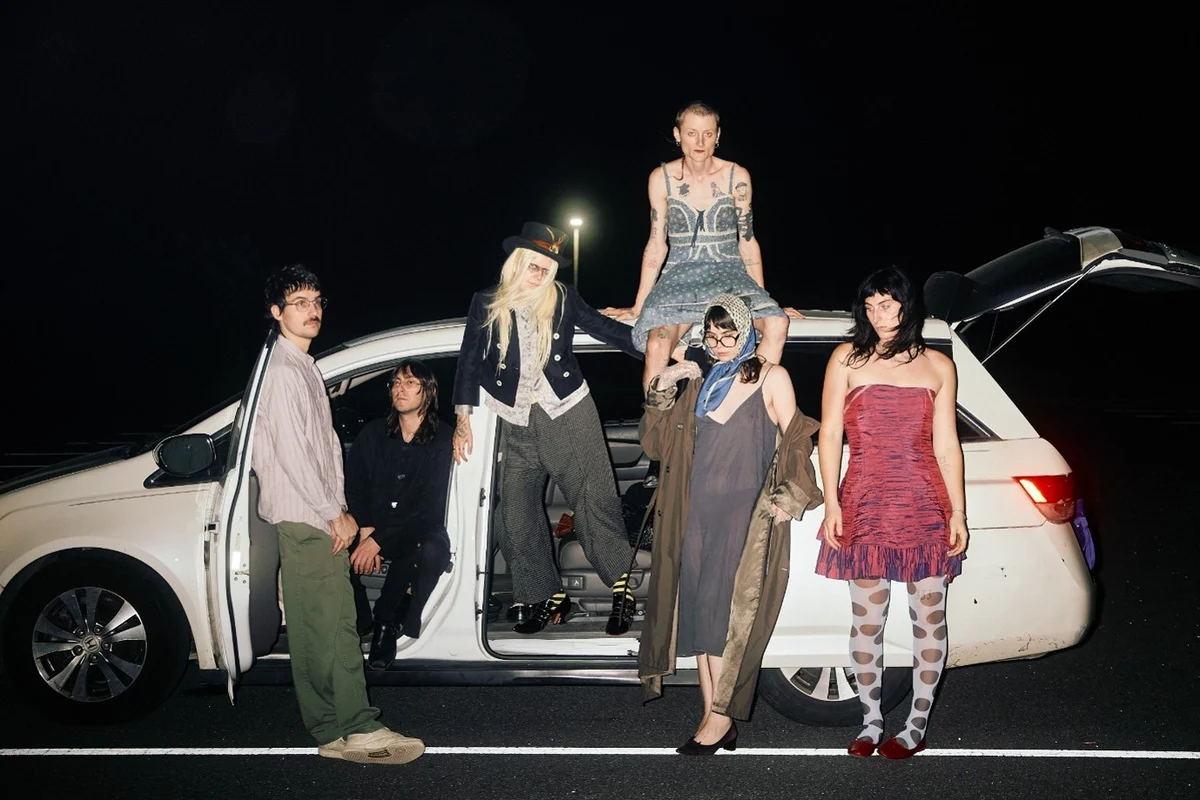
The band would be recording and producing their tracks at the same time, sometimes not even being able to hear what the other members were working on. Sometimes Long would be tracking bass in one corner of the room, while Good would be on headphones, on a separate computer, adding textural layers and abstract electronic elements to a song. As the title track progresses, Good’s textures find their way to the forefront: a mechanical whirr, a crunching, a crushing, a springing, a gong: banging, heralding Grumpy’s arrival.
“There's the warmth of remembering Halloween as a kid. It’s like the warm flash photography from the early 2000s and late 90s,” Schmitt says, about the record’s aesthetic palette. “There’s such a saturation and warmth.” If the last Grumpy EP was inspired by R.L. Stein’s Goosebumps, kid-horror, and things that go bump in the night, is all “kid-mystery,” Schmitt says.
And in its unfolding, rather than in grand gestures, theatrical displays, or seismic shifts, finds meaning in its small movements and in its subtle, slant intimacies. Listening to a song like “25”, it’s nearly impossible to imagine Schmitt having trouble finding something interesting to say about love. The track – shoegaze-inflected and one of the record’s hardest-rocking – was inspired by a conversation Schmitt had with Long. “We were just talking about time travel,” Schmitt said. “About being trans and transitioning at different phases in life, and she said she wished she could go back in time and transition as a kid.” Schmitt characterised his initial reaction as somewhat selfish: his first thought was that if she had transitioned as a child, perhaps they would never have met. “That’s the only concept of the song,” he says. “Just saying like‘Alright. If somehow you get this chance to go back in time, make sure you can leave a clue’.” And so tenderly Schmitt sings, as if we’re all in on the joke, “When you travel back, leave a clue so that / You can still find me when you get to 2025.”
I had a writing teacher once who, like all writers, teachers, and writing teachers, wasn’t particularly fond of sentimentality. She, like the rest of us, wanted pure sentiment. She had an easy solution: pickles. She was from the Northeast; she boiled her own maple syrup from the sap of the trees around her. A Massachusetts delicacy was : maple syrup frozen across the top of that winter’s frost, turned into a chewy candy. It was served with pickles, to cut the syrupy sweetness. Thus, for any bit of writing that could seem too saccharine, syrupy, or sentimental, a writer needed their fair share of pickles – ironies, cynicisms, jokes, specific details – to cut the sweetness.