Liam Neeson still remembers his shock and shame when he read a New York Times article about the mother and baby institution in Tuam, County Galway.
It was 2017 and the article chronicled the campaign by Catherine Corless, an amateur local historian, to expose abuse and neglect by Irish nuns that led to hundreds of children being buried in a mass, unmarked grave.
"I had such a visceral reaction," Neeson told the Guardian. "I'm obviously Irish, I was raised in the Catholic church, and I had a deep sense of embarrassment and obligation for the truth to come out and for there to be some accountability."

It prompted the actor – and former altar boy – to use his heft in the film industry to become a producer for the first time. He optioned the article, visited Corless at her home and assembled a team to put the story on screen.
The result, nine years later, is The Lost Children of Tuam, a feature film that is released in Ireland this week and in the UK next month. "This was such an important story for the world to know about and to give a voice to the hundreds of babies and children that died," said Neeson.
The release coincides with the continuing excavation of a 5,000 sq metre (53,820 sq ft) site where the Bon Secours order is believed have interred 796 infants who died at the St Mary's mother and baby home between 1925 and 1961.
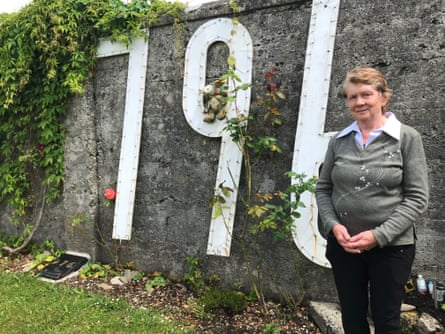
An international team of forensic archaeologists and other specialists has found skeletal remains of 99 babies and children since starting work last year – the result of Corless's research, a judicial commission and a promise by the Irish state to seek truth and justice for survivors and relatives of those who died.
It is part of a wider reckoning of the mistreatment of women and children in state- and religious-run institutions across Ireland. Tuam, however, stands out for its macabre details – some infants were buried in a disused subterranean septic tank – and the doggedness of the woman who exposed it.

In her quest for answers, Corless never accepted "no", said Neeson. "The detective work she did to uncover this atrocity involving the relationship between the state and the church was extraordinary."
The film, based on the New York Times article by Dan Barry, tells the story of how Corless, a former textile factory secretary with an interest in local history, began researching the site for an essay. Officials and the Bon Secours order fobbed her off but Corless discovered that 796 children had died without burial records before the institution was closed in 1961 and demolished.
Early reviews of the film, which was written by Rebecca Lenkiewicz and directed by Frank Berry, say it is sensitive and stirring, with the English actor Monica Dolan giving a powerful central performance.

"She's brilliant – so natural, so down to earth," said Corless. "She portrayed me as I am. She has an English accent so how on earth did she capture the way I speak?"
Andrew Bennett, who plays her husband, Aidan, has also captured his personality and the couple's relationship, she said.
Corless has watched the film three times – two private viewings for her family and survivors, and the premiere at the Galway film Fleadh in July, where it won best Irish film. "I was so nervous I needed to see it a few times," she said.

"We're ordinary people. We have a farm. That a film would be made about us, it was out of this world. It's done with great respect, with the odd little bit of humour in it too, and it just hits people, it hits you hard."
Berry, the director, said the film showed Corless's integrity and persistence. "Her work revealed a lot of very hard truths about Ireland. It's a way of telling truths but with an inspirational central character. It shows that one person can achieve amazing things."