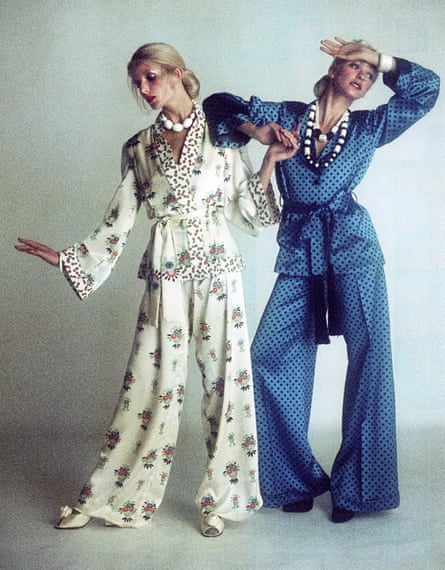
n the mythical age of bohemia, the psychedelic decade between Mary Quant's cheerful miniskirts and the first snarls of punk, Celia Birtwell and Ossie Clark were London's most fashionable couple. Birtwell created the fabrics: daydreamy, botanical doodles that captured the idealism and looseness of the times in wisps of chiffon. Clark magicked these into sensual bias-cut dresses with a freewheeling grandeur that was part Hollywood glamour, part rock'n'roll anarchy.
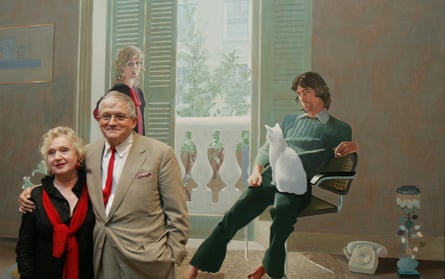
More than just designers, they were a whole vibe. They dressed – and partied with – the innermost of the in-crowd. Talitha Getty, Marianne Faithfull and Anita Pallenberg hung out at Quorum, their Chelsea boutique. At a catwalk show in 1970, there were two Beatles, Cecil Beaton and Brigitte Bardot in the audience – and, after Clark began making stage clothes for Mick Jagger, he accompanied the Rolling Stones on tour. David Hockney's portrait of the couple in their pomp – Mr and Mrs Clark and Percy, painted two years into their marriage, when Birtwell was pregnant with their second child – sealed their place in the mythology of the period.
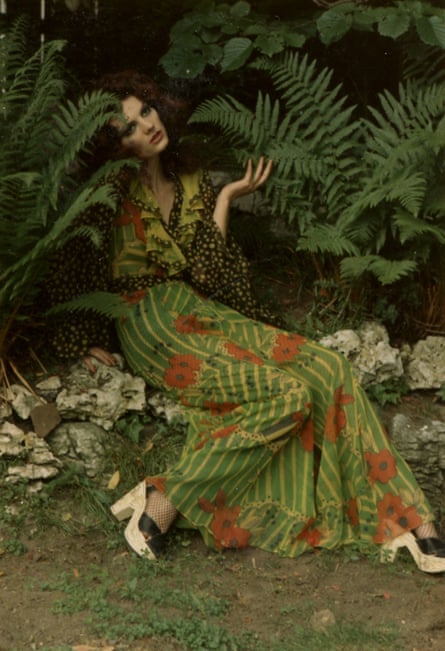
Spoiler alert: stories of sex, drugs and rock'n'roll tend not to have happy endings. The couple split in 1974 after five years of marriage, and Clark descended into addiction and bankruptcy long before his death at 54, brutally murdered in his west London flat by an ex-boyfriend. But their partnership, and the sumptuous clothes they made together, is enjoying another moment in the sun with a new exhibition, Ossie Clark + Celia Birtwell, about to open at London's Fashion and Textile Museum.
These days Celia Birtwell does a terrific impression of being just a sweet old lady. In fact she is so convincing that although she mentions, chatting to me on the phone from her kitchen in Shepherd's Bush, that she has been doing a few bits and pieces in fashion lately, she is so low-key that I don't think much of it. It is only a few weeks later, when I am at Burberry's London fashion week show and she is sitting opposite me, that it turns out "a few bits and pieces" involved co-designing the entire catwalk collection with Daniel Lee, the creative director of Britain's biggest luxury brand. Do not be fooled by the mild-mannered image: Birtwell is, and always has been, a player.
The 85-year-old chats amiably about her grandchildren, the garden of her Shropshire cottage, and the struggles of having fine hair. "The last interviewer caught me in my curlers. I have little plastic ones now because Carmen rollers, which I had for years, bloody burn my poor hair." She was always the calm, blue-eyed yin to Clark's rakish, hedonistic yang. They met as art students when she was 19, introduced in a Manchester coffee bar by a mutual friend who wanted to show her a "really mad boy".
Being married to Ossie sounds like a lot. He was fabulously handsome and openly bisexual, prodigiously talented but chaotic and easily distracted. The day after their wedding in the summer of 1969, he left his pregnant wife at home to honeymoon in Barbados on his own. "Oh, but he was spectacular, at the beginning," says Birtwell. "Just wonderful. The first two or three years were very nice. He would come back from Portobello with lovely vases or pieces of fabric he thought I'd like. Every week he came home with a new disc, we had fabulous music." She didn't go in for the all-night parties, but did enjoy hanging out with the beautiful people at Quorum. "I always thought Pattie Boyd was adorable, a little slim body with rather round bosoms. She looked so lovely in Ossie's clothes. He really was so talented, but he wanted to party more than he wanted anything else. And once he got famous, the partying got a bit too much."
Her wedding dress – a diaphanous daisy daydream with a contrast graphic print defining the yoked bodice – is her favourite piece in the new show. "I always liked putting prints together, not being boring with just one print. I didn't make it as a wedding dress, but I was pregnant and it fitted me beautifully." They had just two guests at their wedding: Clark's sister Kay and Hockney, who had been friends, perhaps lovers, with Clark and had recently begun to draw Birtwell. In the wedding photo, Hockney – unmistakable platinum mop and dark owlish specs – is wearing a crumpled suit with a green carnation at a rakish angle on the lapel. "I made him wear the buttonhole, because he looked a bit scruffy," Birtwell recalls, with a tranquil chuckle.
Birtwell went on to become one of Hockney's favourite subjects, sitting for him around 100 times over six decades, those long hours deepening into friendship. It is easy to see what drew him to her. Angelically pretty – she still is – she has a stillness that seems suited to the patient intimacy of the portrait studio. "We just always found it easy to talk to each other. I don't know why, really. I was from Lancashire and he was from Yorkshire, and maybe there was something about both being northern." Heartbreak bonded them too. Hockney's love affair with Peter Schlesinger ended around the same time as Birtwell's marriage was falling apart, and they supported each other.
Hockney loved Clark but hated to watch him wasting his talent. "He used to tell him, 'You've got to work harder, you've got to improve, you should be working all the time!' But of course Ossie didn't listen." When the Clarks split, it was Birtwell with whom Hockney remained close. "I adored him. He was so clever. I think he found me a bit ridiculous sometimes. He would tease me, but I knew it was always fondly said." Becoming part of his artistic circle, she says, "opened my life up". In recent years, she spent time with him in Normandy, where "he had a huge garden and a pretty little house, with two barns on either side, one of which was converted into the most beautiful studio I've ever seen. Oh, it was lovely there."
His death in June was a huge blow. "I never thought he'd die before I did," she says. "Because he was obsessed with his work, always had new ideas and plans. Whenever he heard someone had died, he'd always ask, 'How old was he?' Or, 'How old was she?' He was obsessed with keeping going, which I suppose is just as well, because it means he's left us with this huge volume of marvellous work. He wanted to carry on, but he had that many damn things wrong with him by the end. Oh, I miss him."
There was a time when Birtwell could have been content to be Hockney's muse – "It was a bit like another career" – but she kept working. She has always been "a homebody", she says. "Ossie wanted to go out all the time, but I just wanted to make a nest and be in it. I'm mad for homes, for moving a room around." She channelled this passion into designing fabrics for interiors. But she never truly left fashion. In 2006, she designed a limited edition collection for Topshop: there were queues around the block when it went on sale, which she got a kick out of.
She designed for Uniqlo, too: "I would have done more, if they'd asked." In 2015, she was commissioned by then Valentino designers Maria Grazia Chiuri and Pierpaolo Piccioli, now at Fendi and Balenciaga respectively, to make botanical prints for a catwalk collection. "They printed them marvellously," she notes. "Top drawer stuff." In 2011, she was awarded a CBE.
Print designers seldom get the visibility they deserve, I say. "I agree. Most textile designers sit behind a designer and never get a mention. I was one of the lucky ones. If I hadn't met Ossie, I think it's highly unlikely another designer would have let me show off like he did." Ossie was happy to share billing because he loved her and trusted her, and perhaps because he was too busy having fun to bother hogging the limelight. "Ossie just said, 'Do what you feel.' I had complete control. I'd work at home and print up 10 metre lengths of fabric and take them to his studio and throw the rolls on the table."
The show makes clear that Birtwell was Clark's equal as a talent and an innovator. Her inspiration came from trips to the V&A, and to Vita Sackville-West's gardens. Her study of Matisse informed her famous Candyflower print, with its cut-out swirls and stark negative space; Sonia Delaunay's avant-garde art deco costumes for the Ballet Russes inspired the kinetic energy that made her designs a natural fit for fashion.
You've had quite a life, I say. "Hmm, I suppose so," she agrees in a placid, low-key tone that probably comes naturally when you have been a Swinging London icon and have a famous portrait of you hanging in the Tate. She is still working: she has been "rather let down" recently by a British textile design company for whom she designed home furnishing fabrics. "The thing is, you don't win every game." Anyway, she has another project on the go that she can't tell me about because she's signed an NDA. "But I don't want to work quite as much any more. I'm not bothered about travelling far these days, but I do like to spend time in the countryside." She has a longtime partner, Andrew, and is devoted to her six twentysomething grandkids – "four beautiful girls and two boys", the children of her and Clark's sons George and Albert.
Birtwell never expected a retrospective like this to happen, not least because she sold most of her own Ossie Clark archive to a vintage dealer in California some years ago. "Half of me cries about that," she says, "but the thing is that if you are going to keep clothes for a long time, you have to store them properly. There is refrigeration and all sorts to think about, so the other half of me thinks the moths would have got them. All in all, it probably worked out for the best."