It’s the final day of the in Venice when I meet (Marie), just a day after her performance at the Arsenale’s Tese dei Soppalchi. Over its 50 minutes, the performance brought sculptural lighting and spatial design into dialogue with Buch’s enigmatic vocal and guitar work, to conjure what she describes as “random magic”. It was nothing short of extraordinary.
An experimental musician and composer based in Copenhagen, Buch’s work bleeds guitar, electronic sounds, and field recordings into texturally evocative compositions. Her releases include the acclaimed albums ‘Skinned’ (2020), ‘Suntub’ (2023), and most recently ‘Suntub Extras’ (2026). For this year’s Biennale, she was also commissioned to compose ‘Silver Grin’, a new piece for electric-guitar ensemble, performed by Zwerm XL.
When we meet, Marie has just spent the afternoon walking with her son and some fellow Copenhagen luminaries, who are performing in for the festival’s closing night. “Venice is really special,” she remarks. “I can’t believe this scenery. I can’t believe this city, to be honest.” Under the direction of , the 70th International Festival of Contemporary Music takes A Child of Sound as its theme, inviting audiences to rediscover a more primal, unprejudiced way of listening – one akin to that of an infant. It’s an idea that feels particularly close to home for Marie, who has recently become a mother herself. “It’s a different kind of attention,’”she tells me. “I guess before I could sort of drift about in the world, but now I see the world through the eyes of my son, and that is wonderful and such a gift… to see all the details that I normally would see, but in a different way because everything goes at a different pace.”
This childlike disposition reaches far beyond the way Marie simply moves through the world; it’s fundamental to her approach to making music, too. “As a child, I gathered all kinds of materials – I guess a lot of kids like that, to just see ‘what is this?, put it in the mouth, and you know. And it is the same process with my music today. So yes, I’m questioning the world, but I do it through experimentation. And so the whole playfulness is very important.” It’s a spirit of curiosity that she sees as essential to the artistic process, particularly for what she describes as “sensitive, creative people”, like herself. It’s also something she believes should be “fiercely protected”.
Over the years, Marie has built a small library of sounds gathered directly from the natural world, recordings she later brings into the studio to add texture and depth to her compositions. “I love recording the sound of wind, especially through tall grass. It’s kind of my thing,” she smiles. It’s actually really hard in Denmark – we only have 0.05% wild nature. It’s insane. So it’s quite difficult to find a place with no cars; just the sound of nature. That’s why I head out early in the morning and in the middle of the night.”
This pursuit to capture nature in its stillest, purest form is central to Buch’s sound. Earthy textures lend her compositions an unmistakable sense of the physical world, until nature itself almost the melody. “I see myself less as a musician or an artist,” she reflects. “And more as a composer and songwriter. I just like to filter my experiences of the world through sound.” She references the game Exquisite Corpse, in which players take turns drawing sections of a figure on a folded piece of paper, each unaware of what the others have drawn before them. When the paper is finally unfolded, what emerges is a strange, often uncanny composite creature, assembled from a series of disconnected imaginings.
“And you can do that with music, you know, any creative process, I think.” Each player draws intuitively, without the opportunity to overthink or rationalise what came before, unearthing something that could never have been conceived in advance; an amalgamation of individual impulses. It’s an interesting way to understand Buch’s own creative process, and the beautiful duality at its heart. She is, in a sense, at the mercy of nature, just as nature is at the mercy of her. She gathers and reimagines its sounds, allowing something new to emerge through their interaction, often with little to no expectation of the end result.
This element of surprise, she tells me, is something she actually feels as a strong component of the elusive “random magic”: “I find ways to create surprises… to do something to create; to be surprised by ourselves. And I feel that it translates often. If I get the little thrill, it usually translates somehow”. Like the unfolding of the paper, what initially appears disparate reveals an unexpected harmony… somewhere between happy accident and conscious creation. Neither pandemonium, nor by design, but a place in between.
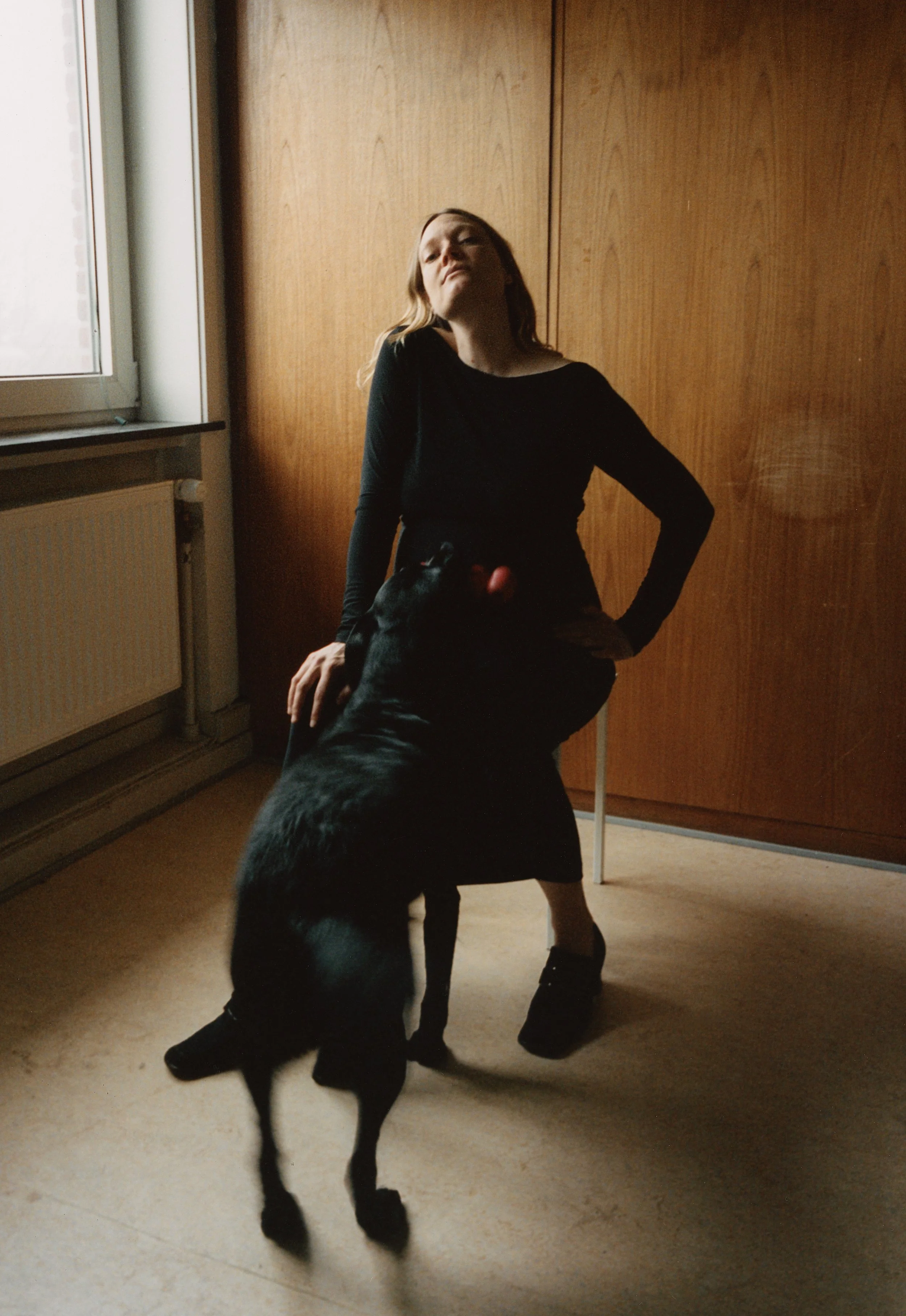
We talk about physical and emotional liminal spaces: those in-between places – cars, libraries, airports – and the transitional moments in which we find ourselves moving from one thing to another. For Marie, these spaces hold a particular creative possibility. “I’m not so good at sitting in the same spot with a pair of studio monitors and just, yeah, making music… I need to go out and have experiences and sense the world, observe something. I totally seek those spaces where it feels like… the transition from something to another thing, and it’s like, ‘Oh, I can make something happen there.’… I get more ideas when I’m on the move.”
Even the exhaustion of touring itself becomes part of this interplay, an accumulation of places and impressions that gradually find their way into her creative world. “And even though it’s quite exhausting to tour a lot, I get to see all of these spaces and places and sense them.” There’s something intriguing about her attraction to these transient environments. Perhaps it’s the absence of a fixed destination, the sense of being temporarily untethered from the familiar, that allows new ideas to blossom. This process of transformation, she acknowledges, can at times feel uncomfortable.
The discomfort, she suggests, enters when you speak of things becoming “disjointed, coming apart or disintegrating”. “It’s a natural process,” she insists. “I do like to touch upon maybe the fact that we’re not gonna be here anymore, and then finding beauty in that as well.” It feels less morbid, and instead speaks to an understanding of the body as inseparable from the world around us. ML Buch is fascinated by how we are shaped by our surroundings, and how much of the natural world we carry within ourselves. There’s an openness to this way of thinking, too, and an attentiveness to the body in all its complexity.
“My whole thing up with flesh and all the bodily—the body parts—it’s just an interest in how everything is connected… I like to dig into the details of our body as well, as well as the surroundings.”
Maybe this is what makes Buch’s approach to music so interesting; that there is no great distinction between the way she creates and the way she experiences the world. Both seem to embrace an openness to play, to surrender, to the idea that what will be, will be. “I think I like to see it as just a row of moments, this life, and a lot of surprises.”, she says warmly.
ML Buch’s music feels like an unflinching expression of this philosophy, and of the freedom that comes with it. “Every project I begin, I try to get lost and then build from there. At this stage in my life, I feel free to do whatever I want.”