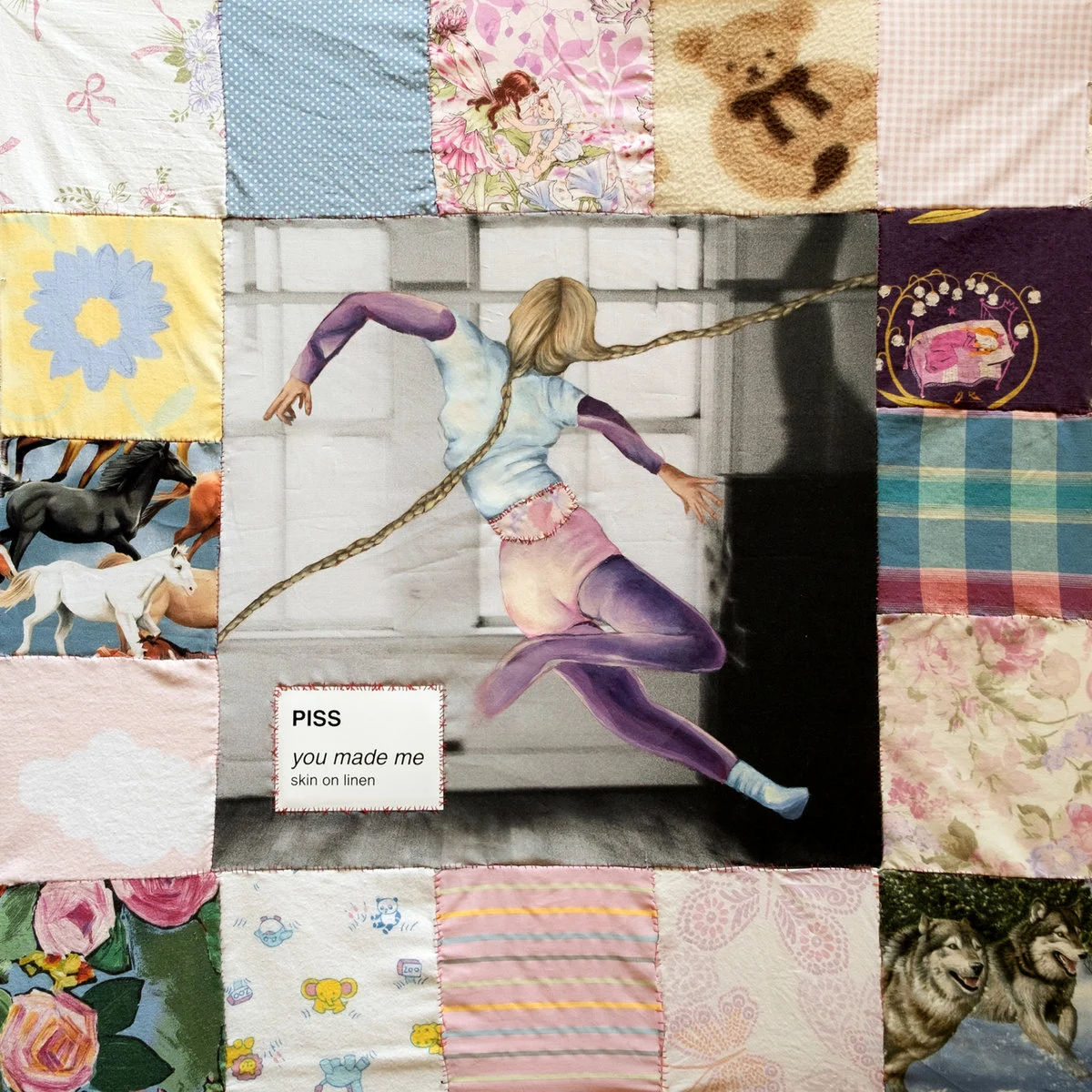
And true to her word, she cuts right down to the bone across the album's 15 tracks, living and reliving her traumatic experiences with assault and misogyny, processing fragments of trauma in laboured screams and audible gasps, pursuing anyone who'll listen.
In an interview with The Guardian, guitarist Tyler Paterson likened PISS’s instrumental approach to “scoring a film” starring Zantingh, situating her voice against what the band describes as “a centuries-long conversation about gender-based violence.” As such, these tracks are as confrontational as can be: mostly two minutes or shorter, constructing and deconstructing noise-rock soundscapes at the pace of a post-traumatic flare-up. Meanwhile, Zantingh recounts a life transformed by misogyny: “learning blowjobs on a glue stick” as a child, coping with assault and domestic violence, fighting desperately to make herself heard.
Interspersed between these songs are recordings of interviews with feminist thinkers and community organisers, their voices paired with sound collages and ambient compositions. They vault between discussions of rehabilitation and violent resistance: radical feminist Andrea Dworkin calls for violent self-defence against rapists; Canadian clinical supervisor Vikki Reynolds discusses our culture of rape that victimises both men and women; anonymous members of a West German feminist militant group, Rote Zora, defend their targeting of sexist institutions.
The band rarely interfaces directly with these voices, instead letting them exist in conversation with each other and with Zantingh’s story. Their omnipresence frames this album as both personal and universal, as an incantation summoning the rage and despair of countless women who have not yet been heard.
At the album’s climax, “blocking a scene you can’t remember,” Zantingh, backed by a Slint-esque slowcore build, performs a screenplay in third-person perspective: “Interior, a girl’s bedroom, nighttime... / His number is dialled, she’s finally going to let him have it”. But she repeatedly interrupts her own screed, unprepared to say what she wants to say.
We never hear her prepared diatribe either; instead, her performance devolves into manic yelling as she recalls her assault, over and over. She attempts to acknowledge the culture of dehumanisation that birthed her assaulter, but she is unable, left with nothing but her trauma and the feeling that “I’ll never feel safe in my body again.” On the next track, she seems resigned to the inevitability of gender-based violence. “You could have lived at any time, in any body,” she tells herself. “You could have chosen any dress to wear for him.”
PISS’s artistry is informed by feminist theory – by the recognition that an anti-misogynist world is possible and worth fighting for. In a society where brutality is the birthright of all women, however, that reality is nearly impossible to access. Hope is an uphill battle, but it is there to be found among the rubble of you made me / skin on linen. Because it distills and contextualises and empowers one confrontational voice. Because it refuses to temper its own righteous anger. Because it dares to imagine a world where men aren’t raised to be assaulters and women don’t have to be raised expecting assault.
By the closing track, Zantingh’s voice is reduced to a whisper: “I won’t bleed forever”. Resistance is possible. Survival is possible. Survival must be possible. It must be.