Nazi kneels down on frozen snow, staring at an endless Antarctic horizon. Another holds a gun to his head, ready to end his own life. I direct a small waddling penguin up to them, trying to imagine what it could be thinking. Dismay, perhaps. Likely bewilderment. But then a faint smile seems to break out across its beaky face, as if amused by these silly humans and their misguided belief that they could ever best this howling, harsh landscape.
For most games, the idea of playing as a penguin observing Nazis losing the plot near the south pole would be weird enough. But Penguin Colony, developed by Origame Digital, pushes further. This is an audacious, frequently brilliant retelling of HP Lovecraft's 1936 novella At the Mountains of Madness, in which eldritch horrors are just as common as Nazis. Further weirdness abounds: the many collectibles scattered about this place are not shiny gold objects à la Super Mario or Sonic. Rather, they are words. So tottering about as a semiaquatic bird, you have a unique mission: collect human language.
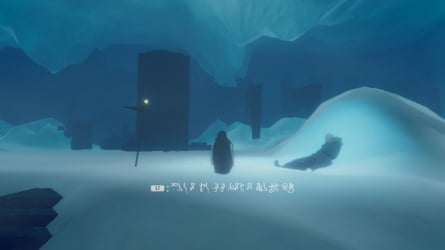
But let's zoom out for a moment because playing Penguin Colony is more straightforward than this description suggests. First and foremost, it is a semiopen world exploration game in which you direct a penguin to the same unearthly entity that the Nazis are chasing. You hop, swim and glide about tummy-first, chewing up miles of frozen wasteland like an indefatigable snowboarder. Tapping a button next to another penguin lets you swap into its body. Some of these, like the rockhopper penguin, are nimble movers, capable of jumping especially high. Fluffy penguin chicks, meanwhile, can squeeze through tiny gaps.
At first, the game's polar levels are straightforward: snow drifts and ice floes peppered with the remnants of human habitation such as fishing huts. But your surroundings quickly grow stranger: supersized stone labyrinths whose architectural splendour evokes Dark Souls, alien-looking obelisks and abyssal crevasses. Everything in the world is rendered in jagged, low-poly graphics, looming from the screen like a hallucinated PlayStation 2 game.
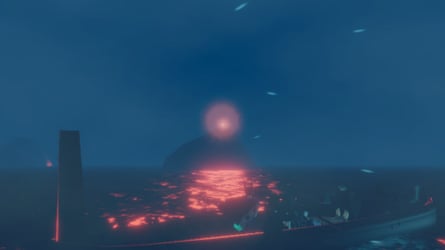
As you navigate these spaces, a deep-voiced narrator relays the expedition of a scientist from decades before. It's clear he is driven by the same hubris and racism as his Nazi successors.
The layering of space, time and narrative is terrifically unsettling. At one point, having just hopped my way through a challenging platform section, I came across a Nazi cannibal feasting on his fellow soldier as a researcher delivered yet another verbose pontification on his God-given right to plunder Earth's southernmost tip. At times, jarring cuts to archive footage and what seem to be Indigenous art interrupt the low-poly action. My head was often spinning, trying to reconcile all these conflicting, contrapuntal elements. Better, I found, to let go and soak up the unnerving, discordant whole.
Penguin Colony is a little uneven technically: I experienced a small number of audio glitches and, at times, bugs with the controls. Yet this does not overly detract from an experience that builds to an incendiary conclusion: a takedown of Lovecraft's racism and Nazi barbarism while also, intriguingly, inviting the player to see the world in newly reenchanted terms.
This latter point is made with aplomb at the game's end: a spectacular cosmological map that details everything you discovered on that playthrough. More tantalisingly, it shows you all the things you missed. This reveal is liable to induce a feeling of vertigo and wonder: Penguin Colony, one of 2026's boldest, most original games, is far bigger than it first lets on. To access all of its secrets and excavate all of its meaning, one must think and act less like a human mainlining towards their objective. On the contrary, you must embrace the spirit of a renegade penguin, waddling carefree towards whatever piques your interest: atrocity, beauty and all.