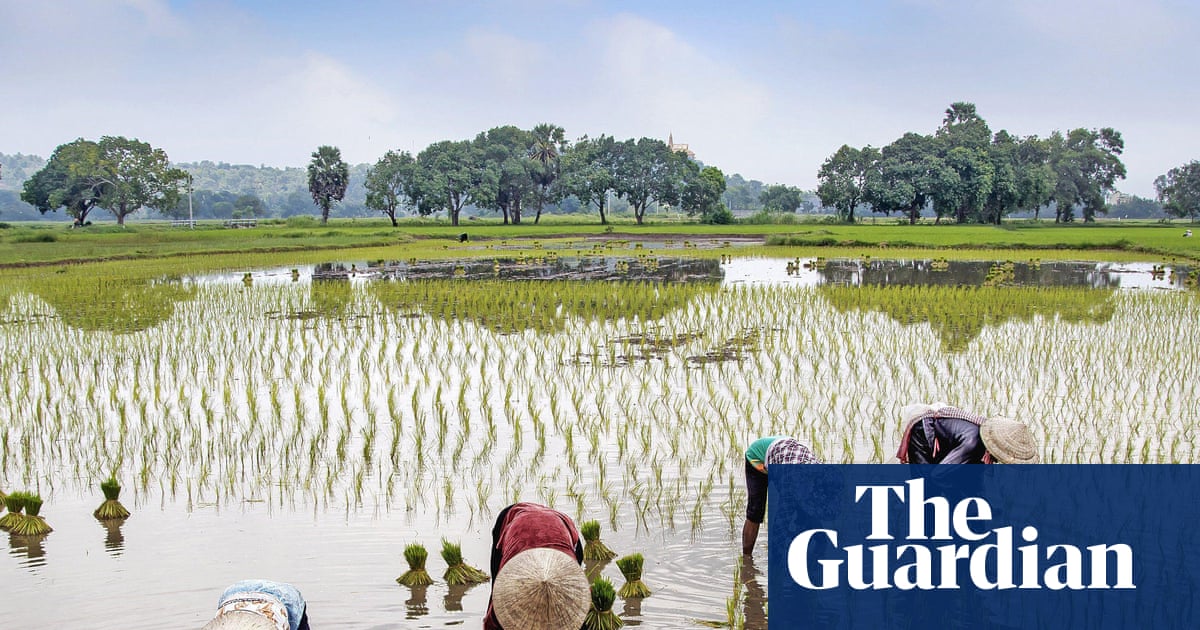
he word "peasant" has a negative edge: it has come to mean someone ignorant, unsophisticated, lowborn. Such an attitude, writes Maraym Aslany in this impressive piece of anthropology-cum-history, is "a residue of the massive psychodrama which made us who we are … we became modern by expelling the peasant parts of ourselves". Her book weaves together a global history of peasants and an account of the four years she spent travelling in India, Cambodia, Peru and Ghana, living with and talking to peasant families.
She aims to challenge the notion that the decline of the peasantry is the necessary condition for becoming "modern". This notion arose in Britain, the first country to rid itself of its peasants when, with the enclosure acts, it turned its land from a common good into a financial asset. As this model of capitalist modernity began to take over the world, intellectuals of every stripe argued that peasants stood in the way of "progress". Voltaire saw them as slow-witted people unable to understand their piteous state, stumbling blocks in the pursuit of enlightenment. Karl Marx believed that their "relentless property fanaticism" made them a reactionary element within capitalism.
Yet, throughout history, peasant civilisations have thrived and endured. From 3000BC until industrial-era Britain, the common form of large-scale human society was the agrarian empire, sustained by the peasantry. The huge calorific surplus produced by such empires – rice in particular being a supremely efficient way of extracting calories from the earth – was spent on massive temples, sprawling cities and complex bureaucracies. For more than 2000 years, until the fall of the Qing dynasty in 1912, the Chinese empire was built on peasant farming, enabled by a vast irrigation system and run by a hands-on state staffed by the world's most educated officials.
The last century, though, has seen a long, undeclared war on the peasantry. In the Soviet Union, Joseph Stalin's policies of collectivisation killed millions of peasants. The US carpet-bombed the peasantry in Vietnam. The Maoism much nurtured on western university campuses in the 1960s and 1970s – with its belief that the peasant populations of newly decolonised countries were the best hope of fighting US imperialism – was too often turned on peasants themselves. Pol Pot's murderous vision in Cambodia, that the country should be returned by force to its peasant essence, led to millions of deaths. More recently, peasants have been the main casualties of superpower-backed civil wars and conflicts over land and resources in Sudan, Rwanda and the Democratic Republic of the Congo.
By the 1980s, many decolonised countries were in debt and needed bailing out by foreign capital. The price they paid was the introduction of market discipline into their agrarian economies. In much of contemporary global capitalism, western corporate power rests on peasant foundations. While producing valuable commodities – rice, sugar, cocoa – these peasants are excluded from the profits they generate. Now they have been left to deal with the climate emergency, and subsequent falling yields, on their own.
In Maharashtra, in the heart of India, Aslany watches and listens to an eternal theme tune of the modern world: the double flash of machete on sugarcane, once to cut off the stalk, then to cut it in half. Maharashtra's cotton farmers have been thrown into crisis by the droughts, alternating with catastrophic floods, produced by global heating. Amid such uncertainty, sugarcane is a good bet. Unlike cotton, though, sugarcane can't be stored but must be crushed within hours of harvesting, and processors exploit this fact to pay farmers less. The women fear missing workdays so much that many have early hysterectomies.
In Ghana, where the world's chocolate industry has always relied on the work of peasants, Aslany finds the cocoa farmers struggling not just with climate change but with crop disease, chronic underinvestment and the poisoning of the land by galamsey – the local term for illegal, unregulated gold mining, the profits from which go to the chiefs and politicians. But peasants find a way of surviving. Peruvian – growers of coca leaf, much of it used to make cocaine – have learned to live with the drug cartels who offer them loans and administrative assistance. Abandoned by the state, they have created a competing moral system, informed by the demands of subsistence living and duty to family and community.
This book has an ambitious range, often deviating into sweeping histories of the last few hundred years. Occasionally it comes unstuck. The economist Adam Smith did not believe that "the capitalist future would arrive only when peasants gave way to wealthy technocratic landlords"; he castigated landlords for collecting unearned income. The claim that William of Orange and his wife, Mary, took the English throne "without opposition or bloodshed" ignores the ensuing violence in Scotland and Ireland.
Despite the odd misstep, a compelling argument develops, one that offers a useful counterpoint to Patrick Joyce's excellent 2024 history, Remembering Peasants, which oddly Aslany cites only in one footnote. Joyce, focusing mainly on Ireland, Italy and Poland, sees the peasantry as "a vanished world", already destroyed. Aslany reminds us that there are more peasants today than at any time in history.
The west may have got rid of its peasantry but, 250 years after the Industrial Revolution, "most of the world has become modern without doing so". Peasant households make up about 2 billion people, a quarter of the human race. Their way of life is far more resilient than factory work, and there is nothing backward about it. The 350m tonnes of sugarcane produced each year in India – the largest output of any country and a figure that has tripled since 1980 – all come from family farms. In the absence of universal industrialisation, which the Earth can ill afford, nothing sustains large populations as well as the land.
Yet most of the world's leaders have come to believe what Aslany calls the "urban fairytale" – that people are moving inexorably to the cities and that the peasantry will soon, and should soon, no longer exist. This means that peasants lack the main thing they need: the long-term investment by states in soil, water and botanical stock that the agrarian empires once provided.
What makes this tragic, as Aslany points out, is that, just when we need it most, peasants offer a model of sustainability and stewardship of the natural world. They serve as a buffer holding at bay a rapacious capitalism that has none of their respect for nature. One Cambodian peasant, farming in the floodplain of the country's massive Tonle Sap lake, tells Aslany: "Rice is our companion. We say human beings have nineteen souls, and rice has the same number."
The peasant belief that the land is sacred is not some quaint relic, but a crucial way of ensuring that the pursuit of productivity doesn't destroy the Earth. That much of the world's cultivable land remains in the hands of peasants protects us against total corporate takeover and environmental breakdown. If we keep trying to enact the urban fairytale, it will destabilise food production, destroy the planet's ecosystem and create an unprecedented wave of refugees. We must hope, for all our sakes, that peasants are not just part of our past, but part of our future.