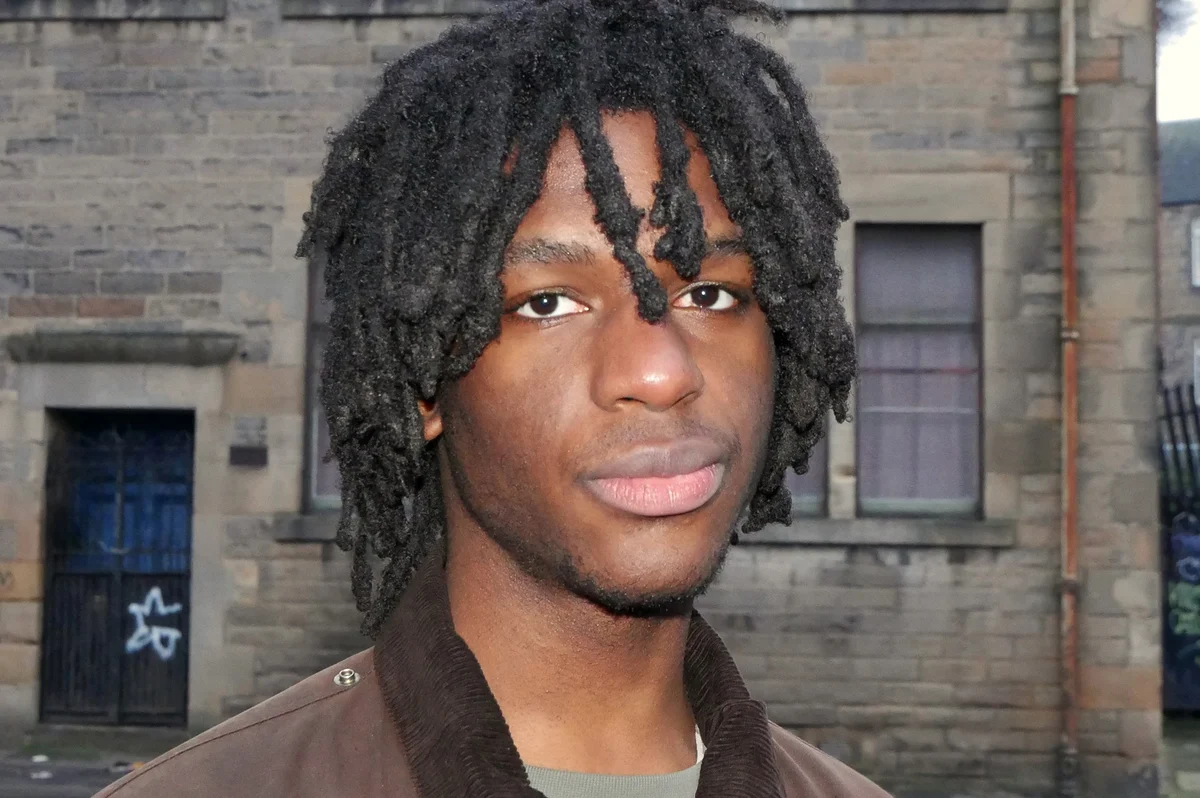
Quietly dropping music online sometimes works. In the boundless pool of information where musicians compete to grab listeners’ attention, Swan is a rare case of that working. Last December, he released the first taste of his incredibly realised folk artistry, the sprawling seven-minute “Me vs. Mothra”, which attracted a bevy of excitable fans across many of the internet’s passionate music corners. The buzz is palpable: “It’s a trip. It’s really, really nuts,” he says. “When you put something up online, especially as someone who’s grown up on the computer, it does seem like this endless void with a bunch of giants you can’t touch. I put out my first song, and then the void smiled back for some reason.”
It’s easy to see why; Swan pours his heart out through imaginative lyrics that conjure abstract images. The lushness of it all, made entirely by himself in his bedroom, beams with life. His weathered, lived-in croon sounds even more astonishing because he’s only 20. Swan has earned comparisons to Tim Buckley, King Krule, and especially Cameron Winter, likening Swan’s precocity in sculpting intricate folk songs alone to that of the Geese frontman. I’d argue the claims about Swan imitating Winter are reductive; the brighter, merrier timbre Swan has found speaks to a different set of formative influences. “Edie”, one shimmying, fantastical number from his second EP , the follow-up to his debut EP , amply proves Swan is crafting his own world.
Already a multi-instrumentalist, Swan is a wunderkind, and that journey had many stops. Swan’s brother played drums, so a drum kit was already in the house. When he wanted to learn keyboard and guitar, his mum got some so he could practice. “I was just really bad at those three things for a long time,” he laughs. Swan further honed his musicianship by playing brass in primary school, guitar in bossa nova bands before high school, and eventually drums for a volunteer church band. Recalling his drumming experience, “You got forced to be at least okay if you’re there every week at the same time in front of people.”
Swan’s zealous folk pop carries echoes of many disparate elements. He singles out jazz-influenced chords, hip-hop’s bruising beats, and sweeping horn sections. He settled on this eclectic style because he can combine those “different segments of the canon” altogether. “Listening to music and hearing and loving all the parts of the song, I just wanted to be able to touch on that and do that for myself,” Swan says. “I’ve never taken lessons for guitar, bass, or drums. I probably should, but instead I’ve taught myself how to play by playing the stuff I really care about.” Today, his claims of once being “really bad” come from a distant universe.
His artistry differs from other artists in this lane because comedy and animation are pivotal influences. The former comes most directly through the writing, as Swan explains, “I was speaking to a music friend of mine, Morgan Morris, shoutout. When we write lyrics, we talk about ourselves, thoughts, and complex emotions, but at the same time, it’s as if we’re writing good jokes. It’s that element of expectation and surprise I think is the foundation of anything I’ve ever enjoyed.” That comes through in “Edie”, which features a fuzzy bass tone mixed with harmoniums and very high strings, Swan tells me, making it the jolliest entry of his growing repertoire. “A good joke, song, or chord progression is about taking you somewhere that still works, but is different to what you thought.”
Then there’s animation; we light up as I mention we’re around the same age and grew up during the same Cartoon Network era. He lifts his zip-up plush bag of ’s Jake the Dog to the camera and mentions the show’s iconic character-centric songs. “I just love the vivid imagery you get [in animation]. I love that everything is squishing and squashing and malleable,” Swan muses. “So when you write a song, you’re putting all these things together; you can blend two very disparate things.”
Also, Swan himself plays a character. His alias appears multiple times across both EPs, but he reiterates it’s not him. “The name came after writing all of these songs; I just picked it,” he explains. “When I say ‘swans’ on ‘Paulie Tooth’, I’m talking about the afterlife, and had a specific vision of how they’d look in this context.”
He expounds: “I’ve always loved music that fits in its own world and takes you on a journey. I think that’s what I like about Tom Waits’ later stuff – he is playing characters, and it feels like a movie from start to finish.”
The Paulie Swan universe begins with his two-part EPs, a sequenced arc of wandering through the psyche. He’s finding peace with the sudden influx of fans, which can overwhelm any young artist, but at least it’s all positive. Swan even shows me a lovely handwritten letter from a fan who attended all of his performances so far. He wants to make an album once he’s ready, write weirder music that draws upon the strangeness of growing up online, and form a backing band instead of playing solo.
But if there’s anything else happening to Swan, it’s that his eyes are full of stars. “I’m waiting for someone to wake me up, honestly, and so I’m just doing everything I’m being allowed to do until they stop me. So that’s my goal right now: Just not to stop.”