he French Riviera is not a place. It is a dream of paradise, one of those Arcadias we long for – timeless, perfect worlds saturated with light. In the modern age, artists found theirs in the south of France. Yet this exhibition misses the point entirely. Instead of the modern myth of the Med, what we get here is a pedantic obsession with the geography of France's southern coast. Artists get rewarded for which bit of it they painted. This leads to some serious distortions.
The neo-impressionists – the dot-fixated movement led by Paul Signac – and their paintings of the Côte d'Azur get a grand, spacious setting. That's OK; though when you've seen one pixelated shoreline, you've seen them all. What's baffling is that Henri Matisse and the Fauves have been squeezed into a smaller, less weighty adjoining display. The revolution that Matisse and his friends enacted at the seaside town of Collioure, replacing nature with the colours in their heads, was far more radical, exciting and visually brilliant than Signac and co. I couldn't fathom it.
Then I looked at a map. Collioure is on the far west of Mediterranean France, close to the Pyrenees. The Côte d'Azur to the east is the Riviera proper, including all your favourites: Nice, Cannes, Antibes, Saint-Tropez. The Fauves are punished for straying from it.
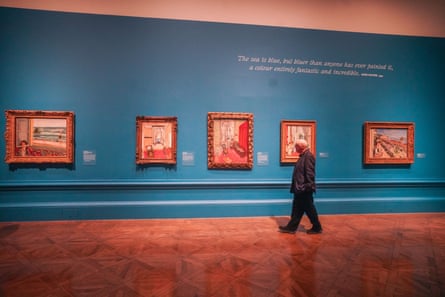
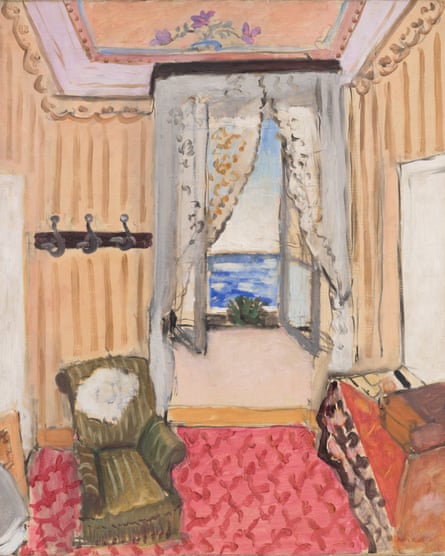
This is ridiculous. In fact there seems to be a grudge against poor Matisse. A mere handful of his 1920s paintings that linger adoringly on women in Nice hotel rooms have to share space with cosy Raoul Dufy who was at best a Matisse imitator. Then at the end a single late Matisse cut-out, a serpentine white line through aquatic blue called The Wave, is juxtaposed with a lot of blue imprints of bare-naked ladies by the showboating 1960s artist Yves Klein.
Yet it is Matisse who defines with one captivating work what Painting the French Riviera should have been about. His 1904 Study for Luxe, calme et volupté, in the little Fauve room, depicts a seaside Eden with unfettered passion and hedonism. Gold, green and violet dots, much freer than the neo-impressionists' pedantic fields, fleck this little canvas in which Matisse experiments with a group of female nudes, gracefully posing by the shore, that he would finalise in the completed version of Luxe, calme et volupté in the Musée d'Orsay. "Luxury, peace and pleasure" – the title comes from Baudelaire – is Matisse's ideal. It's 1904, the new century is full of nationalists, revolutionaries, discontent, but he dreams of a perfect day by the sea surrounded by beautiful beach bodies.
The fascination of this study is its rawness: these might just be actual women on a beach. They haven't yet become the mythic beings of the final version. Matisse stares at real life bathers until they become goddesses – it's the essence of the Riviera in French modern art, both a mythological Arcadia and a place you can get to on the Blue Train.
Picasso's backcloth for the Ballets Russes production The Blue Train hangs here. It is not actually by him but an enlarged copy by a scene painter of his small intense 1922 original Two Women Running on the Beach. Exciting, if you didn't recently see it at V&A Storehouse East. Yet the show's choice of Picasso is even more dispiriting than its meanness with Matisse.
Much stress is placed on how Picasso saw the Riviera through a classical lens, from sculpture-like women to flute-playing fauns. But that's a children's book. For Picasso, as for Matisse, the Riviera meant sex. This show leaves out Picasso's outrageous multi-orificed beach volleyball players, his prints of voluptuous women laid out for the eyes of artists and fauns, his erotic reveries over Marie-Thérèse Walter. Only one work captures his equation of sun, sea and lust: a witty woman-shaped vase from 1961 with a bikini painted on its pink terracotta form.
Why am I banging on about Picasso and Matisse? It's because any exhibition about the Riviera worth its salad niçoise would put them at its heart: it would be Matisse-Picasso, the Rematch. So many of their dazzling creations feast on this paradise – and reveal its dark side.
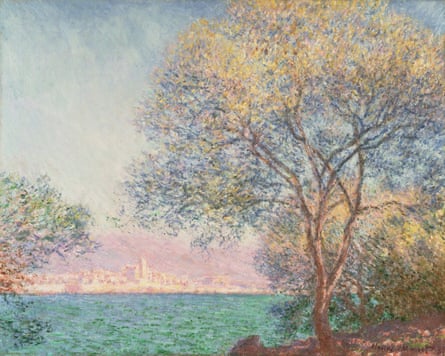
Instead of a dive in that sea, this is a collection of dry little diversions. It gives more space to Monet than Cézanne, which is tomfoolery. Monet's views of Antibes are lovely but this Normandy-born artist is not southern in the same way as Cézanne, who sees his native Provence with painful intensity, burning his eyes at midday. In his painting Bathers, a group of near-nude young men pose against sky and water that seem to be baked rock hard by the sun. You instantly recognise the dream of the Med, the reverie, the obscure eroticism: pink flesh, dark blue sea, light blue sky.
Then more detours. You linger with Bonnard and wonder what Picabia is doing here. Meanwhile, you have to ask why they didn't include van Gogh, who did paint southern beaches, and owned the sun.
The Riviera is left looking about as sublimely erotic and glamorous as a wet day in Margate. Tender Is the Night this is not. I don't know whether the problem is pretension or, more depressingly, pandering to visitors the RA thinks want nice sunsets without the disturbing desires. If you go to this beach, leave your brain behind.