Not long ago, it cost just £2 to put a coat or a heavily stuffed tote bag in a cloakroom on a night out. But over the course of the 2020s, that cost has increased to more than £13 in some UK venues.
At the Outernet Live venue complex in London's Soho, it costs £11 to put a bag in a large locker. It's £9 at east London nightclub Fold, and if you want to retrieve something, you'll need to pay again. At north London's Drumsheds, the UK's biggest nightclub, they cost up to £13.20 (though they're reusable with no extra fee). At the Warehouse Project in Manchester, large bags must be stored at a nearby Premier Inn at £11.99 per locker. Manchester's Co-op Live Arena has a dedicated bag storage facility which costs £15 for large bags. It's £9.99 near the 3,000-capacity Edinburgh Playhouse and £9.90 at Testbed in Leeds. How have double-digit cloakroom costs like these been normalised?
The price rises are helping to push average spending per head on a night out from £20.95 in 2020 to £28.06 in 2026, according to Night Time Industries Association. "For years, nightlife businesses have faced relentless increases in the cost of operating, from energy and employment to taxation, business rates and supply chains," says chief executive Michael Kill. "Many have had no choice but to pass some of those costs on to consumers simply to keep their doors open. But the reality is that consumers have now hit an affordability ceiling."
With consumers spending less on alcohol, locker systems and cloakrooms offer premises a way to make some of that money back, but, Kill says, "the consumer cannot be the industry's financial shock absorber indefinitely".
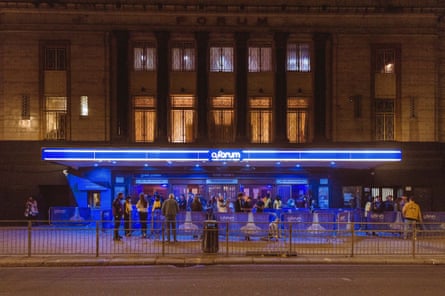
UK storage policy changed after the 2017 attack at an Ariana Grande concert in Manchester Arena which killed 22 people and injured more than 1,000. "Martyn's law" legislation requires "appropriate public protection measures" at public events to reduce the risk and impact of terror attacks. It led to many venues – including the nationwide network of 18 Academy Music Group sites – banning bags over A4 size entirely and offloading them to external lockers or storage partners. In London, these are often kebab shops, restaurants and barbers.
Carrie Wang, a London-based spin instructor, was buzzing to see Hot Chip at O2 Academy Brixton until she learned her near-empty tote bag had to be stored in a kebab shop round the corner. "I was fuming," Wang says. "They charged me £10 and it wasn't a proper facility, it was just a random storage room – it's not like they had lockers and my things were actually safe there." Academy Music Group did not respond to multiple requests for comment.
Ahmed Khan is the owner of Kentish Delight, a kebab shop in Kentish Town. He says that in 2022, O2 Kentish Town Forum's management asked if he had any spare space in the takeaway. "They had a look and said my premises are perfect and secure for the customer – and I said yes, why not?" Khan charges £5 per bag and says nothing has ever gone missing. "Although the bag people never buy kebabs."
The high costs and added logistics mean that some people are taking risks with their belongings. At an AEW wrestling event at Wembley Arena, fans were directed to a nearby Premier Inn to stow their bags, at £10 a pop with long queues.
Soul singer Danny Toeman decided to stuff his rucksack behind a carpark vending machine. "I could stuff most of the valuable contents into my pockets," says Toeman. "So I thought: let's just stash it somewhere and if it gets stolen, so what?"
That in itself is a security risk – if staff had seen Toeman's backpack, the venue could have been evacuated. But it's become commonplace. One Reddit user opted to hide their bag outside the O2 Academy in Southampton. "They will literally not let you in," they wrote. "I was forced to leave it outside the building entirely and it was stolen when I came out."
Willem Pelle is head of sales at eLockers, a Dutch company working with many UK nightclubs including Drumsheds, Fold and Warehouse Project. "When we expanded into the UK, we saw that many venues were facing staffing challenges following Covid, making traditional cloakrooms increasingly difficult to operate," Pelle says.
London is their main UK market, with Manchester a close second. Pelle says there is typically no upfront cost for the venue, which gets to share the takings with eLockers, adding: "It's important that the pricing works for both the venue and its customers, while creating a sustainable additional revenue stream."
Some clubbers have reported benefits to lockers, such as those at Drumsheds, where you can put stuff in and out – allowing for outfit changes during an event. But not all venues opt to install expensive locker systems. At Hackney Bath House, the cloakroom is free. Sneaky Pete's in Edinburgh installed lockers in 2012 and still charge £2 per locker. Peckham's 200-capacity club the Carpet Shop charges £3 per item: "No need to charge more, it's a tiny bit of space and a rail," says general manager Cam Prentis.
He sees the cloakroom as a valuable part of the club experience in its own right. Upstairs and away from the bustle, it's where staff and punters can have a break and a chat. "Whoever's on the cloakroom has their own music playing," Cam says. Unlike at an unstaffed array of lockers or the back room of a kebab shop, "it's a vibe up there".