As the theory goes for music, the songs we hear when we’re young imprint themselves on the psyche, define tastes in music and shape our identities. Whether or not you buy into the idea, the music that Richard Thompson heard in his household as a child has not only never left him but played a pivotal role in shaping the force of nature that he is as a guitarist and songwriter.
The same can be said of his first band, Fairport Convention, with whom he broke through in the 1960’s, and left in 1971, but like the music of his youth, they’ve have also been pivotal in his life and stayed with him.
“I played them in August actually. My wife and I played at Cropredy Festival on the Friday and Fairport played on Saturday. We got Fairport up as a rhythm section with us on the Friday, we played some old stuff and some new stuff and that was great fun. We had a wonderful time.”
Thompson was surrounded by music as a child, where the family home was soundtracked by the record collections of his father, a jazz loving Policeman who was also an amateur guitar player, and his sister Perri, who had an indelible influence on his love of Rock and Roll.
Finding his own voice as a musician was both defined by what he didn’t want to be – Thompson describes the blues guitarist scene of the late ‘60s an overcrowded field and jazz felt too niche for him – and embracing music outside of the mainstream. After he left Fairport, he released his first solo album, Henry the Human Fly in 1972 he made a series of records with his then wife Linda, before returning to a solo career in the 1980’s.
Thompson is about to release his 20th solo album, which showcases his talent not only for incredible guitar playing, but his love of writing seemingly disparate character pieces that come together as a distinct story. When I ask how he feels about releasing twenty solo records he laughs and says, “Oh God, that's ridiculous, isn't it? It shouldn’t be allowed.”
He explains that the need to keep writing songs is because songcraft is part of who he has always been. “Well, it's interesting. I kind of call it a job, but it’s been a fascinating thing to do since I was about 14, or earlier, maybe 11, and I can't help it. I just keep writing stuff, and once you've written stuff, you think, ‘Well, what am I going to do with this?’ And it’s, ‘I know. I'll make a record.’”
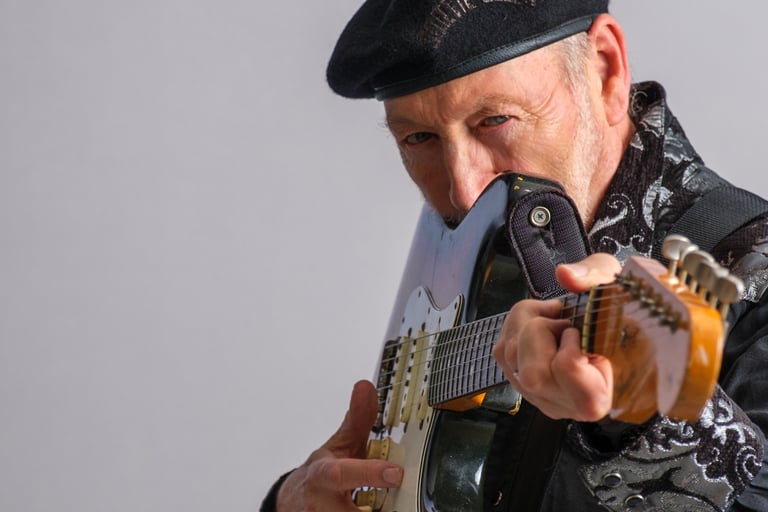
As much as he loves writing and recording, for Thompson playing songs in front of an audience is his favourite thing to do. "It’s all wonderful, really, I'm fond of all the processes. For me, the greatest pleasure is playing in front of an audience, where you get that feeling of communication, something that comes out of you and gets received by other people, heart to heart, or soul to soul, or whatever you want to call it", he explains.
"That's the best thing, and you don't really get that any other way. I love recording and I love writing, but it's the sense that something you've written, something you've performed - is received by other people, and that's the payoff for me.”
Next year is Fairport Convention’s 60th anniversary, of which Thompson says, “goodness, who knows where the time goes?” Before he gets to play with his old bandmates, he’s touring with his band in January and February in the U.S. and in April and May in Europe. “The 60th anniversary will be a big one. We're doing a mini tour as part of Fairport, and then I'll do Cropredy Festival with them. It would have been Sandy Denny’s 80th birthday, so it’s all kinds of stuff for next year. It's going to be busy, but I think it will be wonderful.”
As we finish up, I ask Thompson about the foundational impact that songs can have on us, especially the songs we fall in love with when we were young, and he describes his Nine Songs choices as, “absolutely pivotal, unavoidably so. The stuff you hear when you're young, you can take it or leave it. All the musicals that my mum used to love - everybody's parents had , and that was another part of the background of growing up in the ‘50s and ‘60s, and you rejected them, although I still learnt a lot about musical structure from those musicals.
“You absorb stuff, even if it's on the back burner, even if you’re not accepting it, you're always learning.”