“Law is only one way of doing it. I myself favour violence – deeply, I favour it. The reason that I favour it is that the law isn’t working. As long as the law isn’t working, women who have been attacked, or who are being attacked, need to be able to understand that they have a right to defend themselves…”
Taylor Zantingh’s voice isn’t the only one on PISS’s debut album, you made me / skin on linen. The previous quote comes from the venerable academic and self-described feminist militant Andrea Dworkin, interviewed back in 2002, a few years before her death, two decades before Sarah Everard was raped and strangled by Met Police officer Wayne Couzens – an event horrifically emblematic of “the law isn’t working.” Dworkin stars posthumously in both “andrea I” and “andrea II” from the album.
There’s also French philosopher Manon Garcia, who addresses the sickening case of Gisèle Pelicot, and the “resistance is possible” call to action of Rote Zora – the West German “terrorist” group. Zantingh borrows quotes from an interview two members gave in 1984. After all, the PISS vocalist never intended to be an in-the-spotlight messiah or soap-boxer. She doesn’t claim to have all the answers. Since forming the emotional-noise-art project barely two years ago, she has approached PISS like an unlocked rage room – working through her own trauma without being prescriptive, and sharing it without caveat or expectation.
“I wanted the samples to provide a wide range of perspectives on the issue of violence. Only because I don’t have the answer. Nobody, I think, has every single piece, because the problem affects every individual person,” Zantingh tells me, calling from her Vancouver apartment first thing in the morning. “To get to the answer – that starts in an ability to tolerate discomfort, of listening to different perspectives and taking what you can from something, and then understanding when you can leave it.”
This is why some of the samples posit conflicting views. She describes the album as a reading list – providing several introduction-to texts that listeners may follow further if they wish. Her Nine Songs selections, similarly, double as a primer on the past 50 years of music that pushed boundaries and had important things to say.
But before we get into her picks, back to “we have to find some way to keep the rapists off the street.” As Zantingh puts it, “I think way, way, way more men are doing this, and many of them are not psychopaths. So what does that mean about culture? Having [Dworkin’s] voice articulate that so clearly – I’m really grateful for the challenges that led to her being on the record.”
When it came time to set in stone the audio snippets that thread through PISS’s live show, tough decisions had to be made. “When Howard Stern’s lawyer sends you an email, you’re like, oh, we’ve got to think about this,” she says, explaining that some of the speakers they approached didn’t want to be involved. Those “were at the more, I would say, nonviolent or gentle side of the spectrum, and they elected not to be a part of it because they didn’t want to sit alongside some of the more militant voices on the record, which was a shame, because when you take those voices out, then the record does skew much more militant.”
For Zantingh’s part, she has several modes, vacillating between blood-run-cold shrieks and matter-of-fact spoken-word. Or breathlessly repeating the line “howcanyouactoppositetothisemotion?” again and again, exhausted and falling over herself. Lyrically, there are strident, graphic slingshots such as “there is a stickiness on my tongue that never washes out” from the more classically riot grrrl “time loop at hot slit”. “blocking a scene you can’t remember”, the album’s thematic centrepoint and the most unforgettable piece of their live show, is more abstract and cinematic. “Interior, a girl’s bedroom, nighttime,” Zantingh says, continuously interrupting herself as she rehearses a confrontation. “I still feel the weight of all that skin – , again,” she pants, exacerbated.
“Everybody who has ever known me, and everybody who never will know me, will know this music,” Zantingh says. But PISS’s debut album was tracked by nobodies. They’d played their first gig barely six months earlier. Shows beyond Canada’s rainy left coast weren’t in the calendar.
Ever since they entered the studio in the first few days of 2025, though, the quartet has become anything but anonymous: talk of the town for experimental-noise philomaths, check. A giggling point for men nursing flat ales in festival fields, that’s a check too. But – above all – a companion for anyone whose life has been singed or scorched by abuse, as well as providing a way into the conversation for sympathetic or complicit outsiders. And all of this happened with only three demos released – barely five minutes of music.
“It’s a lot to get so much attention so quickly for something that is also very sensitive and personal. So on top of everything, I have to learn these skills of compartmentalisation, where I can separate artistic criticism of the record from these feelings that get pulled up of people criticising my story. There are a lot of parallels between my experience of telling my story in the past in a non-artistic way and having it questioned, criticised, picked apart, and learning to separate those two things.”
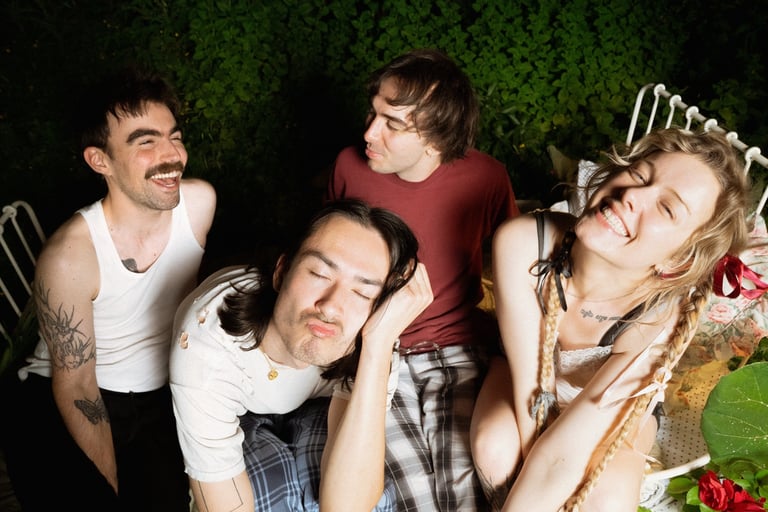
Navigating such hordes of new participants in the real and online worlds – and so quickly – would be challenging enough for a “normal” band. But PISS is not a normal band; indeed, their framing as a “punk band” or “hardcore band” falls short of what they do.
They are performance artists, activists, experimentalists, something we haven’t quite been able to categorise accurately. What other distressing, exhausting, but ultimately cathartic live show opens with a trigger warning and closes with an ending the artist keeps trying to change?
“The biggest question was this constant dilemma of how you write an ending to this that feels sincere in some way, because there isn’t an ending for trauma – it just keeps evolving,” she says of wrapping up the album. “Sometimes there’s hope, but pretty often you have this understanding that it’s something you will live with for the rest of your life in some way. I didn’t want to give this sense of despair because I don’t feel despair. Even just me being in this project is evidence of how far I’ve come.”
On “i keep trying to change the ending”, the album’s finale, clanging metal, chainsawed cello, and thunderous drums eventually, reluctantly give way to a reflective afterglow where Zantingh sings – or perhaps it’s more like an absentminded hum – “I won’t bleed forever.” It’s a powerful mantra, and the instruments know it; each time the singsonged words poke through this atonal war in the track’s first half, the rest of the band responds more angrily than before. But Zantingh drags them kicking and screaming into something close to peace. They fall in line. The album is over.
“The only way to end the arc where the album leaves off was to make sure there was a sort of ambiguity where it was sad and hopeful. You only get there after you listen to this big chunk of noise that makes no sense and is just annoying to listen to. Then you can have a moment of peace. It’s not definitive, but I do want people to feel hopeful because change is possible. You can’t go back, but you can get better.”
“Sometimes I’ll tell a story to my bandmates, just casually relaying it to them, and the look of horror on their face will bring me back and make me think, holy shit, I have really crawled my way, on hands and knees, out of this hole.”
Here are the Nine Songs that accompanied Taylor Zantingh out of the hole.