Indeed I should, but I'm not complaining. Our conversation darts wildly all over the place, from her nighttime jazz odysseys as a young girl in Mumbai to unprintable anecdotes about her halcyon days in New York, via touching stories of her sister and mother and much more besides. “You’ve got to stop me, darling. I digress and then I digress on top of that,” she continues, laughing into the camera of her phone, held so close to her face that sometimes all I can see is her bright red lipstick and a beaming smile. “I can’t think linearly,” she tells me more than once, “horizontally or vertically!”
Puthli, now 81, is calling in from her retirement village in Miami, but she hasn’t hung up her silver suit just yet. She’s fresh off touring with Gorillaz, having guested on their 2026 album , and is set to perform a show of her own this weekend at The Barbican – a rare UK headline performance where she'll be joined by Anoushka Shankar, Yazz Ahmed, Sarathy Korwar, and potentially some hush-hush other guests as part of this year's EFG London Jazz Festival.
Having only resumed touring in 2024 after a 40-year break, Puthli is gushing with the joys of the road. She describes meeting Damon Albarn and Jamie Hewlett as an immediate rush of chemistry ("like we'd known each other in a past life or something") and is excited to be reunited with Shankar ("my unicorn") at the Barbican.
Back in the '70s, Puthli and Shankar's father, sitar virtuoso Ravi Shankar, had plans to work together on an off-Broadway play about the Hindu mystic Mirabai, but it never came to pass for reasons she doesn't remember. "Our costumes did share a display in the Grammy Museum though," she says, before going on a diversion about how she would have loved to get a Grammy nomination but her music was never submitted. "My career has not been very consistent, but I'm very happy to continue the legacy of that friendship with Ravi."
Puthli's own legacy started as a story of being tugged in two very different directions: the Hindustani classical singing she was learning at school and the opera lessons she'd take after hours with a British woman named Hyacinth Brown, who would have examiners from England's most prestigious music schools travel out to India to hear her students. Puthli describes it as "colonial hangover," and herself as someone born close enough to 1947 to count as "one of those midnight's children."
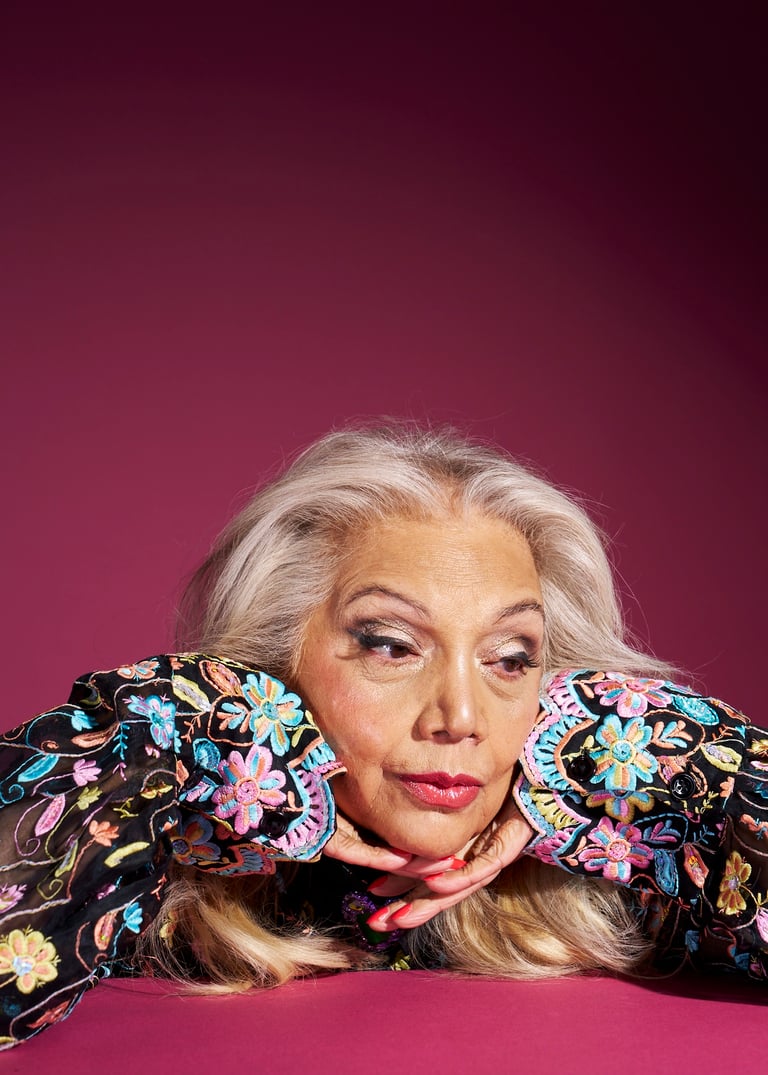
Her early love for opera came from her dad, who could turn any daily interaction with her into a song, but Puthli presented a challenge to the teacher, who couldn't quite figure out where on the scale her voice belonged. Having started Puthli on an Agnus Dei, then shown her the ropes of composers like Bach and Christoph Willibald Gluck, Mrs. Brown moved her on, undaunted, to the French composer Georges Bizet. But that didn't seem to fit either, so then Puthli learned to sing high soprano instead, working on her coloratura with "The Bell Song" from Léo Delibes' 1883 opera .
Ultimately, though, despite her teacher's grand plans, Puthli fell out of love with opera after she was given an ultimatum to choose between that and the Indian classical singing she so loved, in large part due to her older sister. "That was it for me," she says. "She was trying to put a restraint on me, but my other teacher, Guni Gandharva Pandit Laxman Prasad Jaipurwale, asked me to give up opera. But I did, and continued on with him instead."
There are no opera songs among the nine tracks that Puthli has chosen to talk through as the songs that shaped her life. There's nothing either of the cosmic disco that she's most closely aligned with after the success of her 1976 album The Devil is Loose and its irresistibly slinky single "Space Talk". Instead we get a broader look at her tastes, from her sister's ghazals to a '90s karaoke favourite.