For , “the dark” can have endless meanings. There is the literal, an emptiness that can envelop you, and there are odes to the romantic mysteries of the Gothic, in film, television, art, literature and, certainly, music. And, there is a deeper, spiritual meaning that particularly resonated with Wolfe. “It is about doing that sort of deeper, inner shadow work and facing things in your own life that are difficult to face, [and] having difficult conversations — that’s all very clearly there,” she explains.
The phrase “the dark” continued to resonate and would eventually christen her ninth album (out now via Loma Vista Recordings), manifesting in her mind as “this multifaceted dark crystal,” she describes with a slight smile, and each song that comprises the album became a different facet of its surface.
The title initially sparked in Wolfe’s mind from the concept of the Dark Night of the Soul, a poem by St John of the Cross. As she explains, it came to define feelings of hopelessness and loss, but also a lingering sense of hope, and it is this energy that forms an undercurrent of ‘The Dark’, in its entirety. As Wolfe expands upon during our conversation, there was a necessity to strip everything back — her sound, her surroundings, her persona — and return to herself.
Across the album, bare-bones renditions of her signature gothic-folk melodies expand with the lightest of synths, conjuring her most intimate sound yet; and in her songwriting, this is mirrored in a vulnerability unlike any that she has offered before, pulled from reflections of past selves and relationships, as well as the lives and lessons of her ancestors. ‘The Dark’, in turn, exists within the veil between life and death, where Wolfe has found the space to both reset and re-emerge.
The beginnings of ‘The Dark’ came about around 2024. Could you talk a bit more about that initial period and how the themes of the album coalesced for you?
I knew I wanted to focus on songwriting for this album. I didn’t know exactly what I wanted it to sound like yet, production-wise, but I didn’t want to focus on that, at first; I just wanted to focus on the songs themselves. I started having writing sessions with a few different collaborators to see what was feeling right, and all of the sessions were really cool and productive. But, when I worked with a songwriter named Jen Decilveo, I felt like the way that we worked together was very fast and easy, and we would instantly start getting things done. And I love that energy: I love to start working as soon as I’m in the studio. I’m there to work and I’m excited about getting to be in a studio, so it was cool to have that energy matched and just dive right into it.
We were writing a few songs. She’s in LA and I’m in Northern California, so I would go down and have these couple-day writing sessions. At some point, though, she was like, ‘Okay, we do need to kind of figure out what kind of album we’re making here.’ When I closed my eyes and really felt into that, I wanted it to be about the basic elements of alternative rock [and] acoustic music: guitar, piano, drums, bass. Just focus more on the songwriting and stripping things away. There is a little bit of synth and extra production, because that’s just intrinsic to my music and to what my collaborator, , brings to the music. But, it was fun to come at it from a different angle and think about songwriting, having Jen help me write choruses and things like that, which I don’t usually focus on too much.
What is that experience of going into the studio like for you? Have those moments where, as you said, you’re ready to lock in and get the work done, evolved over time?
I work so much from home that I end up writing a lot by myself and spending a lot of time in my own little spaces that I’ve created to work. For me, hiring someone to produce a record or to write with me feels like getting out of my comfort zone, and creating a container of time and space [that is] going to be a focused space of work… For me, like I said earlier, I feel like getting to be in the studio is really special and a gift — and I don’t have the budget that some artists have to spend endless time in the studios. For me, I’m like, I really want to utilise this time…
I think sometimes it can seem like writing with a co-writer is maybe the easy way out, but for me, I felt like it was going to challenge me in new ways, and it did. It’s not super comfortable to bring a song to the table and have someone tell you, ‘It’s not right, it needs this,’ or push you to a place that you wouldn’t normally go with your voice, or something like that. But, I was like, I just feel like I need that, at this point in my life, and I’m open to it, as well.
One of the things that’s lingered with me since listening to ‘The Dark’ was this sense of intimacy and closeness in the production, across every song. Even on the more grand ones like ‘Seethe,’ I feel like I’m in the studio, in the room there, with you. I’m wondering if or how that was a conscious effort, production-wise?
[‘Seethe’] is interesting because that one, I wrote before starting this whole process of working with songwriters. That was one that I actually wrote on tour in 2024, backstage. [I] set a little, simple recording setup and played bass — which, I don’t normally write on bass. So, I guess there is some intimacy of just being in this little backstage room and writing the song. Eventually, we finished it off with Jen and she added the line that comes in at the end. She’s really good at adding something that comes in over [the] top of something that’s already there, that kind of keeps it driving forward. I really like that. That song is much about being a woman in this world, so it is very personal and intimate to my own experience, and to so many.
On that note, considering the amount of inner work, if you will, that’s evident in the album’s lyrics, how has your relationship to being honest and forthcoming in your writing transitioned over time?
I definitely feel like in the past, I was a lot more guarded and would write about personal things, but in a very cryptic way. I just felt like I wasn’t interested in really putting it forward. But for this record, I was very direct, and very honest and open, and Jen encouraged me to write about what I was going through in real time. I would be driving down to LA and thinking about what was actually going on in my life, and writing lyrics as I was doing that, and then I would show up with this pile of lyrics that’s really about what’s happening in my life.
Then, of course, I always try to give it a little bit of a mythical bent or something, to make it feel more universal and not so personal, because I’m still not one who’s going to talk about exactly a song is about or it’s about. And I want the songs to feel like everyone can inject their own meaning and experiences into it, as well. This album feels very personal and again, very direct. Like opening up the album with a line like, ‘I’m letting you go,’ and, ‘I need to know who I am without you,’ those are very simple, direct ways of speaking to someone. It was interesting for me to put that into a song, in that way.
You’ve described the album, overall, as a séance, contemplating loss in various forms and struggling to let go. With this record, was there ever any sense of doubt, or a daunting moment, where that level of vulnerability came into play?
Yeah, for sure. I think I knew that this album was going to be, like I said earlier, a sort of reset for myself. And it might not be what people wanted or expected from me, at this point, but I just knew that this is the record that I needed to make, and was hoping that aspects of it would connect with people. I know there’s kind of something for everyone on there, which isn’t always the best thing; sometimes it’s better to [stick to] genre, or record, but that’s never really been my strong point. I often have heavy songs and acoustic songs on the same records.
I think knowing I was putting a song like ‘Cold’ at the beginning, and a song like ‘Dancer in the Sky’ at the end, felt very vulnerable to me, because they are very clear and open, and a little bit more pop-leaning. This was another exercise for me to get out of my comfort zone — exposure therapy, of sorts — to allow myself to be seen in a different way. Then, visually expanding upon that and letting myself be seen more than I usually do.
You have a number of collaborators on the album too, from Queens of the Stone Age’s Troy Van Leeuwen to Kælan Mikla. What’s something that you learned, for yourself, in having this cast of musicians featured?
It’s really interesting to invite new people into the fold of your music and see how they approach things. It reminds me of when you’re the support band for another band, and you see how they operate and you can learn little things about that.
Watching players like Troy and [Nine Inch Nails’] Robin Finck come in and seeing how on-lock they have their guitar tone… When Troy came in, he was fresh off of tour and I think his gear was still out, being moved somewhere… and there [were] only a few pedals at this small studio that we were at for the day. He somehow managed to twist and turn all the knobs just right, so that it sounded like his tone, even though it was pedals that he doesn’t normally use. Again, it was just really cool to see these really great, seasoned players know themselves, their guitar tone and their way of playing so well, that they were able to just lock it in a couple of minutes. And, just how quickly they work because they know themselves so well, as artists.
That’s really cool. I’d love to dive into the aesthetics surrounding ‘The Dark’: there’s so much of the natural world, from the music video for the title track and ‘Death Is Not the End’ & the album’s cover. How did these visuals come together for you, and how do you see them mirroring the sentiments across the album?
I think a lot of this album comes from where I’m at in my life, being a woman who’s entering her 40s, sort of entering this second half of my life and feeling very different. It feels like changes and integrations happen a lot more rapidly now, which is nice. But I think that there’s a choice that people have to make at this point in their life of, am I going to just keep living the same way I have been? (And that’s okay. Maybe that works for some people.) Or, am I going to change and fight for myself?
2024 was not a good year for me: I was not feeling like myself, I felt like I just kept putting on an old skin, [or] an old costume of myself, over and over. I couldn’t quite figure out what was going on, and I just felt like I was abandoning myself over and over, giving myself to other people, giving of myself what they wanted for me and not what I felt like I was truly meant to give. So, I did have to make a choice of, am I going to stop abandoning myself and reclaim my own self, my own power? And that is the choice that I ultimately made, and I put a lot of that into this record.
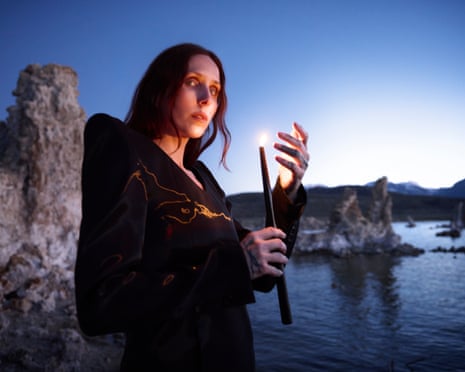
The location that we took the album cover photo shoot at is a place called Mono Lake in Northern California, that’s a very strange, ancient saltwater lake in the middle of the mountains. It’s a pretty important ecological place: at some point, the water from it was being diverted to Los Angeles, and so the lake started dying and becoming so drained that it was almost dead. That’s when the beautiful structures were revealed, because they were underwater [and] had been formed over thousands of years. Then, a group of people decided to fight for this lake and fill it back up, basically, so that it can still exist and the birds can stop there and feed, and do what they need to do.
I just feel like it was a good parallel to something worth saving, something that took a long time to form but because of that, it’s beautiful… Western culture tends to really glorify youth, and the beauty of youth, — and of course, that’s beautiful. But I think that growing older, learning to know yourself and becoming more comfortable in your own skin is also really beautiful. I just felt like that location really reflected where I was at in life, in a strange way.

Across the album there is also the idea of communicating with your ancestors, looking through the veil between the world and the afterlife; and the idea of rebirth comes through, too, in your writing. I’m wondering how you saw the relationship between spirituality and rebirth within yourself channel into your lyrics?
As you mentioned earlier, I brought in the theme of the séance a lot to this record, and I knew that I wanted to explore that visually, like we did for the video for ‘Cold,’ but it also is throughout the lyrics a lot, as well, like [the line], ‘Turn the table.’ [There are] these little nods to an actual séance, but it’s also about summoning yourself again, reaching for your own soul.
I also did some ancestor work, connecting to the matriarchal ancestors of my lineage. I felt like that’s very much where ‘Death Is Not The End’ came from: the feeling that our energy gets a lot bigger when we pass on from this realm and being okay with not knowing exactly what that looks like… For me at least, I don’t feel like it’s just ‘over,’ I feel like it’s an expansion, of sorts. And I’ve always been interested in the space between two worlds, between sleeping and waking, death and life.
There’s this film that I’ve loved for a really long time called with Robin Williams. In that film, the main character literally has to go into hell to pull the love of his life out and fight for her, and that was also a big inspiration for ‘Death Is Not the End’ and ‘Dancer in the Sky.’ I’ve just always been really intrigued by that concept. The film The Others (2001) was also a big inspiration: the ghosts haunting the house and the house haunting the ghost, that sort of interplay.
As you were recording the album, when it came to the instruments and the sounds, was there anything that struck you that was either new to you, or maybe trying something out that you hadn’t before, that was maybe unexpected and formed a good basis for the record?
I typically work with my collaborator Ben Chisholm, so bringing someone else into the fold, having him and Jen Decilveo working together on the writing and the production, was interesting in a way of, it was very clear that the three of us were going to see this whole thing through together… Both Jen and Ben are really great with synths and electronic production, but we were trying to use that in the most minimal way possible. Sometimes there would be just two little dots of sound in a song, and that was kind of a good lesson, as well: sometimes. less is more.
Jen’s piano was always going out of tune… I think the nature of, she lives near the ocean, [there’s] something about the water, it’s just always out of tune. I felt like it lent itself to the record. I like things to be a little bit imperfect, and so there’s a little bit of dissonance here and there, with the piano. I enjoyed that.
Jen and Ben again are both really great producers and they think of things differently than I would. Like, we had Kælan Mikla sing on a song that didn’t actually make the record, but Jen had the idea to sample them and put it onto the song ‘Humours’… it just fit so perfectly, and had that in-between, veil kind of feeling, like you mentioned.
How has your relationship to taking an album like ‘The Dark’ and then translating it into a live setting evolved for you?
I think it’s still evolving, for sure. Because this album has so much to do with letting go and that space in-between life and the afterlife, I wanted to have some sort of physical representation of that. So, we found this really light fabric, it’s so thin and if you throw it in the air, it flutters down on its own. It felt like this nice representation. So, we’re experimenting with creating this portal-column of that behind me, and still need to experiment more to get it.
I think I’m kind of into minimalism these days, when it comes to my personal style and stage style. Whereas in the past, I may have wanted more things, wearing more jewelry and things like that. Right now, I’m feeling a little bit more stripped, and wanting to find meaning in and simplicity. I think having that fabric was just enough to have this feeling of the veil in-between worlds.
Looking ahead for your tour, how are you hoping that ‘The Dark’ continues to grow?
I’m really excited to play these songs live. I’m not playing the full record yet, but there’s a pretty good number of songs that are in the set, definitely more than half. I’m excited to see which ones feel good to play live, which ones are going over well. I always love feeling into how songs evolve and finding little melody changes that I wish I would have done that I’m like, ‘I wish I would’ve done that on the actual record,’ but it just happens in the moment, playing a song live over and over.
I’m also excited, too, because there’s so many extra songs that we recorded, and eventually we’ll start releasing those, too. We recorded quite a few songs and even some covers, around this album, so I think it’ll be fun to just start sprinkling out other things that are related to the album, but didn’t make it on the record.
‘The Dark’ is out now.