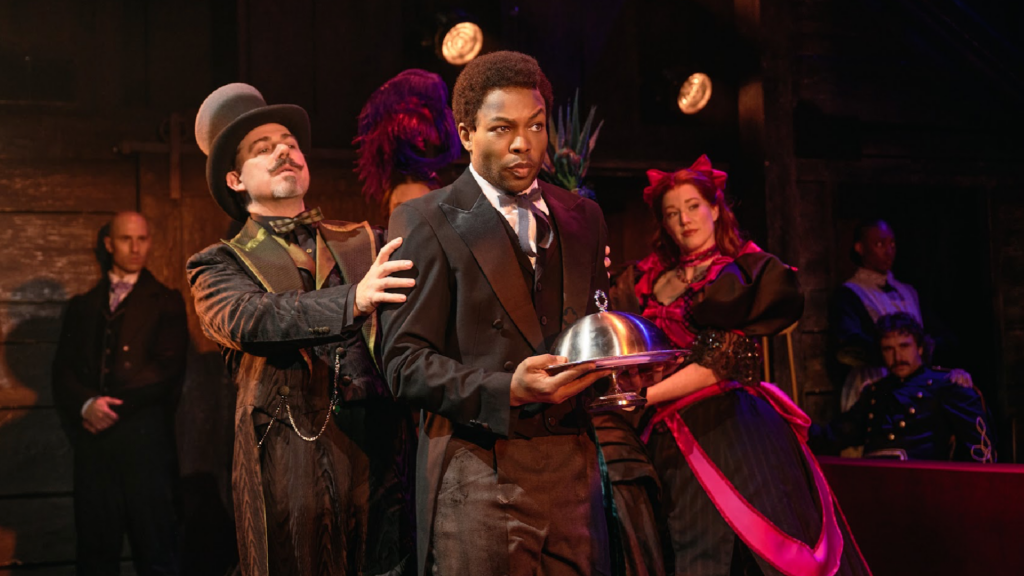
’s has extraordinary voices, memorable music and a powerful heart. What it needs is room to breathe. It starts at a ten and stays there, until even its most inventive moments begin to feel exhausting.
Set in the American South during the 19th century, centres on Rail (Hall), a young Black man, and Richard (Jeremy Beloate), a wealthy neighbour who offers to help him following a fight with his brother. Richard agrees to marry Scarlet (Kennedy Caughell) on the condition that Rail comes to work in his household. Rail also has a lover, Lily Rose, played beautifully by Charlotte Odusanya. As Rail and Richard’s connection deepens, the competing demands of love, race and social standing promise little hope of a happy ending.
There are moments of musical theatre brilliance here
Vocally, the company is exceptional. Hall’s voice moves from silky smoothness to thrilling power as he riffs at the top of his range. Beloate has a gorgeous, full, rounded tone reminiscent of , with delicious phrasing that makes his musical lines a pleasure to hear. Ayana George brings the house down with her magnificent belt, while Odusanya’s perfect mix belt had me smiling.
There are moments of musical theatre brilliance here. George, as Ethel, sings ‘The Dancing One’, a song that shines in both writing and performance. The recurring “pretty eyes” musical phrase is gorgeous; I loved hearing it return and have been singing it in my head ever since. ‘White People’ is hysterical, and the audience at my performance clearly loved it.
During the letters sequence, Richard and Rail turn to the audience with asides just as their lips are about to meet. It is a wonderfully playful touch that makes us feel included in their unfolding romance. The operetta trios of wealthy ladies, reminiscent of Gilbert and Sullivan, are another delight in both acts. And the ensemble numbers raise the roof: the soul and gospel voices in this company sound like heaven.
Yet I wanted more time for the central love story to develop. Attraction becomes devotion so quickly that the relationship never quite earns the emotional weight placed upon it. The scenes in which one man teaches the other to write offer an opportunity for intimacy, but more gradual development and more chemistry would make their connection considerably more affecting.
Morgan Large’s set design is beautiful, although the stage sometimes feels cramped
The narration could also benefit from restraint. George, as Ethel, is such a compelling storyteller that I often wished she alone could guide us through the piece, rather than sharing that responsibility across a trio. The talent is there; the question is how much the storytelling actually needs.
That sense of excess becomes particularly frustrating in the second act. Having the performers switch roles is a fascinating theatrical idea, but replaying so much of the first act delays the story just when I wanted it to move forward. We wait until near the end of act two to return to the point where act one left us. By then, the repetition has drained some of the urgency from the romance.
I wondered whether introducing the switch midway through the first act, or substantially shortening the replay, might give the device greater impact. As it stands, an idea with enormous potential becomes another layer in a production already overflowing with them. When every number demands the same intensity, the biggest moments have nowhere left to go. A quieter scene, a little stillness or more time spent developing the relationship could make the show’s power land more deeply.
Morgan Large’s set design is beautiful, although the stage sometimes feels cramped for the number of people occupying it, and the prominent clock feels overly reminiscent of . The suspended costumes and the mannequins rising and falling are inventive touches that make striking use of the space. Beck Jones’s costumes clearly distinguish the upper and lower classes, with a particularly fabulous highlight arriving in act two’s ‘Black Excellence’. Jake DeGroot’s superb lighting design gives the intimate theatre the scale and spectacle of a Broadway stage.
Hall’s choreography is exciting and fresh, but, like so much of the production, it would benefit from less. The movement offers plenty to admire; more restraint would allow its strongest moments to register without constantly competing for our attention.
I left with the songs in my head and admiration for the performers
Hall’s gifts as a writer, choreographer and performer are extraordinary. Reading about Jonathan Larson’s creative development has made me interested in the process of shaping an abundance of ideas into a finished musical. Watching , I had the exhilarating, sometimes frustrating feeling of seeing that process still underway: flashes of genius, beautiful songs and bold theatrical ideas waiting to be shaped into a more cohesive whole.
I left with the songs in my head and admiration for the performers. The heart and message are there. With substantial editing and a more varied emotional pace, could give its love story, and its audience, the breathing room they deserve.