here is a moment in episode one of Michael Palin in the Philippines where our host surveys a group of children swimming gaily in the harbour of Pangasa, a tiny island in what western atlases traditionally refer to as the South China Sea. "Oh, if only I were young again," he muses. "Eighty-one would do!"
Palin is now 83 and into his fifth decade of travel presenting, which is longer than he spent as an active member of Monty Python. Naturally, he is not a dynamic or imposing presence on screen. His insights are applied with a soft, broad brush and jokes like the one about pining for the lost vigour of his early 80s are his metier now: simple, classic, corny, even.
This is despite late-period Palin, in the documentaries he has made since signing up with Channel 5 in 2018, visiting places scarred by conflict. Having previously journeyed to North Korea, Iraq, Nigeria and Venezuela, he's taking it relatively easy in the Philippines, although all is not well there, either.
There is an old meme about hack foreign correspondents who conclude that every country they visit is "a land of contrasts" – Palin would never stoop to such inelegance, but the contrasts in the Philippines are an inescapable theme. He sees destitution next to stately luxury, political fury expressed by warm and friendly people, and paradisiacal destinations ruined by excessive tourism when there are still untouched havens a short boat hop away.
He starts in Manila, where citizens are celebrating 40 years since the removal of the loathed autocrat Ferdinand Marcos, while also protesting against corruption and inequality in a country whose elected leader is now … Ferdinand Marcos's son, Ferdinand "Bongbong" Marcos Jr. A chat with an anti-Marcos campaigner is pleasant without throwing up much analysis, beyond head-shaking bemusement at the electorate's apparent act of self-harm.
But in his voiceover, Palin regularly makes reference to hard work being done by his crew behind the scenes, to gain access that other films – ones with less respected presenters, perhaps – might not be able to score. Soon he is stepping into the lavish Marcos residence, Malacañang Palace, where – after flexing the old comic muscles by observing that Ferdinand Sr's notorious spendthrift wife Imelda "certainly knew how to buy a carpet" – he meets Bongbong himself.
Palin confesses that Marcos has refused in advance to answer difficult questions, so none are asked. Our man doesn't mention what he's just witnessed on the streets of Manila, where deprivation is so acute that there is a stall selling large plastic bags of "recycled chicken" – scraps from the bins outside fried chicken chain restaurants, scavenged and reheated.
However, the facade Bongbong presents is fascinating, since it doesn't tally with rumours spread on national television by his estranged sister that he is a drug addict (which he denies). Instead, he is more like the sort of mid-ranking executive Palin might have to tolerate at a corporate do in the home counties: smooth and charming, despite his self-deprecating patter almost certainly being insincere. He is also, having been educated in England in the 1970s, a Python superfan, possibly because it gave him a sense of humour to borrow in lieu of possessing his own. Palin politely fields every comedian's least favourite question – the one about where they get all their crazy ideas from – as Bongbong fanboys over the Fish-Slapping Dance.
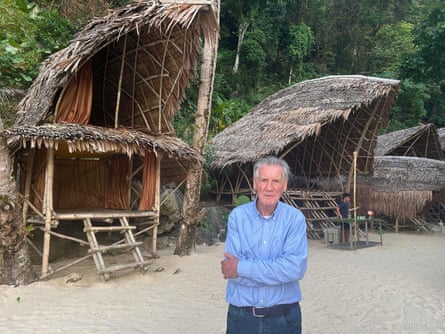
After that, Palin hits the archipelagos, watching as tourist boats clog up the waters at El Nido, an area popular with influencers; he escapes and spends the night instead at a restorative micro-resort that pointedly doesn't have hot water or electricity in its bare bamboo huts, enabling guests to focus serenely on a stunning bay surrounded by the region's signature jagged limestone islets.
Yet tension and strife are never far away – and these days they're encroaching from abroad. The hour concludes with a military flight to what Palin's local guide firmly labels the West Philippine Sea, a part of the ocean to the west that the Philippines claims. China disagrees and so, as the children on Pangasa play, the horizon teems with Chinese craft; when Palin boards a boat and sails into disputed waters, a Chinese coastguard vessel warns them to turn back. Legally, they're not obliged to, but the safe option is to comply.
With the first of three episodes down, Palin is on the way to providing another assured primer on a part of the world that has more going on than many westerners may know about, mainly because so much has gone wrong there. But it feels as if nothing can be too bad if Michael Palin is there – his enduring ability to find joy in all things human is more precious than ever.