as Vegas's Sphere takes on the characteristics of whatever it's advertising on its exterior. Depending on when you look, you might see Orbi, the Sphere mascot, winking at you, or an ad for one of their Wizard of Oz showings, or maybe a roiling mass of red flames and shocks of lightning announcing the arrival of Metallica for their residency Life Burns Faster. Looking at it feels like staring at the end times. It's like a huge black hole, sucking in the jittery sun blasted energy of Vegas and transmuting it into an ominous ode to the renegade titans of thrash, but, you know, an older, wiser, therapized version of the band.
This is the first night of Metallica's 24 show residency, and it features the return of their "no repeat" format, meaning they play twice a week without repeating a single song during that week. It's a showcase of the breadth of their catalogue as much as it's a reminder of just how many indelible classics they've written. It also makes for a more interesting show. It's not especially difficult for Metallica to play hours of hits, but it's more fun when they forgo a few obvious ones in favor of a larger narrative.
The implication of the unpredictable set list means that these shows are for the real fans. On night one, the band avoid a full nostalgia grab, playing Hardwired…to Self Destruct's marching Now That We're Dead from 2016, the furious Lux Æterna from 2023's 72 Seasons, and the half-ballad-half-catharsis of The Day that Never Comes, from 2008's Rick Rubin-produced return to thrash Death Magnetic. The loose, non-chronological album-hopping allows the band to track their progress through their relationship to those real fans, focusing on emotion over adherence to a rigid greatest hits timeline.
Yeah, they do not play Enter Sandman on night one, but they play Ride the Lightning's instrumental The Call of Ktulu while a giant, slimy Cthulhu unfolds itself and plods through Vegas, mottled skin shimmering as it grabs a fighter jet and throws it at the audience. As much as I love that moment for the way it brings Metallica's gruesome visual world into a twisted hyperreality, I can't help but wish I am seeing the band in a tiny, sweaty venue without any visuals at all. They still hold so much kinetic energy and power.
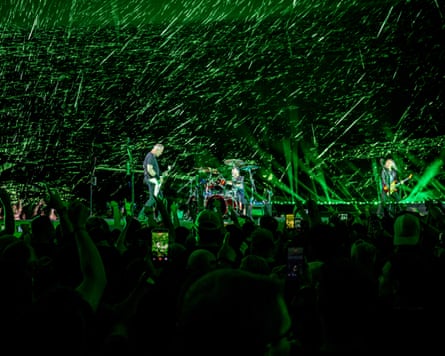
Everyone in Metallica is now in their early 60s, but it doesn't seem like it. Lars Ulrich finds new pockets to expand his driving rhythm, James Hetfield can still move his voice from gravelly-metallic snarl to full and rounded ballad, Kirk Hammett's guitar-work is intricate and unpredictable, swerving when you think he'll just keep ascending – he's undeniably one of the greatest living guitarists – and Robert Trujillo's percussive work on the five string bass adds depth to everything, gluing it all together.
In other words, Metallica don't need the bells and whistles, but they've also long been a band that loves to experiment with their live show, and sometimes their entire identity: like when they invited a therapist to help them navigate interpersonal turmoil and then filmed the whole experience and released it as the documentary-cum-concert film Some Kind of Monster in 2004, or the time they performed a show they called Pandemica to virtually no one on an empty winery during those uncertain early months of the pandemic, and then toured a concert film of the event at drive-in movie theaters across the country.
Most Metallica songs are built on constant forward-movement and simmering rage, but as they've gotten older they've peeled back the facade and revealed the self-awareness that allows them to avoid the nostalgia trap of seeming like faded versions of their former selves. Metallica's whole thing – iron crosses and electric chairs, squealing guitar solos, obsession with mortality and death and war, skulls flaming and otherwise, the aforementioned Cthulhu – still works.
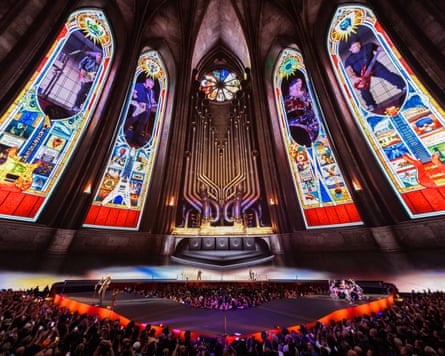
The band bookend the show with two cuts from Master of Puppets, kicking things off with a furious rendition of Battery, an ode to their early thrash roots that is also about relentless destruction, and closing things out with the anthemic title track, which is about the all-consuming pain of addiction as the walls of the Sphere morph into an immersive version of the album cover's military graveyard, with each member of the band projected onto one of the crosses. Heavy-handed? Sure, but Metallica have always been heavy-handed. That's part of the appeal.
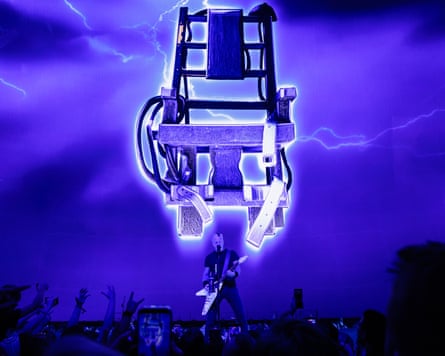
One odd dynamic about the Sphere is that the bands that play there are forced to compete with their own visuals for attention. Metallica circumvent this by dialing into their visual world. During Ride the Lightning, a song about being wrongly executed in an electric chair, the audience stare out at the band from the chair itself, the headpiece crackling overhead as if we were the ones waiting to be killed. It was frequently overwhelming and occasionally awe-inspiring, but it never fully distracted from their very tight set. Ulrich is an elastic, fluid drummer, Hetfield's voice is like a battering ram, and Hammett and Trujillo still look like there's nowhere they'd rather be than up on that stage, masters of their respective instruments.
In the middle of the show, Ulrich and Hetfield leave the stage, as the other two spend a few minutes jamming to the marching rhythm of a single kick drum. In this huge room, with sound bouncing off the curved walls, their guitar and bass tandem take on new textures, sounding full-bodied even when it gets a little indulgent or silly. While they are in a world of insular musical rapture, they are projected onto the Sphere, melting into viscous ocean waves. It feels like happening upon a 3am public access live performance that you can't tear your eyes away from because it is so weirdly compelling. A moment of warm humanity in the midst of a reckoning.
Metallica has survived this long not because they're genre shapeshifters, but because their music is so rooted in the forever resonant concepts of injustice, mortality, human violence and mistrust. During each decade they've been active, the band has taken a look at the world they live in and come to the conclusion that there's no escape, which is probably why they play like they're trying to outrun something – time, death, love, reality, literal and figurative demons – but never can quite get away. Why would they want to? No other band at this level can make anger sound so good. During Nothing Else Matters, a ballad about love and loneliness that opened up the band's sonic universe when it was released on 1991's pivotal Black Album, Hetfield asks the crowd to sing the chorus back to him, and then after the final "and nothing else mattersssss" was belted out from the stands, he responds: "You're absolutely right." A guy a few rows in front of me clutches his head, staring down toward the stage in rapture or pain or both, or maybe he is just looking straight into his own soul.
Toward the end of the show, Metallica go all the way back to the beginning with a tight, faithful version of the all-time classic Seek and Destroy, which is accompanied by footage of the band members in their early days. It's always emotional to see titans of rock grow older, but there was another layer here, too. Metallica have been part of our musical landscape for so long that it's easy to forget how innovative their early stuff was, and how Seek and Destroy in particular slashed its way through the then stagnant hard rock tropes of the '70s, giving way to the apocalyptic '80s, as a sound that was scuzzier and more nihilistic thrashed and clawed to the surface, taking hold of popular culture.
Eventually the inside of the Sphere light up flat gray. The house lights come on, Hetfield greets fans, and Trujillo and Hammett throw cups full of guitar picks into the audience while Ulrich carefully hands out a few drumsticks, presumably to avoid pegging people in the head, before stopping to shake hands and admire signs concertgoers had written. The show is over, but Metallica are still here.