For this year’s edition of Beyond the Music, the recently approinted Prime Minister “convened” the AI summit , an insurgent new-music showcase and conference launched in Greater Manchester in 2023. As one of the event’s co-founders, Andy – as he is known around here – essentially got the right people in the room for the keynotes and workshops. But many thought “convened” meant he would be giving the state of union, milling about, subject to back slaps and reprimands to keep on the straight and narrow. Maybe we’d catch him taking a stroll through the Blue Peter Garden in Salford's MediaCity.
But Burnham’s absence is a good thing. It evidences the success of the Manchester pipeline; the localised work and ideas and hope that he embodies are off being implemented at an even more influential level. In other words: we can take it from here, Andy.
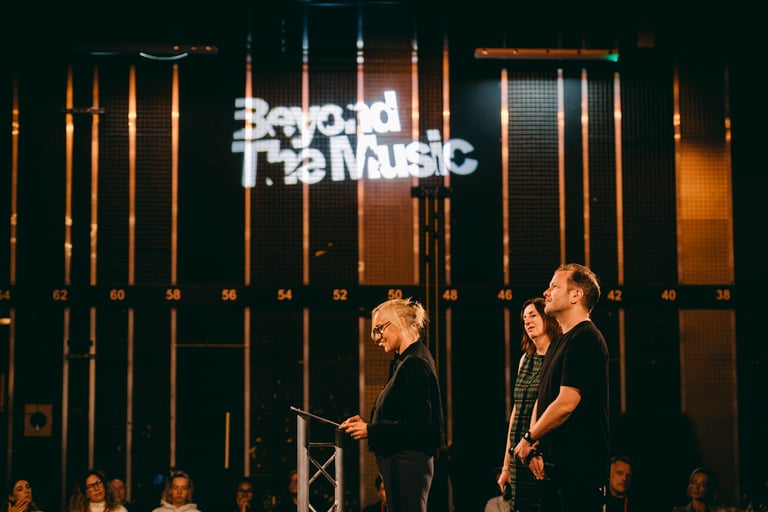
Greater Manchester has always gone with the we’ll-take-it-from-here approach. Trade unions, the suffragettes, co-operatives, the very concept of the weekend – Manchester has led positive societal developments for hundreds of years. Wisdom follows that this – Beyond the Music, newly relocated to Salford – is the place for some course correction. Areas of the creative industries are increasingly veering into unchartered territory and we’ve got fewer footholds as we compete with more and more unknowns.
The big debate circa 1844 was the price of bread. So we’re told by Rose Marley, Beyond the Music co-founder and “the real Queen of the North,” as she’s introduced. The Rochdale Society of Equitable Pioneers was founded that year with bread in mind, and is widely considered the basis of the co-operative movement as we know it – from the Co-op where you buy bread to Beyond the Music itself to any hierarchy-free, member-owner organisation.
The Pioneers’ quality of life was nosediving: arsenic in the sugar, rat poop in the flour, unaffordable bread, low wages. So, as the first wave of the Industrial Revolution was cresting, they wrote up some core principles. These included open membership, a one-member-one-vote democratic baseline, political and religious neutrality, and so on. Together, the 28 Pioneers would open their own store off a £1 per person contribution, and sell staple goods at fair prices before dividing the profits.
We are living through another of these watersheds today, Rose Marley figures – the first five minutes of a new Industrial Revolution – and thus in need of new principles. After all, those nineteenth century workers were forced into poverty due to rapid, unchecked technological advancements and the absence of guardrails. Oop. The difference today – one of them – is that things are advancing much faster than they were at the advent of the electrical telegraph.
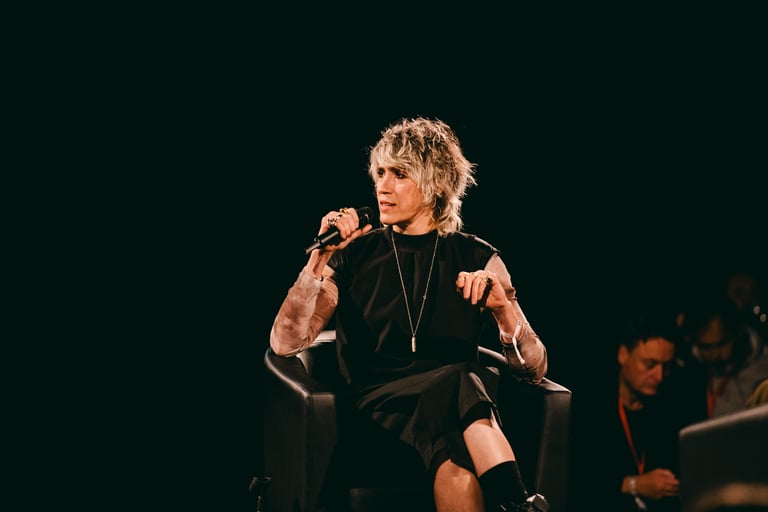
It’s a little chilling, but a dystopia doesn’t necessarily await. The on-a-precipice feeling informs every conversation – and in some cases the performances – throughout this blustery October week, even the many not directly about A.I. There’s a sense that this kind of galvanising is exactly how shit gets done.
Especially when you’ve got Imogen Heap in the room; Mayor Bev Craig in the room; unsigned artists in the room; as many representatives from major labels as indie ones; and legends like Tori Tsui – a climate advocate who works with Brian Eno to Billie Eilish. Burnham has even sent Ian Murray, the Minister for the Creative Industries, Media and Online Safety.
With so many fascinating conversations, it’s hard to know where to begin. But let’s start with Steve Coogan, who set the tone on the opening night during a keynote talk before the 24th anniversary screening of . Back in 2002, the actor portrayed Tony Wilson, the George Washington of that fertile Madchester / Factory Records era, and father of Beyond the Music co-founder Oli Wilson. “He’d probably take a bit of a dim view of all this self-congratulatory back-patting that we’re all doing, although he’d secretly like it as well,” Coogan said before the screening. “He was always looking forwards. What’s next? Be creative. Move on. Don’t look backwards. And in that way, he set the bar.” Coasting off past glories is how empires fall and all that.
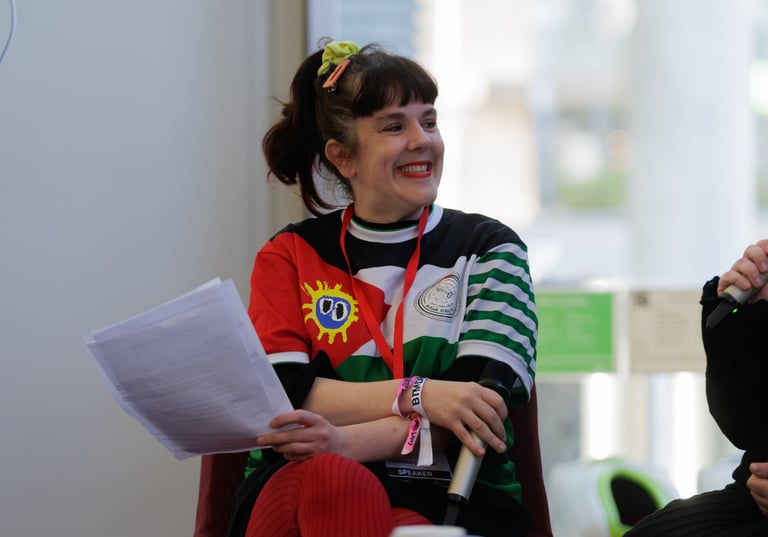
The “State of Independence” summit stuck out the next day, as Heavenly Recordings' social media manager Katherine Cantwell reminds us that there isn’t one avenue leading artists to the big time. She works with Kneecap whose appeal, in objective terms, should be far more esoteric. So why are there “10,000 kids going crackers in Australia” for Gaeilge rap? Initially, the label didn’t realise how deeply anti-colonialism had infiltrated youth culture in Australia, as it has across the UK and beyond. The music industry can still surprise you – not only in bad ways.
It’s refreshing that a label with such clout remains driven by fandom and an independent way of thinking, as she tells it, even as Heavenly grapples with their ballooning size. Indeed, it’s refreshing, too, that we don’t have to awkwardly smile away any conflict and can bring it into conversation. PIAS’ – and therefore Heavenly’s – recent distribution deal with Universal “kind of goes against the ethos of what Heavenly is,” Cantwell explains. “Artists are saying to us, ‘we’re not sure about that universal bit.’” Much like the Factory Records ethos that "all [our] artists have the freedom to fuck off," she is enthusiastic about autonomy, that artists can make it by themselves. RAYE, for example, called out her label, Polydor, for refusing to release her record until she hit certain bullshit metrics of commercial success. So she went the independent route and won, going on to take home six of her seven record-breaking nominations at the 2024 Brits.
There’s hope in the air elsewhere. One of the most striking summits is “How Music Can Save The World” with author Shain Shapiro, and the aforementioned climate campaigner Tori Tsui. The title lands at first like a hippy-dippy sentiment, but they explore the largely untapped influence music has to provoke -musical actions that can – and are – saving the world in different ways. “Music has the power to get people to do stuff that’s not musical: buy a t-shirt, write to an MP – none of that would happen without the music,” Shapiro says, and it all comes back to the emotional connection we forge with music, he thinks.
“The world-building that Björk does means that when she brings up a topic, it meets you in a different place than a scientist or politician,” moderator Sean Adams agrees. “20 seconds of an artist speaking on stage will stick with me more than a two-hour Ted Talk.” Likewise, as Tsui puts it, “what Billie Eilish says ,” with her fans completely entranced by the singer’s every word. This is a positive thing if it’s Eilish – who calls out billionaires, and advocates for the climate – but it raises concerns about less principled artists wielding such influence. Still, the point stands that music is a resource for change in ways more tangible than we’re-all-in-this-together singalongs, the extent of which I hadn’t appreciated before.
This is especially clear when Shapiro cites some more practical examples, such as Heidi Lenffer’s work. The vocalist/keyboard player for Australian rock band Cloud Control joined together with some collaborators and funnelled her tour profits into a solar farm. One thing led to another and the farm eventually spawned a programme that raised millions of dollars to invest in sustainable battery technology for festivals. She also worked with an Aboriginal community in Tasmania to buy and restore a bioreserve, and is now one half of the leadership team behind FEAT., whose mission is “reshaping the environmental legacy of live entertainment.”
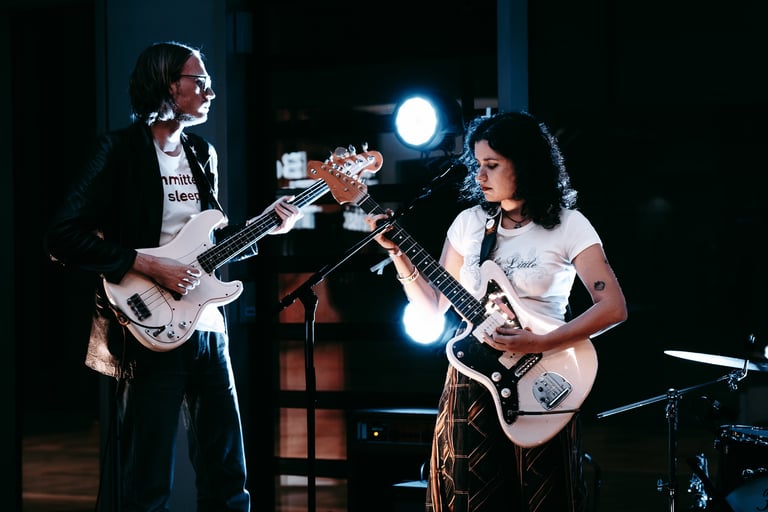
All of these talks are hosted in MediaCity's Dock10 studioes, built on the site of the former ship canal docks. By night, the spaces are given over to rising stars such as the drones-and-dance M.O. of folkmodern Irish quartet The Wran, the magnetic showmanship of Sunderland’s Tom A. Smith, and hometown rock-revival heroes The K’s, whom BBC 6 Music’s Chris Hawkins introduces as “the best live band on the planet.”
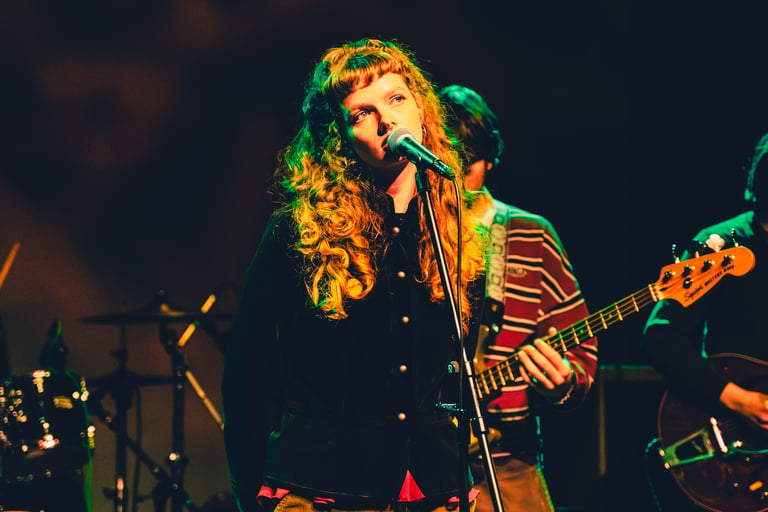
, a fun-grunge quartet of weird-tuning pop contortionists led by Amber Warren’s dreamy vocals, tell me in no uncertain terms how rich the Manchester scene is: it’s exploding, everyone’s friends, we’re spoilt for choice. They shout out fellow locals on the bill, including Holly Head and Cutscene, but express reservations about Beyond the Music’s move to MediaCity. The historical venues of the Northern Quarter – where Beyond the Music’s showcases took place in 2023 and 2024 – grounded the festival in what makes Manchester fun, they say. This year, “it moved away from where the music actually happens.”
I agree: there should be fewer showcases happening concurrently in order to drive splintered industry crowds into one place – and thus get more ears in front of not only the buzziest bookings, but the smaller, equally worthwhile underdogs. Besides cruush, standouts include the wobbly-horizon desert-psych sounds of ; the entrancing LaunchPadding of , which lands somewhere between Moin, The Postal Service, and Overmono; and , who knows how to win over a conference crowd with her charming, bouncing-off-the-walls Pantomime punk.
The showcase element isn’t Beyond the Music’s headline, though. That would be Friday’s unveiling of The Manchester Principles: guidelines for how to move forward into this new chapter defined by A.I., hyper-commodification, and the massive consolidation of power brokers – from Spotify to the Big Three majors. The hope is that everyone present will take these away and apply them in their own niche area of the industry.
1. Working together: we start from what we share, and talk in good faith.
2. Fair value: if your work makes the money, you get a fair share, big or small.
3. Respect for creators and their works: ask first, give credit, treat people and what they’ve made properly.
4. Investing in the next generation: skills and chances for those coming through.
5. Open to all: everybody’s welcome; you don’t need to agree on every detail to have a seat.
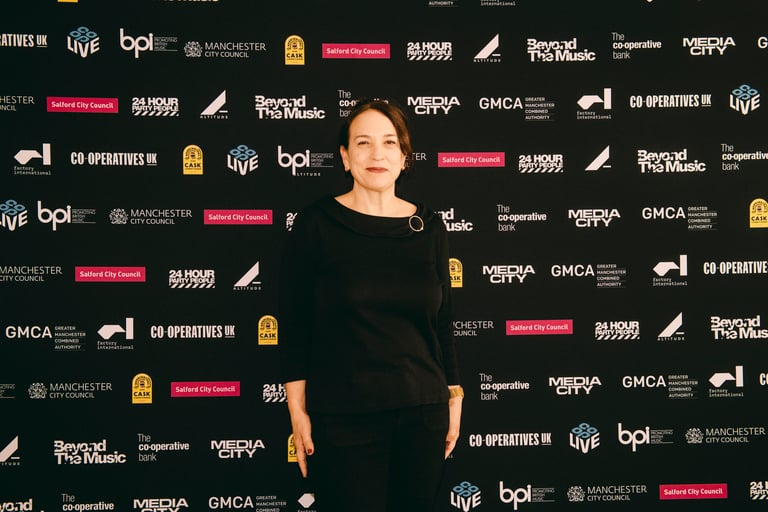
Just as Oli Wilson – son of Tony and Beyond the Music co-founder – wanted to marry the scruffy side of rock and roll with the changemaking aspect by screening 24 Hour Party People on the opening night, Neuman, for me, represents a bridge between boardroom-industry and DIY art.
Neuman also helps me consolidate dozens of hours of lofty word-salad conversations that can leave you wondering where to start, how to get meaningfully involved: “Any opportunity to come together as a music community, no matter how experienced or early in your career you are, creates a chance for learning and connecting, which is crucial in our increasingly siloed and digital lives,” she tells me. At the same time, she admits that not every conversation is going to be world-changing, and it’s okay to disagree: “It’s important to think critically about what’s presented, to listen between the lines and know when things are talking points – even from me! – or when they are valuable and insightful. I always love it, no matter how big or small.”
So the price of bread wasn’t lowered this week; there are still some rat droppings in the flour. But the most important thing, at least in the first instance, is getting in the room together. Beyond the Music enables that and then some.