omething strange has happened with Lupin. Two years after the French jewel heist thriller's third season aired, its series one plotline played out in real life, in the form of a global news story turned viral sensation. The Louvre heist of 2025 happened by day – while Lupin's main character Assane Diop (Omar Sy) stole jewels from the Louvre at night. The real-life robbers posed as construction workers – Diop posed as a caretaker. You couldn't help but draw comparisons.
So it returns for the fourth series with a salience the makers could never have predicted – amid a renewed appreciation of the power of a cleverly crafted disguise to dupe even the world's most revered cultural institutions.
Things are higher-budget, higher stakes and more cinematic from the title card onwards. The show's central question seems to be: what happens when a mastermind finds themselves a victim of their own intelligence? We meet master criminal Diop, four years after he surrenders to the police at the close of the third season, in a maximum security prison. Diop is a week away from release, hoping to fulfil his fatherly promise to put the life of crime behind him and join his family in Senegal, when technology across Paris is hacked, and warnings of imminent heists signed with the name "Lupin" appear. Things are not looking good for Diop, who has modelled his life on fictional master criminal Arsène Lupin. He is swiftly straitjacketed and locked in a panopticon-style glass cell, allowing surveillance and mockery by prison guards and prisoners alike. We are only 12 minutes in to episode one. I repeat, things are not looking good.
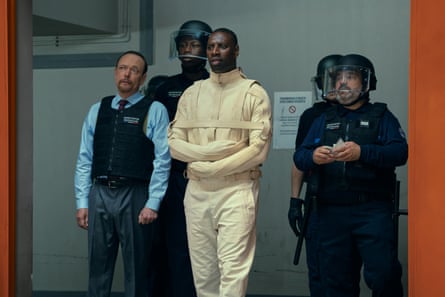
Diop's Blackness has often served as his strength – the racial stereotypes still rife in supposedly "colourblind" France allow him to camouflage as a janitor or delivery person for his crimes. But when he becomes a suspect, his racialisation is his downfall; blurry security footage shows that a robber was a Black man, which is taken as unequivocal evidence that Diop is guilty.
So Diop is hoisted by the petard of his own notoriety: despite being imprisoned in a high-security facility, the police still believe he was somehow involved in the jewel theft. He must have found a way to become invisible, to break out. He is implicated in a crime that doesn't seem to bear his fingerprints, before it even happens.
Lupin eschews exposition and offers up Houdini-style thrills right from the start. I find myself wanting to believe that Diop is not responsible for the robberies, but it is hard to know what to trust in this show. The twists have been relentless: last season concluded with Diop's nemesis, Hubert Pellegrini, revealing himself as the secret mastermind behind much of the series' conflict.
Lupin asks complicated questions about what it means to attempt to leave things behind when you have achieved a certain level of infamy. Other thieves (in the show and in real life) become copycats. To those investigating, it becomes unthinkable that anyone else could have pulled this off. Yet Diop is no longer the puppet master – now, he is at the mercy of others. "I want to be done with Lupin once and for all," he remembers telling his son. But there is an irony here: Diop embarked on his life of crime to avenge the death of his father, who was falsely accused of a jewel theft. Now, Diop finds himself falsely accused, while the potential impact on his son hangs in the balance.
This is all compelling enough to justify another series of the Netflix hit, which has been subject to delays that some fans have bemoaned as making it as drawn-out as the end of Stranger Things. Much like that show, Lupin has been scaled up from a five-episode series to eight. Sy, whose performance is magnetic as always, has graduated to co-showrunner and wants to lean harder into the show's "superhero"-like qualities. These include tech and set pieces which undoubtedly add a sprinkling of Marvel.
Certain moments do feel over-dramatised – and it relies on that cliche of the old pro getting roped back in for one last hurrah. But will Lupin manage to shapeshift from a French drama punching above its weight on the global market to a big-budget thrill-ride? Watching on Netflix's default US English setting (which is sacrilege, anyway) would certainly tip this Hollywood feel over the edge. Make sure you switch to French.