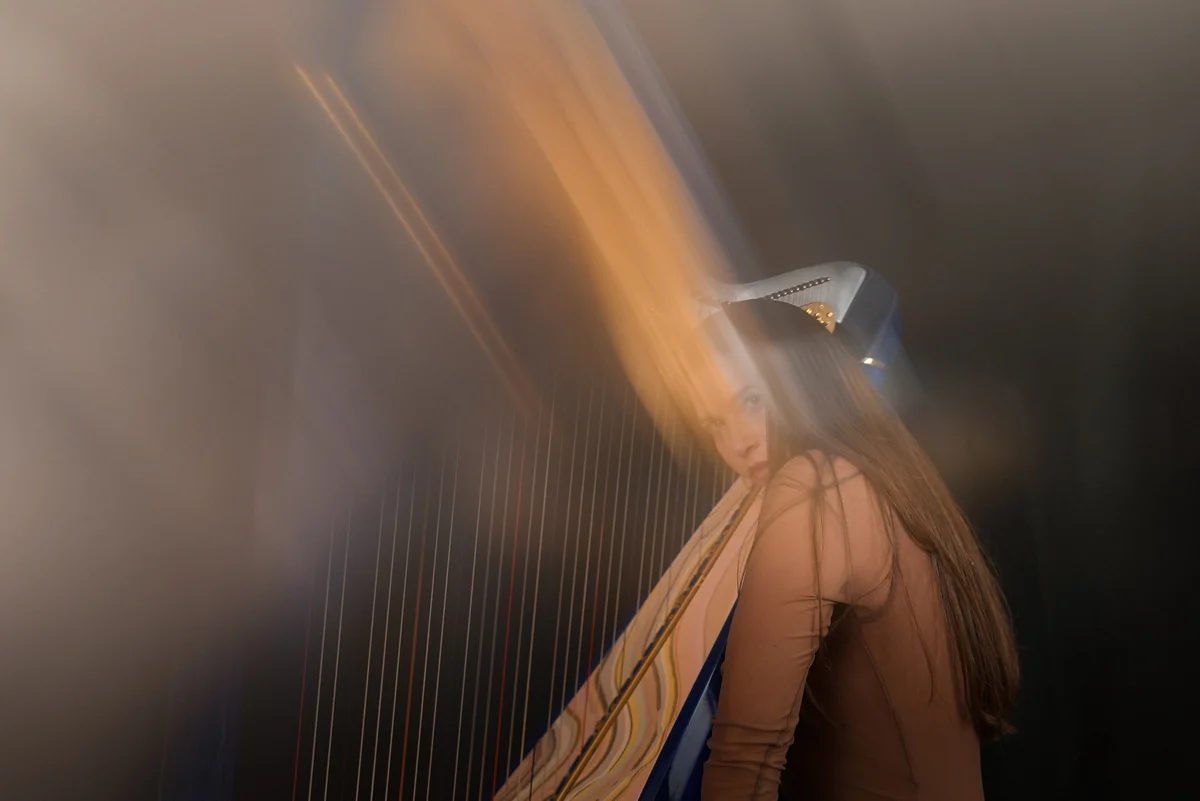
The album, then, is a dialogue with spectres of herself as well as with time, because despite ceding some autonomy to these pedals, she is still the one who’s feeding them – twisting the dials, twirling fingers around strings. “There’s a difference between sitting with the perceived passage of time, or actually being active in it and sensing it.” The second track, “Sojourn”, she cites as a counterpoint to that floaty, friendly opener and demonstrative of the pedal effects. The composition’s quivering glitches are reminiscent of stepping into a butterfly conservatory. Rich, romantic swells like a whale’s slipstream are provided by the London-based string section that features across the record, another break from the harp-only rule she used to abide by.
Even though there’s a practical, technical angle to all of this – programming the division of notes on the delay pedals, say – the way Somogyi experiences time, how she , is fluid and free. “There’s nothing about time that’s numerical to me. It’s all sensory. It’s all based on how you’re experiencing things. It’s like: how did it smell that month? The summer that smelled like fresh grass. What was the sound through the trees in that moment?”
That’s how the album feels when you sit with it: divorced from technicalities and content with serendipitous, shapeshifting half-truths. The dream-sequence glissandos of track 5, “elsewhere”, morph into a trigonometric arpeggio and rhythmic pulsations that come and and go. There’s a gorgeous paranoia to “sitting circle”, a collaboration with arranger Rob Moose, who played on Sufjan Stevens’ and has worked with Phoebe Bridgers and dozens of other indie A-listers. “intimacy gradient”, my favourite, feels so suspended and in-between, like you’re being presented with hundreds of previously inconceivable possibilities. It sounds like she’s holding a vibrating tattoo gun to the strings, which scuttle and stutter asymmetrically.
Certain ambient music unfolds under your nose without your realising; a [time] patterned is consistently engaging without requiring anything of you.
And when you listen, you’re listening with Somogyi, sharing a vantage point. She explains how, for her, composing isn’t over-intellectualised; some of her music could have been made in a dream state. “A lot of it is purely out-of-body. I do sit with it a lot while I’m making it, but then I’m able to release it and then listen and watch it as an observer.” She doesn’t self-critique after the fact either, letting it be. “I’m just really happy and grateful it’s out in the world, because it was something that I said through my fingers, through something else, through the harp, through the electronics. It feels kind of rather than thought.”