an they do it again? The runaway success of the Bayeux tapestry has put the British Museum in a league of its own, perhaps making it, at this moment, the leading museum on earth – and it's rapidly following up with Korea, a survey of "2,000 years of creativity" in a land that, before its sufferings in the 20th century, enjoyed millennia of calm, at least to judge from its art. But it's a blockbuster with a tragic flaw, a lovely broken vase badly stuck together.
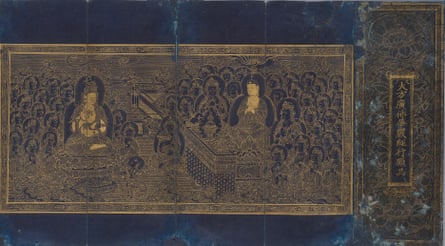
You are lured at first into a nirvana of beauty. A giant bronze bell from a Buddhist monastery, cast in the eighth century AD and bulging with dragons, flames and flowery embossments, strikes the tone. It calls you to meditation. A gong adds to the harmony (and if you need that underlining, there are bells and gongs on the now obligatory exhibition soundtrack). I was held rapt by this Buddhist period in Korea's history, when the contemplative religion from India interacted with the artistic influence of China to inspire ecstatic hand-copied sutras (spiritual scriptures) and slender little statuettes of bodhisattvas (Buddhist saints who have achieved enlightened holiness).
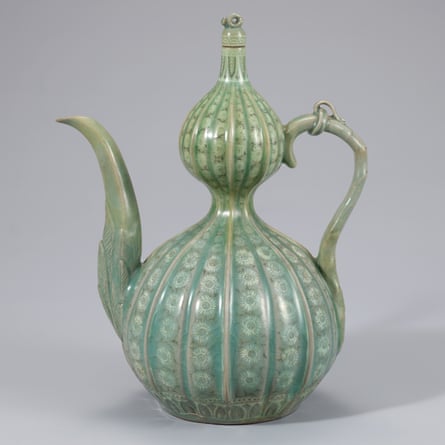
Yet even before Buddhism brought its ethereal aesthetic, the resourcefulness of artisans in the Korean peninsula was staggering. Intricate stoneware objects from as early as the fifth century include a horse standing on a circular plinth with a drinking horn balanced on its back – a practical object of wild beauty. Ceramics came to Korea from China but took root in creations of fantastic originality. The kingdom of Goryeo, which unified the peninsula from 918 to 1392 and made Buddhism the state religion, sponsored superb courtly ceramics. Potters adopted the green glazed stoneware, celadon, from China's Zhejiang province and perfected it in smooth pale green bowls and vases that soothe your soul.
A flair for exquisite earthenware continued under the neo-Confucian Joseon dynasty, which ruled from 1392 until, astonishingly, 1897. The most captivating pot from this era is a huge, white, near-spherical moon jar made in the 18th century. It's an intoxicating blend of scale and geometry created by throwing two semi-circular bowls and joining them together. You can see the imperfect, dimpled join, cherished in Korean culture, which adds to its uniqueness, its personality.
And then the spell is broken. The show shifts forward suddenly, brutally, into some so-so early 20th-century Korean art. Modern pastiches of traditional art mix awkwardly with European and American-style modernism from the 1900s to 1950s. Why this lurch, just as you were starting to grasp the subtle shift from Buddhism to neo-Confucianism and how their aesthetics differ? The blockbuster cultural history of Korea falls apart. It's just a collection of things, after all.
In fact, this is, with a few additions, the collection of Lee Kun-hee, who was the chair of Samsung – the exhibition's "corporate partner" – until his death in 2020. It's a fine collection. Several works here, now owned by South Korea's leading museums, are national treasures of unique significance. But a collection comes with its owner's idiosyncrasies, and cannot be taken as an objective history of a people's art and beliefs. It is not very insightful about the modern history of Korea: where are the photographs, news stories, popular imagery, if you want to tell that story? Instead the show shrinks into a display of elite art. Fair enough if it was simply presented as one collector's taste.
The 20th century was a brutal period for Korea: from 1910 to 1945 it was colonised by the Japanese empire but the cosy modern paintings here say nothing about that. More mention is made of the Korean war that killed three million people. A desperate, cartoon-like pastel by Lee Jung-seop of a fisher being welcomed home by his family is an unfulfilled dream: this artist became a migrant in the war and died before ever seeing his family again. Another roughly drawn work by him shows naked bodies tied up in a chilling glimpse of the horrors of that time.
That grief, chaos and cultural loss – with Korea still divided today – is only slightly evoked. What stays with you is the lost harmony of the past, when scholars and monks meditated on nature and its beauties. The work of art that most gloriously responds to Korea's landscapes is Jeong Seon's hanging scroll Clearing After Rain on Mount Inwang. Done in ink on paper in 1751, this more than metre-wide view takes you into a fresh, atmospheric encounter with nature: a dark mass of mountain hangs over the scene while trees are evoked as rapid moist blurs. It is not idealised but spontaneous. You wonder what Jeong and his faraway contemporary Thomas Gainsborough might have made of each other.
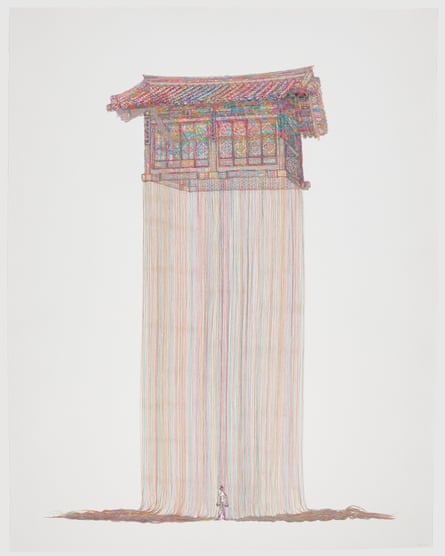
Perhaps the broken feeling of the show, in which there is no link between past beauty and modern violence, tells us a tragic truth. The very last object implies this. Do Ho Suh's 2019 self portrait, owned by the British Museum, depicts the artist as a tiny figure under a cascade of multicoloured threads streaming down from a floating image of a traditional Korean house. The grace of this world holds you in this exhibition and you feel its vanishing as a personal loss, wherever you come from.