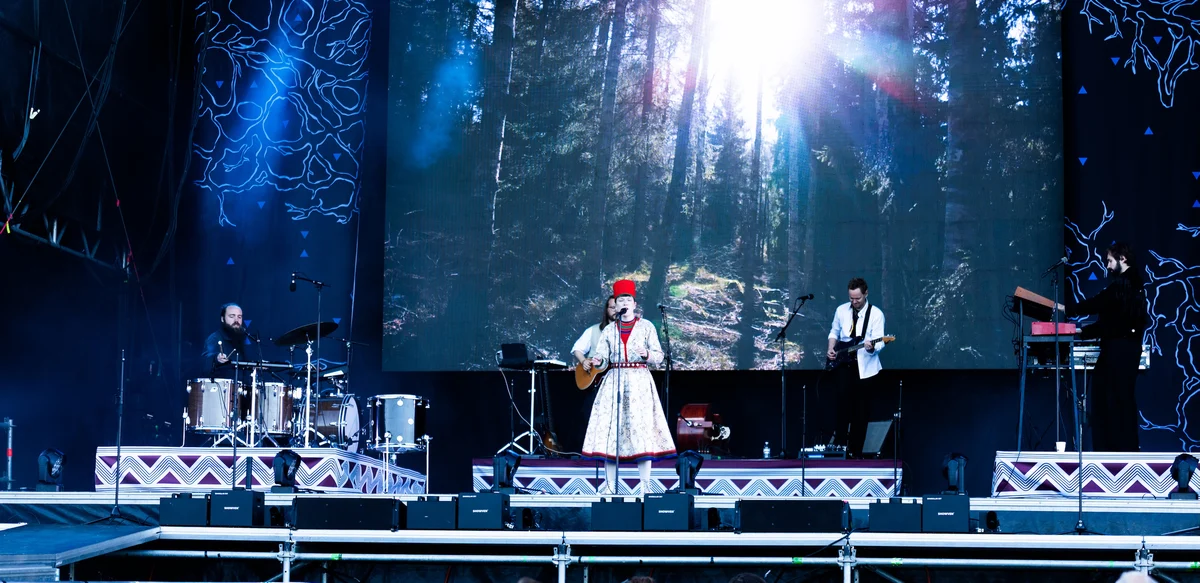
Some of the pieces she performs are modernised versions of century-old joiks, glossed with atmospheric synth pads, wandering bass lines, and thumping, body-jerk percussion. One, “Umealven” – “Ume River” – channels the river where she grew up. She tells me how she never knew the river before hydroelectricity development. It now has 13 power stations. “When I joik, I can see how it was when it was running freely.” She’s never actually it, but “the joik is also a way of remembering. It sort of tells the state of that person or place in that time.”
One of Marja Mortensson’s performances is a joik of her grandmother, named Malages, or – if I misunderstood that in translation – she certainly talks about her. Mortensson, from Innlandet county in southern Norway, would accompany her grandmother on journeys through stories, she tells the audience, Malages passing down tales of reindeers and rivers and songs.
“We carry the knowledge forward,” she says. And that’s kind of the whole point: the first book ever published in any Sámi language was in Ume Sámi, back in the 17th century, so Barruk and her peers are extending the Ume Sámi peoples’ long history of documentation and preservation. If not them, who else is going to do it?
Barruk tells me about how artists such as herself, Mortensson, and Stenberg – the latter a renowned joiker who’s singing for the first time tonight – have been forced to become more political, because “you fight for your culture on a daily basis.” There’s almost an inherent politicisation to everything they do. Whereas traditional joiks would centre on people and nature, now, there are other things they must discuss and put focus on through their art or the discourse around it.
“We see it now, with the right wing going over all of Europe, and also Sweden and Norway, that it becomes harder to be Sámi, unfortunately. That is a reality that we live in. But I wanted to make music from a human standpoint. I can make whatever music I want to. But now as I get older, it becomes a little more political.”