must admit, I was apprehensive about meeting John Cena. The WWE wrestler turned actor has built an enviable Hollywood career playing idiots – capable idiots with real heart, but dimwits nevertheless. Still, Cena is obviously nobody's fool; fools don't rise from humble beginnings to become their generation's answer to Hulk Hogan or The Rock. Would the Cena who appears on my computer screen be the real one? Or something closer to the comic-book characters he embodies so well: guileless, silly and fond of a deliberate misunderstanding?
John Cena is a company man. The word "loyalty" comes up often, and about everything from his friends back home to the wrestling to the US itself. Admirable, no doubt. But Cena's loyalty has drawn him into some uncomfortable positions, and for 20 minutes our good-natured chat about reliability, discipline and what it means to owe everything to something bigger than yourself has set us on a collision course with one of the most disgraced figures in modern entertainment.
In January 2024, Vince McMahon, the all-powerful chairman and CEO of WWE, resigned from the organisation and its parent company TKO Group Holdings following a slew of sexual assault allegations and pending lawsuits that made his position in the company he'd spent his life building untenable. The final straw was a suit filed by a former WWE employee, Janel Grant, alleging that McMahon sexually assaulted her and pressed her into sexual acts during her time at the company, sent explicit images of her with other men without her consent, and passed her to others – in one instance, the filing says, to help secure a wrestler the company hoped to sign. McMahon denies all the allegations and in June, the litigation between him, the WWE and Grant was transferred voluntarily by all parties from the federal court into confidential private arbitration.
McMahon was a mentor to Cena, and as well as sponsoring his career, provided him a second family amid the travelling circus of 00s wrestling. "I have no guilt nor shame about my friendship and my relationship with Vince McMahon," he says, swiftly followed by "you're obviously going to put this in [your] article". He's right, of course. What is strange isn't that he foresaw this line of questioning – it's that Cena took such an unequivocal stance in the face of something so potentially damaging. He is audibly proud of the association, revelling in the idea that he's abiding by his principles in the face of what he calls "the storm". "It's OK to love somebody when they're not perfect," he says.
ena was born in West Newbury, Massachusetts, in 1977, one of five boys in a household that watched every dollar. His grandma and grandpa lived in an adjoining house. "There was a lot of 'How are we going to pay the bills, how are we going to keep the lights on?'" Cena says. He worshipped the movie action men of the era – Schwarzenegger, Stallone, Willis – but he also loved hip-hop, which in suburban Massachusetts made him a target for bullies. Bodybuilding was the answer, and it doubles as an origin story – the boy bullied for dressing like a white rapper, growing up to become an icon for the next generation of suburban youth.
Still, when I raise it, Cena is quick to correct the emphasis: the bullying wasn't the point; his response to it was. "I didn't treat hostility with hostility," he says. "I got bullied for the way that I dressed, so I dressed more outlandish." The muscle was a visible deterrent. "I'll just project a physical sense of: Man, I don't want to press my luck with that guy," he says.
After college, he drove to California in 1999 with about $500 to follow Schwarzenegger's playbook to bodybuilding glory. He worked on the shop floor at Gold's Gym in Venice Beach for six dollars an hour, and for a stretch, slept in the back of his 1991 Lincoln. A wrestler who worked out at Gold's steered him towards the industry and in 2000 he made his debut in WWF (now WWE) as The Prototype, a robotic character whose deliberate speech was a clear nod to his idol Arnie. He was paid $250 a week "which meant I spiralled into debt". To Cena's credit he understood that the short-term loss had the potential to lead to long-term gain. "I've been pretty astute at understanding when luck arrives," he says.
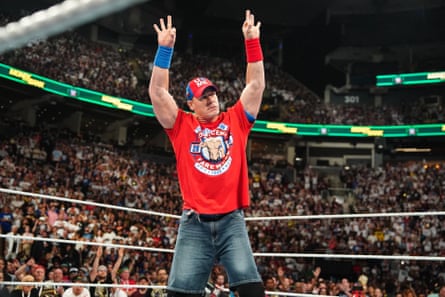
What followed was a 24-year stint as a WWE superstar, a period Cena describes without irony as "service". "You can't fake that," he says. "If you're in the business of bullshit, somebody's going to see through it." He stumbled on a character that stuck: a jersey-wearing, battle-rapping white kid from Massachusetts, who literally went by the name John Cena. Despite some distrust from fans – over his general clean-living, wholesome persona – and fellow wrestlers who initially ostracised him for not engaging in the hard-boozing that was par for the course, the gimmick worked. In fact it was so successful that it led to theslightly odd ongoing situation where Cena doesn't own his own name.
"John Cena is who I am as a human being," he says, "and there is a company – WWE/TKO – that has invested hundreds of millions of dollars in the intellectual property of the character John Cena. And rightfully so; they have earned their share of ownership of that." In Cena's words he read and understood the agreement and he thought it was fair. However, the lingering sense that a career at the top of WWE requires a deal with the devil prevails (Dwayne Johnson only got his own moniker, "The Rock", back in 2024, and now sits on the board of TKO). But Cena explicitly rejects the idea that he has had to make sacrifices along the way. "I prefer to use the word choice … When we say yes to something, we say no to everything else." In effect, he gave up his name for the rare chance to live his dream.
And for more than a decade he did. Cena was beloved throughout the 2000s and early 2010s primarily as an avatar for a certain brand of flag-waving, white masculinity that was firmly in tune with the climate of post-9/11 America but is maybe less so now. Donald Trump was a recurring presence in WWE during this period, memorably shaving McMahon's head after besting him at WrestleMania and even "buying" flagship brand Raw as part of the pair's staged rivalry. The DNA of today's toxic masculinity can be seen in the WWE's Attitude era: Muslim performers were painted as would-be terrorists; female wrestlers, known as "divas", were sexualised, fighting in "bra and panties" matches; and scandals around steroid abuse and traumatic head injuries were raised in lawsuits.
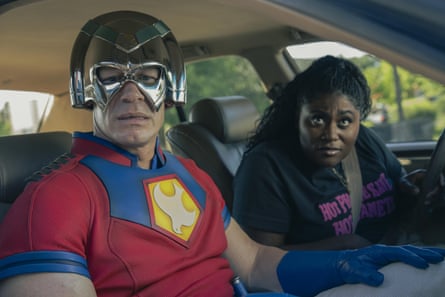
The miracle of Cena's career is that the man who spent a decade as the straight-faced embodiment of American masculinity proved to be equally good at sending it up. After a handful of underwhelming action and sports film roles, he was cast against type by Judd Apatow for the 2015 romcom Trainwreck, playing a musclebound hunk whose attempts to be threatening just sound homoerotic. Then as the pumped-up Peacemaker, first in superhero movie The Suicide Squad (2021), then in the comedy spin-off series named after the character, Cena managed to strike a balance between serious man and silly goose that would be tricky without a healthy amount of self-awareness. This quality was on full display during Cena's small but charming turn as a merman in Barbie, a commitment to the bit that was all the more admirable given his agents tried to talk him out of the role.
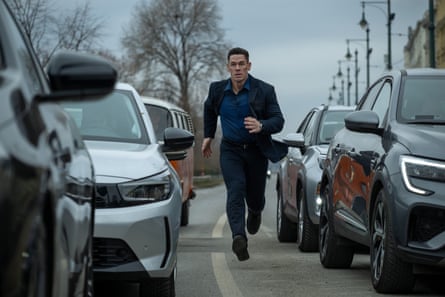
atchbox, his latest film, is a vague attempt to recapture Barbie's magic in the more contained format of a traditional action comedy. Cena admits feeling relieved when he read the script and found the cars to be "so far down the list of things they were doing with the IP". He plays Sean, an undercover operative whose entire life is a performance. When I wonder aloud whether the part sits close to the bone, he eagerly connects the dots himself: "How does someone who thinks they're always being watched act in a public place? That I got a little bit of familiarity with."
Cena's onscreen persona is an intriguing model of masculinity: the strongman remade as softie. What's more, his wall-to-wall presence in the childhoods of millennial men makes him a far more credible advocate of positive manhood than a Joe Rogan or a Jordan Peterson. But he is reluctant to assume the mantle. "Rather than trying to take the reins of a movement or be the poster child for something, I'm just trying to be me," he says, before offering his own diagnosis of why so many people are in the business of selling a personal vision of masculinity. "The appetite for a certain kind of manhood is just supply and demand," he says. To the people clamouring for it, "my advice would be: go get it".
Perhaps Cena's lack of desire to be cast in the role is emblematic of why it would suit him. The system, he says, "is real fragile … if I say I'm going to be the showcase of masculinity and the supply-and-demand chain pivots in five minutes, I'm shit out of luck." He is keen to underscore how much he "loves the United States and admires its military force that makes the vow to, under the ultimate sacrifice, protect that piece of paper that says 'We the People'. To me, that's extremely heroic."
Cena's own heroism came into question in 2021 when, while promoting Fast & Furious 9, he referred to Taiwan as "a country". The Chinese audience took offence, and he filmed a contrite apology in Mandarin, a language he had been learning for six years in an attempt to grow the WWE's presence in China. In the US, the grovelling video read less as an apology than a capitulation to the weight of China's economic might. The fan backlash was so intense that he told James Gunn he'd understand if he had to be fired from Peacemaker. He takes full responsibility for the episode. "Just because you know the language doesn't mean you know the culture," he says, admitting, "I got way too overconfident. I thought I was the smartest guy in the room." Part of what frightened him was the very real possibility of "the termination of employment that I love". The same reflex to remain loyal to the brand has carried him, without complaint, to numerous events in Saudi Arabia. "WWE offers a universal language of diplomacy," he says. "So, to your question of: 'Hey, the thing that you're in is sometimes criticised for the moves that it makes as an entity – is that difficult?' Of course it is, especially when you believe in the entity."
or a man who prides himself on saying yes, it is revealing what he has time and time again said no to. Cena does not want children, and the reasoning is entirely in keeping with his sense of discipline: they'd simply require too much of him. From 2002 to 2015 he was home "about 15 days a year and even now it's maybe 70", he says. "If I said yes to children, I have to say no to everything else." His engagement to fellow wrestler Nikki Bella – his co-star on the reality show Total Bellas – collapsed in 2018, in large part over whether to have them. Cena, who'd had a vasectomy, offered to reverse it, but the relationship ended shortly after.
"I really enjoy my life," he says. Cena has granted more than 650 Make-a-Wish wishes, more than anyone alive. He sees his ability to do so much work for the organisation as inextricably linked to being child-free. "If I have a family of my own, I don't have those 650 moments … I'm flying with just my partner on this one." Cena married Shay Shariatzadeh, an Iranian Canadian tech product manager, in 2020, after meeting in Vancouver while he was shooting a film. They had only been together a year but he's said he would have proposed after three months. "I have a loving connection that people don't see," he says. "I don't need the world to totally know me as a person."
He remains on the WWE's books as a "brand ambassador", a reflection of his gratitude to the company, but also an unresolved transition back into civilian life. Next up, he will star in One Attempt Remaining, a comedy from Kay Cannon (director of Blockers and the writer-producer behind the Pitch Perfect series). He plays one half of a divorced couple who is forced to team up with his ex in order to track down the lost password to a crypto account worth millions. Whereas Dwayne Johnson has become a brand bigger than his wrestling fame, you get the sense Cena will never fully escape his WWE persona, his screen performances a callback to the exaggerated version of himself he's been playing since 2002.
Perhaps that's what it is to be a company man: not an empty suit or a servile mouthpiece but a person so thoroughly committed to the brand it is simply who he is. Present, punctual, polite and perfunctory. The job is done and it's back to the gym.