ne morning in February this year, I opened my laptop to find an email with an all-caps subject line: TOP SECRET. Being a fashion editor can be exciting but state secrets are not generally my beat, so I was intrigued. Sure enough, it was a thrill: an invitation from the Fashion Museum Bath to choose their Dress of the Year for 2025.
What an honour. Dress of the Year began in 1963, the brainchild of the museum's founder Doris Langley Moore, as a way of keeping a static collection perpetually current. Each year a fashion expert picks an outfit or outfits that capture the year just gone, and these become part of the permanent collection. There is a Mary Quant dress and a Katharine Hamnett slogan T-shirt, Ossie Clark chiffon and Ralph Lauren pinstripes. There is sublime beauty from the catwalks of Yves Saint Laurent and Chanel and John Galliano, and pieces of cultural history: McQueen's bumsters, Jennifer Lopez's internet-breaking green Versace Grammy dress, Dior's "We Should All Be Feminists" slogan, Naomi Campbell's pandemic hazmat suit, a Black Lives Matter T-shirt, and the dress worn by the Duchess of Sussex for her Oprah interview in 2021. "Dress" is interpreted loosely, in the sense of clothing rather than a frock: the lineup includes men's suits. The Bath museum is currently mid-revamp, having closed its doors in 2022, with construction soon to start on a new museum set to open in the city's old post office in 2030. Meanwhile the collection is stored in Wiltshire and can be seen online.
The roll call of previous selectors is formidable. All the front row grand dames are present and correct. There are Vogue editors and Fleet Street's most feared critics. Legendary stylists, including Grace Coddington and the late Isabella Blow, iconic retailer Joan Burstein and beloved London milliner Stephen Jones. The protocol of Dress of the Year is singular, in that the museum chooses the chooser, who then has complete freedom. The thought of my fashion verdict being preserved on a pedestal in a glass case forevermore, rather than printed on the proverbial fish and chip paper, was daunting. I experienced a swift emotional gear change from "chuffed" to "mildly panicked". Plus the schedule – decision made in spring, selector announcement in summer, and DOTY revealed in October – gave me well over a month to make my choice, a timeframe which my daily-deadline-institutionalised brain found more overwhelming than liberating.
But I knew what I wanted to do. Most fashion journalists are current affairs journalists at heart, I think. Fashion expresses what it feels like to live in the world at a particular moment. An eye for fashion is essentially a curiosity about that, because the clothes we wear speak to what seems beautiful or important or valuable to us. This is where the juice is. So I wasn't interested in making a best dressed list, or awarding a prize to the prettiest frock of the year. I wanted my choice to tell a story that would help future museum visitors understand the fashion and culture of 2025.
The trouble is, once you decide you are choosing a piece of history rather than a dress, almost anything is eligible. Lauren Sánchez Bezos' girls' trip space suits? The Birkin that sold for $10.1m? Naomi Osaka walking on court in a kimono? A Labubu?
Well, no. What I chose would form part of the permanent collection of one of Britain's foremost fashion museums, so it needed design credentials of its own. In other words: I was looking for a great look that told a great story.
2025 was the year of the "naked" dress. Dresses that made headlines did so by their virtual non-existence. Margot Robbie on the red carpet in strategically covered strings of crystals – not so much a dress as a very impressive necklace. Julia Fox in transparent mesh, her long dark hair trapped beneath it and preserving her modesty a la Botticelli's Venus. Zoë Kravitz at the Oscars in a black dress with a heart shaped window framing her bottom.
Fashion has always been partly about sex, but the naked dress is different. The naked dress is about the body, not the bedroom. Fox's dress is not alluring: it is confronting, verging on repellent. At a moment when women's bodily autonomy is once again fiercely contested in the US, and when cosmetic surgery and GLP-1 usage is physically transforming celebrities in front of our eyes, bodies are more political than ever.
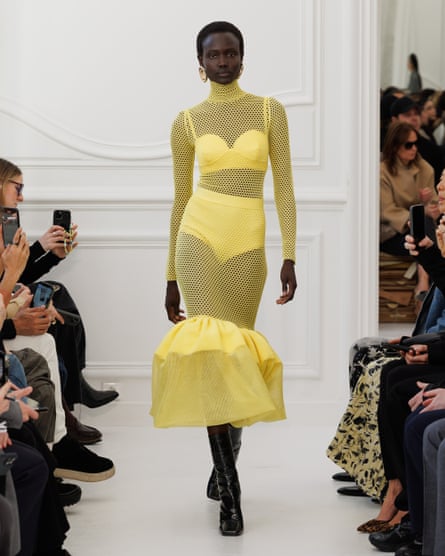
There is female empowerment here; there is also subordination to the male gaze. Both of those things are true at once. But I chose a naked dress by Sarah Burton, who I have known and admired since she was Alexander McQueen's right hand woman in the late 1990s. Burton is cherished in fashion, a woman who celebrates rather than objectifies. The daffodil coloured sporty mesh dress with visible retro underpinnings that I have chosen is from her first collection for Givenchy – a significant moment in itself, at a time when female creative directors are thin on the ground – and suggests a dialogue between fashion past and present that felt perfect for the assignment. Also, the kicker hem makes me smile, and the sunny shade will look terrific on a mannequin.
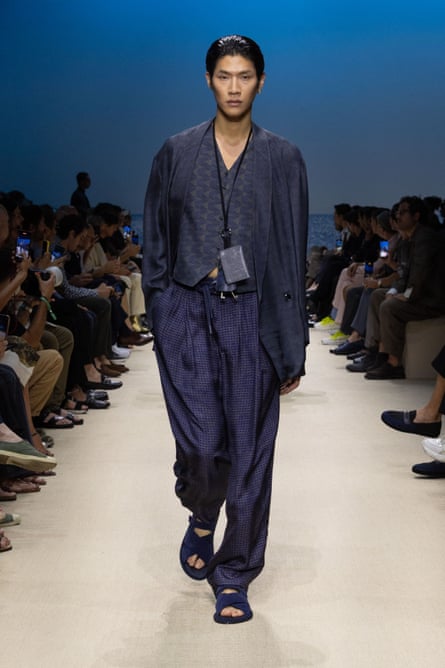
As for my menswear choice there was never any question. The death of Giorgio Armani in September 2025 was the loss of a giant not just of fashion, but of culture. Armani changed what it meant to look modern. He invented the smart-casual mode of menswear that dominates cities all over the world today. In so many ways, he was decades ahead of his time. He pioneered gender-fluid dressing, putting women in trouser suits and men in sensuously draped silks. He always believed that fashion should be about timeless style and clothes made to last, and deplored the churn of trends and fast-fashion. He stuck to this point of view through decades when it put him at odds with the rest of the industry; these days, everyone acknowledges that he was right all along. The ensemble I picked – soft shoulders, fluid fabrics, layering that looks effortless but immaculate – comes from the last collection Armani designed, shown on the catwalk at an emotional, elegiac show in Milan a few weeks after his death.
Last year was the year of California wildfires and Zelenskyy's Oval Office showdown; the Louvre heist and the first American pope; the rise of Reform and Euros triumph for the Lionesses; victory for Zohran Mamdani and the assassination of Charlie Kirk. But beneath the headlines, it was a year when we lived and loved, worried and argued. When we prayed for Oasis tickets and got obsessed with Celebrity Traitors. A Dress of the Year, to me, is not necessarily a look that everyone wore. It is about getting a bit further under the skin of things. (The DOTY for 1996 was Lee McQueen's bumsters, which stands up well with hindsight, but definitely wasn't a common sight on the street that year.) What happens in fashion captures the attitude of its time, the way fabric holds on to a lingering trace of perfume. Long after the headlines of 2025 have blurred together, I hope these clothes will retain something of how it felt to be there. That, in the end, was what I wanted to put in the glass case.