a Petite Maison, in Nice, has a certain reputation as a five-star celebrity haunt. Beyoncé eats here. So do Elton John, Tom Cruise, Harry Styles and Leonardo DiCaprio, their meals presided over by the restaurant's founder, Nicole, variously described in print as "eccentric", "unique" and "truculent" (she's standing by the entrance when I arrive, and suffice to say, doesn't look like someone you'd much enjoy being on the wrong side of).
It's enough of a celebrity haunt that the arrival of U2 – still incontrovertibly one of the biggest bands in the world 40 years after they could first reasonably have called themselves such – causes barely a murmur of interest among their fellow lunchtime diners. Then again, Bono is a regular. He was eating on the outdoor terrace the night of Nice's terrorist attack, on Bastille Day in 2016, in which 86 people were killed. "I climbed through that window and hid under there," he nods, pointing to a table at the rear of the restaurant. "Nicole," he adds, "didn't hide."
It's a very plush spot for a rehearsal lunch break, which is what my meeting with U2 amounts to. All the band's members own houses nearby and the interview has been squeezed in among preparations for a secret gig at London's Tate Modern, at which U2 only played songs they recorded in collaboration with Brian Eno – "to celebrate the great man and our collaborative history", as the Edge puts it. The show, on Tuesday night, was the latest event in what is proving a packed year. There were the EPs Days of Ash and Easter Lily, the latter filled with songs of a spiritual bent, the former with righteous anger and invective variously inspired by the war in Ukraine, the genocide in Palestine – Bono recently caused uproar in Israel by comparing comments made by the country's national security minister to Heinrich Himmler – and the Trump administration. (It arrived a month after ICE's shooting of Renee Good, the subject of its opening track, American Obituary.)
There is also their first album of new material in nearly nine years, Carnaval de Luz – of which more later – and an accompanying world tour. And there was a performance at Dublin's Mount Temple Comprehensive, to commemorate the 50th anniversary of Larry Mullen sticking a card on the school's noticeboard ("drummer seeks musicians to form band"). U2 were greeted enthusiastically by an audience of current pupils waving homemade signs. Some were apparently suitably reverential: "Welcome home"; "Truly it's a beautiful day". Others were, perhaps, a little less so: "Which one of you is Inhaler's dad?"; "When are Oasis on?"
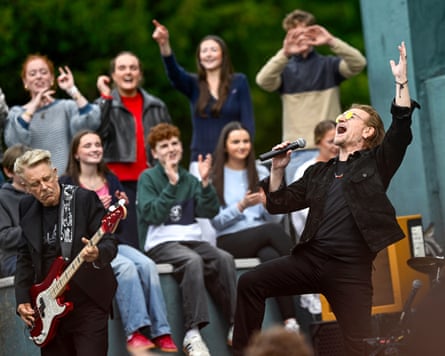
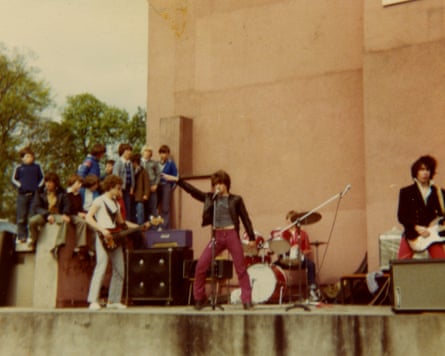
Impertinent calls for them to cede the stage to the Gallaghers notwithstanding, the gig at their old school has made U2's members think about their early days. It wasn't so strange that they formed a band, muses Adam Clayton – it was, after all, the punk era, and plenty of other teenagers had the same idea. It was that, from the start, U2's aims seemed slightly different. "We thought longevity for our band was an important goal," he says, "which was the absolute opposite of the punk thing. In school in the 70s, we'd been faced with the petrol crisis, the economic crisis, worrying about what you were going to do. I think we thought: if we've got this thing, let's just do it for as long as we can."
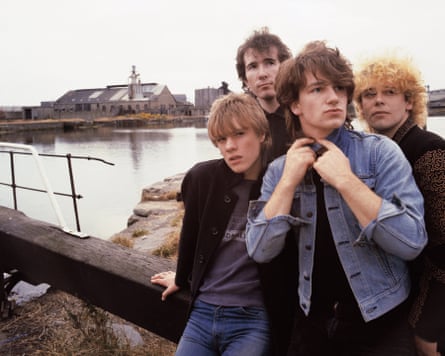
"I remember that period when we first started to look for a record deal," says Bono. "We were actively impatient; we had a great level of expectation. It didn't occur to us that this was preposterous. We were 16, 17, 18 and we to get a record deal. I think the clue's in the title of the first album, Boy. It was a sort of examination of innocence and naivety, and those things are so important: they give you the sense that anything is possible, that change can happen, that you can be a huge band. It allowed us to think about global success, when there was almost no evidence that it was possible."
What seems almost impossible is that U2 are still here, half a century later, with the same four members: there are doubtless other bands who can claim the same thing, but you struggle to think of one. That they have survived intact is down to what Bono calls "the soviet" – a democracy in which songwriting credits are always shared equally and everything is decided by committee.
Watching them interact over Madame Nicole's butterflied prawns and you get a vague sense of how "the soviet" might work – occasionally, after Bono offers a long answer that digresses into quotations from books, songs and the Bible, another member of the band steps in and effectively grounds it, summarising what he's just said in more direct terms. But nonetheless, there's no getting around the fact that an equitable division of power is supposed to be a disastrous way to run a band. As Bruce Springsteen said when he inducted U2 into the Rock and Roll Hall of Fame in 2005: "I believe they actually practise some form of democracy – toxic poison in a band's head!"
"I think if we really understood how it worked, we'd have moved out of the rock'n'roll business and into political advice," says Mullen. "You have to be able to go into a room and share and be open to most circumstances."
"It's got harder as time's gone on," says Bono. "Because, as Marianne Faithfull would say in situations like this: 'Never underestimate the male ego, darling.' Students of male psychology will tell you that as men lose power, be that physical, sexual, mental, you make up for it by flexing." He laughs, saying that when his own father reached that point, "he started sleeping with an iron bar under his pillow", and illustrates this with a story about U2's peers in the late 70s Irish rock scene, the Virgin Prunes. "As an art prank, they came by one night and wrapped our car up in hankies and powder, then threw eggs when I went to the window. Da thought we were being attacked and the fucking iron bar came out and he's off down the road chasing them. But our rehearsals rarely get to that level. Very rarely."
uccessful democracy or not, this year's flurry of activity comes at the end of a lengthy period of turbulence for U2. Bono and the Edge's flop Broadway musical about Spider-Man, in 2011; the misguided launch of 2014's Songs of Innocence when they invaded everyone's iTunes libraries; the cool reaction afforded that album and its successor, Songs of Experience; Bono suffering both a bike crash in 2014 that left him with umpteen broken bones and facial trauma, and open heart surgery two years later. There were triumphs along the way, not least the Innocence and Experience and Joshua Tree tours, which had a combined gross of $543m. But by the time U2 played their 2023-24 residency at the Las Vegas Sphere without Mullen – recovering from neck surgery that looked like it could end his drumming career – there were rumblings about the band's future, not least within U2 themselves.
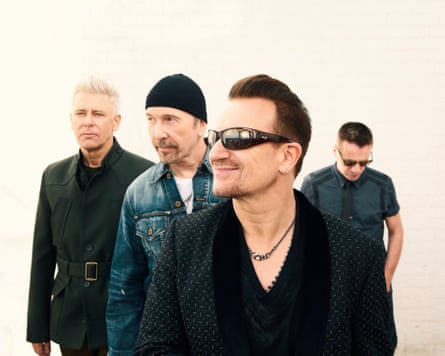
"U2 is the four members of the band," says the Edge, firmly. "I think that doesn't mean we would stop making music if somebody left, but I think it would be a very different kind of group. We definitely would acknowledge that it was a U2 part two, rather than the same thing. I'm not sure we'd be sitting here if Larry wasn't ready to play."
And yet Mullen is here, looking in impressively chiselled rude health, and U2's new album sounds noticeably more confident and, well, U2-ish than Songs of Innocence or Songs of Experience, both of which carried the faint sense of a band struggling to work out where they fitted into the 21st-century landscape. There were clumsy lunges for pop contemporaneity – Auto-Tuned vocals, songwriter-for-hire Ryan Tedder in the credits – and moments that sounded less like U2 than they did Coldplay. "The coherent many have overpowered the transcendent," offers Bono, carefully: by contrast, on Carnaval de Luz, he says one of their aims was "to make music only U2 could make".
It features a duet with Dolly Parton that is now the last song the ailing country star – or, as Bono calls her, "the last thing all Americans agreed on" – ever recorded. "To sing alongside her is to be somewhat embarrassed, and that's not false modesty," he says of the experience of duetting with a vocalist whose skills he compares to those of Pakistani Qawwali master Nusrat Fateh Ali Khan. And there's The Mirror Maker (Rosalía), a song in praise of the titular Spanish singer, replete with a falsetto vocal that mimics her operatic flourishes, which apparently required a meeting of the aforementioned soviet before it could go ahead.
"Just to fling the idea about and say: can we really do this?" says Bono. "I've been a fan for ages. She's in the territory we were in – Catholicism, the saints, love for God – but it was a little bit embarrassing that she became so popular: like, great, U2 cop on to Rosalía just as she's becoming the biggest star on the planet." He ended up texting the singer to let her know what they had done. "I had to explain to one of her friends that I know that we were not, in fact, stalkers. But she was very humorous about it. She said, 'I don't have to sing on this, do I?' And I said no, no, how on earth could we ask you to sing a song about you? That said, we got Johnny Cash to sing The Wanderer [on 1993's Zooropa], and that was about him."
"But it didn't actually have his name in the title," frowns Clayton. "It wasn't called Johnny Cash: The Wanderer."
The emotional tone of Carnaval de Luz is noticeably different from either of the EPs that preceded it, the anger of Days of Ash replaced by calls for community and a kind of defiant joy. "The news can't break us," as a song called Superficiality puts it.
"It's not fiddling while Rome burns, it's taking the fiddle off Nero and playing a better tune," notes Bono, very Bono-ishly. "These divils must not control our mood."
ono says these are "exceptional times". He is an activist who has never been averse to breaking bread with US politicians whose views evidently don't align with his own. In the early 00s, he famously talked the Republican senator Jesse Helms, a virulent homophobe, into supporting funding to combat Aids. He lobbied George W Bush on debt relief for developing countries, and corralled a load of corporate suits into supporting the Product Red charity initiative. But he has been noticeably absent from the White House during the second Trump presidency: an administration that in 2025 disrupted the very Aids programme Bono helped to initiate.
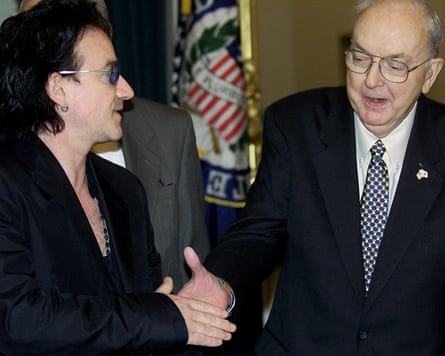
"There's a permission you need to feel to do a certain task," he says, "and if you feel it spiritually. You feel like: I think I might be able to help here." With the Trump administration, "I have been invited, but I know I'm not up to that, I don't have the ability to negotiate [with them], it's too much." Bono says he doesn't have "a plan, a strategy for successful action, a particular original idea I could get past them. Maybe just leave that to someone else. I don't feel … the leading, is that the word? That thing where you think you know what to do."
Mullen picks up the thread. "When money was taken away from Aids, from people in Africa, I think to be honest you were in a state of complete shock and dismay at what you were seeing. And these things take enormous amounts of time and energy and you can't do everything, you can only do a certain amount."
Is he saying he thinks this is a fundamentally different situation than what he'd encountered with right-wing politicians in previous administrations?
"Yes, I do," says Bono. "It's a new world. This is different. There's a whiff, there's a honk, and we're all just trying to discern it. There's a brand new dance and we do know its name," he says, paraphrasing David Bowie's Fashion. "It's a little … fascistic. And it needs a different response."
He talks about a meeting he had with Demis Hassabis, a Nobel prize-winning AI researcher. "Maybe one of the cleverest people on the planet," who suggested that "unless there's an exponential change in human behaviour and how we get on with each other and how we cooperate and reorganise to face the challenges of the world, like the climate crisis or whatever … we're in deep trouble". He says he still genuinely believes that rock music has a role to play in bringing people together, calling their upcoming tour "a no-holds-barred fight for a great night out".
That's despite a song on Carnaval de Luz called The Greatest Show on Earth, which you could take as a eulogy for U2's imperial phase in the 80s and 90s, or for pop's once-central, now-diminished role in culture. "We were once the greatest show on earth," he sings, a line which apparently caused some consternation among U2's ranks.
"Everyone was going: 'You're not going to sing , are you?'," he laughs. "Edge was saying: 'How about: we could still be the greatest show on earth?' Adam said: 'What about: I we're the greatest show on earth?' But I know how I feel when I sing it. The feeling of grasping that nettle – look what might have been – gives you hope."
That time, he says, he overrode the objections of the soviet and got his own way. But it happens a lot less than you'd think, and perhaps that's for the best. "I genuinely fantasise that one day these lads will actually just do what they're told, but at this point, I'm giving up on that fantasy," he smiles, as U2 head for the rehearsal room. "I just don't think it's going to happen. And thank God, because if they started doing what they're told, there'd be an absolutely album."