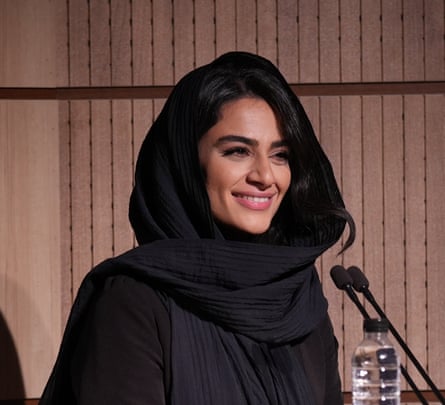
An Iranian court's decision to uphold a sentence of 74 lashes against the popular singer Parastoo Ahmadi for performing without a hijab has sparked outrage among rights groups, who described it as "a form of torture".
In June, Ahmadi, 29, and eight members of her production team, including musicians, were sentenced by a court in the city of Qom over a concert that was streamed online in 2024, which went viral and racked up millions of views. The court said the group had violated the country's "legal and cultural norms" and called the performance "obscene and vulgar".
Under Iran's "hijab and chastity" law – passed in 2024 but not yet officially implemented – women caught "promoting nudity, indecency, unveiling or improper dressing" face severe penalties, including fines, flogging and prison sentences ranging from five to 15 years for repeat offenders.
Lawyers say the verdict, announced last week, was not a surprise as the head of the Iranian judiciary had recently said the regime should not be afraid of the resulting "uproar" from a harsher crackdown on those not wearing the hijab. Ahmadi and her production crew are expected to be punished with lashings within the next three months.
Roya Boroumand, co-founder of the Abdorrahman Boroumand Center for Human Rights, said: "This concert is treated as an act of defiance not only because a woman is singing unveiled, but because she is singing old pre-revolutionary popular songs."
Moein Khazaeli, a human rights lawyer at Dadban, a legal counselling centre for Iranian activists based outside Iran, said: "The verdict is against humanity. It is a form of torture under the [United Nations] convention against torture. Unfortunately, in the Islamic republic's judicial system, applying torture is effectively legal. It's against human rights – a crime against humanity."
The harsh sentence of lashes imposed on Ahmadi has alarmed the musical community in Iran. Leili, 36, a singer in Tehran, told the Guardian that she felt like a "coward" for "helplessly" watching fellow musicians pay the price for expressing themselves and doing what they loved.
According to Hengaw, a Norway-based group that covers human rights in Kurdistan and Iran, another singer, Hiwa Seyfizade, was also reportedly sentenced last month to four years in prison over a performance on charges of "promoting corruption and prostitution".
Despite years of arrests and prosecutions aimed at enforcing the law on mandatory hijabs, women continue to appear without headscarves in public. Some Iranians attribute this change not to a relaxation of the regime's policy, but to women continuing to defy the restrictions.
Leili said: "What you are seeing on social media about women freely walking around is true, and I see fewer and fewer women wearing the hijab. But the regime has no contribution here; it's us women who continue to push. We aren't scared to go protest [against] this."
In what appears to be a renewed wave of protests against mandatory dress codes and worsening economic conditions, students at Allameh Tabataba'i University in Tehran demonstrated this week. Protesters chanted: "Exploitation, unemployment, compulsory hijab for women" and "Top academic rankings, but crumbling dormitories".
Calling for the sentences against Ahmadi and other musicians to be overturned, Skylar Thompson, the deputy director at the US-based organisation Human Rights Activists in Iran, said flogging was "an archaic and deliberate act of violence against a person's body and dignity" and was being used on Ahmadi to "frighten other women into compliance".