lice Diop has just returned to France from California when we speak. It's a Zoom meeting with a bad connection, and Diop leans close to the camera, always in frame, barely moving. It's like watching the characters in her documentaries and films, where her camera lingers on its subject with a slow, cool intensity.
Diop had been attending a two-week celebration of her work organised by the French department at University of California, Berkeley, in which academics pored over her documentaries (Nous (We), Vers La Tendresse (Towards Tenderness)) and her first feature film, Saint Omer, which received the Silver Lion in Venice in 2022. The courtroom drama was inspired by a real trial that Diop attended, of a Senegalese woman who had allowed her baby to drown in the sea. Over two hours, it explored the complexities of race, culture and motherhood in contemporary France. The film was the first by a black female director to be entered by France as its official entry in the 2023 Academy Awards.
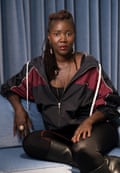
"To be studied like that, in such a temple of intellectual resistance, I was bowled over," says Diop of UC Berkeley. "As a film-maker, it's not up to me to analyse my work. But listening to them, it was good to feel understood."
As a film-maker, it's also not her usual role to be putting on an exhibition. But today, we are here to discuss Geste de Consolation (Gesture of Consolation), a multipart installation involving film, artworks, readings, music and dance, soon to open in Paris, coinciding with the Art Basel fair. Diop was invited by the Italian fashion house Miu Miu to create the five-day extravaganza, and is approaching it scene by scene, like a film director. "I'm not an artist, I've no desire to be an exhibition curator," she says.
Instead, it offered an opportunity to "bring together in one space, many of the women who work with me, who nourish me, who have helped me heal, and have together enabled this notion of consolation". They include Marie Ndiaye, with whom she writes her films, the American poet Robin Coste Lewis, Chicagoan composer Angel Bat Dawid and historical figures such as Virginia Woolf.
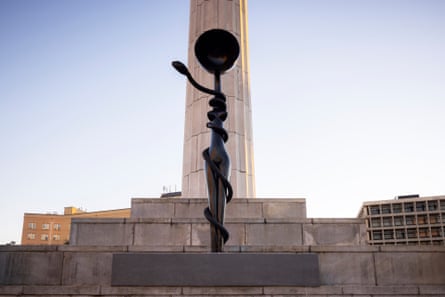
The exhibition will open with a poignant image from the South African artist Zanele Muholi, of a woman looking at herself naked in the mirror. "Zanele gives dignity and a voice to those who are marginalised," says Diop. It closes with Simone Leigh's sculpture Mami Wata, representing diasporic west African spirituality. "You will be able to see her from all over the hall," says Diop of Mami Wata's towering presence. "Simone is a star in her native US, and has a huge retrospective coming to London in 2027. But she's never had a show in France. This is an attempt to redress that."
This is the third year that Miu Miu has sponsored this exhibition, set to take place in the Palais d'Iéna, a modernist masterpiece from the early 1940s with an extraordinary 60m-long uninterrupted central hall. It's where the house puts on its catwalk shows, and it applies the same no-expense-spared policy to the presentation of art. The first iteration in 2024, by the Polish artist Goshka Macuga, included a massive mechanical conveyor belt and a cast of about 100 actors. Diop's will offer four principal scenarios, including a library of the texts that have most informed her work and life, where visitors are invited to read and relax. She says she reads more than she watches film, "But cinema is my language. It allows me a precision that I couldn't achieve in literature … Or maybe I make films because I'm a frustrated writer."
In 2025, Diop contributed to Miu Miu's Women's Tales, a series of short films by female directors. In her 20-minute film, Fragments for Venus, art looms large as actor Kayije Kagame stares at paintings with black subjects in the dwarfingly large galleries of the Louvre, before the action shifts to a Brooklyn street where the gaze belongs instead to the phenomenal Séphora Pondi and the women around her, full of agency and vitality. Kagame and Pondi could be Diop herself – the still, silent observer.
"From the moment I agreed to take on this project, I decided it had to be another opportunity to pursue all the questions that I ask in my films," says Diop. Her own work in the exhibition is a split-screen video installation of archival imagery and film clips that she says have formed own cinematic image bank. "Some of them are quite troubling, violent," she says. "In others I have found consolation." In Diop's world, it seems there is rarely one without the other.