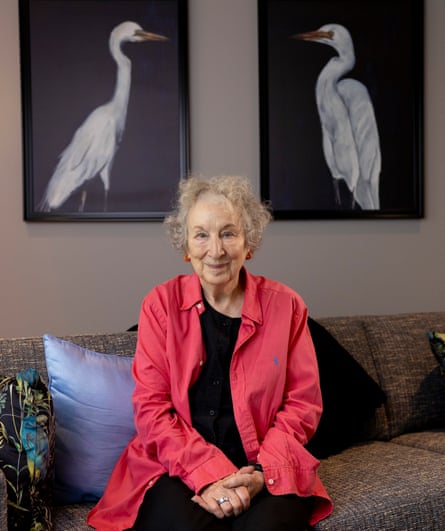
If she could be any bird, Margaret Atwood would transform into a raven. "They're very smart. They're social, playful and just a very successful bird," she says while seated in a corner of a bird observatory in the Lake Erie Islands archipelago. "They're quite an intelligent problem solver."
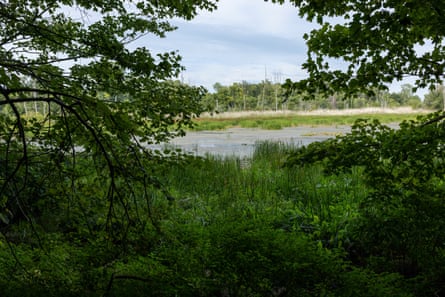
The observatory, which she set up with her late partner, Graeme Gibson, is located on the west shore of Pelee Island – the southernmost community in Canada – and is so new that there are no lightbulbs in a handful of lamps.
Pelee sits at the nexus of two important migration routes, making it a destination for birds travelling thousands of kilometres each year. Ravens are not among its regular visitors – only one was spotted in recent memory, in 2023 – but Atwood likes the old Inuit joke about them.
A hunter arrives at a place he has never camped before, and asks a raven where to spend the night. "The raven says, 'The base of that hill is a good place,' and so he sets up his little tent there," says Atwood.
"In the middle of the night, a boulder rolls down the hill and crushes him. And the raven, as he's enjoying the feast, says, 'Works every time.'"
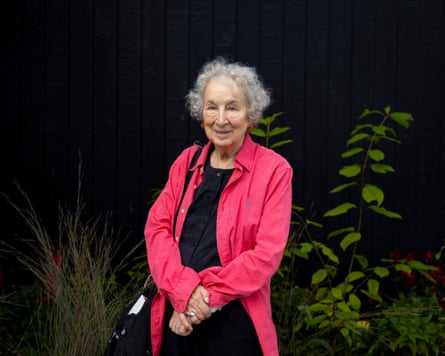
The bestselling Canadian author, whose prophetic works of speculative fiction have won countless awards, has blurred the lines that separate humans and birds both in her work and, at times, in her life.
She and Gibson, also a novelist, once dressed up for a party as Odin's ravens, Thought and Memory. They wore black gloves and fashioned beaks from black construction paper.
Gibson died in 2019. In his final years, vascular dementia overtook his ability to journal about the birds. Still, he would watch them daily.
"Our back yard feeder and our birdbath were attracting only sparrows and robins and grackles and the occasional pigeon, but he didn't care: every bird was worthy of attention," Atwood wrote in a foreword to Gibson's book, The Bedside Book of Birds. "'I no longer know their names,' he told a friend of ours. 'But then, they don't know my name either.'"
Now, Gibson's legacy is about to help expand humanity's understanding of birds. On Friday Western University, in London, Ontario, announced that Atwood had donated C$1m (£540,000) to celebrate her late partner's love of birds.
The gift will create the Graeme Gibson chair in avian biology, with the goal of better understanding the fundamental processes that shape how birds move, adapt and behave in an environment undergoing profound transformation.
Atwood has championed many causes, including Indigenous education and human rights, but environmental protection is at the forefront of them.
"I have what they call a platform," she says. "And I also had what they call extra money."
Behind the deadpan is a longstanding belief in the power of science to answer deceptively simple questions about the natural world. How do birds navigate thousands of kilometres? How do they sense magnetic fields? How do they know where to go?
"Look at navigation," says Chris Guglielmo, the co-director of the advanced facility for avian research at Western University, which received Atwood's gift.
"We have a lot of descriptive understanding of what happens when we manipulate the magnetic fields, for example, the bird changes its orientation. We know they have these senses. But how they actually work is still a big mystery, and very exciting for people to try to study."
The university has emerged as a global leader in avian research, developing the world's first hypobaric climatic wind tunnel for bird flight in order to better study how they move through different types of air.
Guglielmo and his team have also made significant contributions to understanding how migratory birds fuel themselves, travel and survive long-distance journeys. But even the leading minds remain stumped by many of the mysteries that still surround the lives – and minds – of birds.
"Our new graduate students sometimes struggle to come up with a scientific question," Guglielmo says. "And we tell them, there's a million questions we don't know the answer to. I have a whiteboard covered with potential questions. I just don't have enough funding, people and time to even begin answering them."
That's why when he received the call about the gift, he was told to sit down first.
"It made me feel so good that we're not only reaching and having impact in the scientific community, but that more broadly in the public sphere," he says, adding that the gift was a "validation" of work done by the university's scientists.
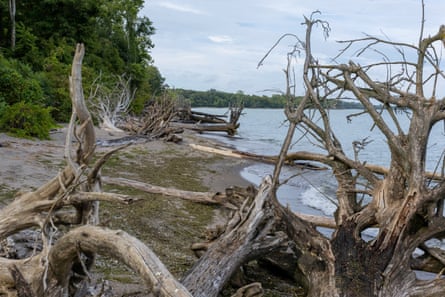
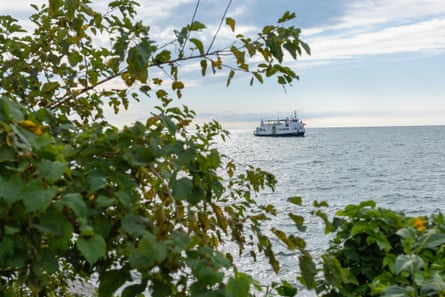
Weeks before the gift was announced, Atwood celebrated the opening of the Atwood-Gibson Bird Centre on Pelee Island. Resembling a towel hung loosely from a clothesline, Pelee Island is a rare enclave that blends Carolinian forest, dunes and marshes. Sitting at the intersection of the Atlantic and Mississippi migration routes, each spring it welcomes more than 200 species, not to mention thousands of serious birders.
At the event, she was simultaneously treated as literary royalty – attenders queued nervously for a chance to speak to her and pose for photographs – and as Peggy, the no-nonsense islander who often spends months at her cottage there and is woven into the community of 235 full-time residents.
The new building expands the footprint of the Pelee Island Bird Observatory, which the couple co-founded more than two decades ago to study the transcontinental movement of birds. It is also a refuge from Atwood's nemesis: chiggers.
"You don't know about chiggers?" she says of the six-legged larval mites hiding in the grass around the building. "Once you learn about their bite – and the itching that never stops – you never forget."
While Atwood was exposed to birds – and chiggers – during a youth spent in the Ontario hinterlands with her forest entomologist father, Gibson became a bird lover later in life, with the zeal of a born-again religious convert.
"At its heightened moments, birdwatching can encourage a state of being close to rapture," he wrote in his book. "It is an ecstasy that is said to accompany the writing of poetry; sometimes it comes when we're listening to music."
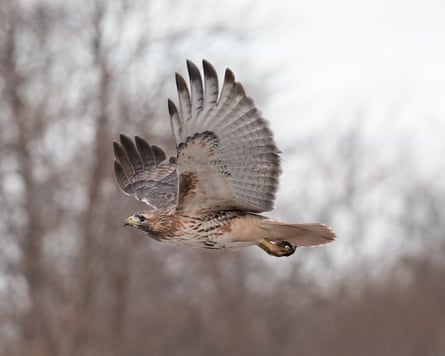
His "spark bird" – the name birders give to the particular species that triggers a lifelong love of the pursuitwas the red-tailed hawk, which is spotted frequently on the island.
Others, including the blackpoll warbler, are declining rapidly. The warbler breeds in the northern boreal forest, as far north as the Arctic, before embarking on a nonstop journey of almost 1,800 miles over open water to South America. Its population has dropped more than 80% in the last five decades, making it the fastest declining songbird.
Canada and the US have lost nearly 3bn birds since 1970. While certain species, including ducks and birds of prey, have surged in number, birds that travel thousands of miles each year have dropped in population by nearly 30%.
The declines, expected to increase further with the climate emergency, matter profoundly for a place such as Canada, where many bird species are migratory.
Atwood says the four biggest threats to birds – windows, cats, toxic pollution and environmental destruction of their habitats – are all things humans can help stop.
The first two are easier to address, but the latter are more challenging.
"People think: we can cut down this forest, and we'll just make another forest over there. It's not going to be the same. Birds have specific habitats that they need, so it's not like spreading butter on a piece of toast."
Atwood, who has spent much of her career imagining dystopian futures, is nonetheless optimistic about a future that has not yet been decided.
"Let's say hope is a built-in human characteristic. Unless you're deeply depressed, you wake up every morning thinking, what will this day bring? Maybe it will be a chocolate bar. Maybe there'll be some surprises. If our ancestors didn't have that, we probably wouldn't be here," she says.
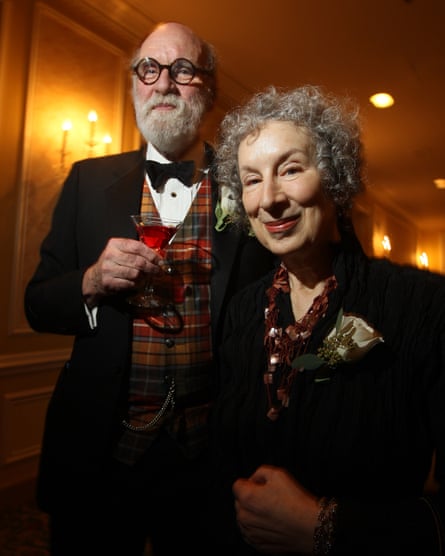
"All of us trust this possibility that the doors are not locked. Yes, you may open door A and fall down a flight of stairs, but you may open door B and there will be a chocolate bar."
She points to how young people, especially children, appear hardwired to engage deeply with nature.
"The passion is built in. They're very interested in anything that moves, anything outside, and unless some grown-up teaches them to be afraid of such things, that interest will continue," she says. "We are part of the natural world. It's your choice of how to be in it."
More than 11 years ago, Atwood and others signed a letter of outrage after the Oxford Junior Dictionary dropped a number of nature-themed words – including raven – in favour of a technology-heavy vernacular.
The writer Robert Macfarlane and the children's book illustrator Jackie Morris released an elegy to youthful wonder in response to Oxford's decision. But against the odds, birding is surging in interest among young people.
"If there's no young people interested in a thing, whatever that thing is, it will die out. The fact that it's not dying out, but it's going in the other direction, is quite hopeful," says Atwood. "I was talking to some booksellers recently, and I said, 'What are young people buying?' They said, 'They're buying great big fat Victorian novels.' Who would have thought that?"
Birding can nevertheless appear to be a rather niche interest. To those who do not quite grasp the appeal: "I don't think it's a question of what birders are seeing that you're not. It's a question of what they're feeling that you're not," she says.
"So maybe you should take some magic mushrooms. Because it all comes down to passion. Most of what we do in our lives we think it's reason; we think it's something that you can put into an argument. But everything begins with emotion."
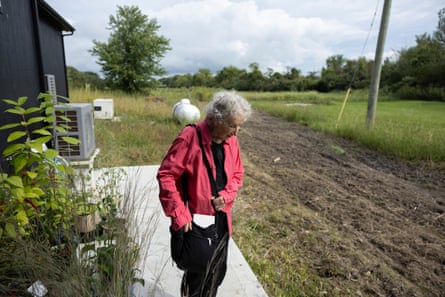
Atwood has spent much of her career examining the implications of societies that allow their freedoms and ecosystems to erode. But she is also a critic of those who neglect the relationship between humans and the natural world, cautioning that neglecting one can have dire consequences for the other.
"It's easy, for example, to raise money for kidneys. Because people think: 'Everybody's got kidneys. I've got kidneys. If anything happened to my kidneys, I would want there to be a kidney facility for me," she says.
"But people don't make that immediate connection between their bodies and the natural world. There's so much research that shows just how beneficial it is for our bodies to spend time in nature."
Indeed, Atwood's writing has long contained a warning that societies can allow the systems that sustain them to erode, often recognising only too late what was lost.
"Utopia is impossible, but if you don't believe in the ability to attain something better, you will inevitably end up in a dystopia. Because dystopia is quite possible," she says.
"Or to put it another way, we're much better at creating hell than we are at creating heaven. Although I also think heaven would be quite boring."