atricia Langa parades on to an invisible stage in a basement room of Instituto Cervantes in central London, locked into the character of Conchita, a professional mourner loosely based on the sorrowful heroines of Federico García Lorca's 1936 play, The House of Bernarda Alba.
"His voice was too loud, too queer, too alive for those around him, filled with jealousy and hatred," she tells her imagined audience. "So they silenced him."
Langa (who uses she/they pronouns) is rehearsing her cabaret-cum-drag ode to Lorca, which they will perform as part of the Festival of Queer Spanish Culture, taking place in London this November. Combining flamenco, lip-sync and poetry, the show imagines a funeral for the poet and playwright, 90 years since he was killed by Franco's nationalist regime. His body was never found.
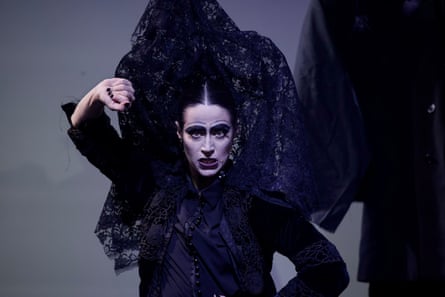
The performance feeds into a growing embrace of Lorca among Spain's LGBTQ+ community. From viral Booktoks, drag memorials, documentaries, book clubs and, most recently, the Oscar-tipped film La Bola Negra, the Andalucían poet has emerged as an increasingly important queer icon in Spain.
For Langa, studying Lorca's work through a queer lens has led to a deeper, more personal, connection with it. "He went out there and told stories that are not typical," she says. His first play, The Butterfly's Evil Spell, about the forbidden love between a cockroach and a butterfly, serves as one example. "A lot of his work is about being different. There is something quite magical about understanding these little tricks that he used to share something that maybe he publicly didn't feel he was able to."
Born near Granada in 1898, Lorca rose to be one of Spain's greatest writers in his lifetime. Although there was speculation about his homosexuality, allegedly a factor in his murder, Lorca was never openly gay. Homosexuality was violently oppressed during the Franco regime, and Spain was one of the last western countries to decriminalise same-sex relations – sentences for which were only cleared in 2001.
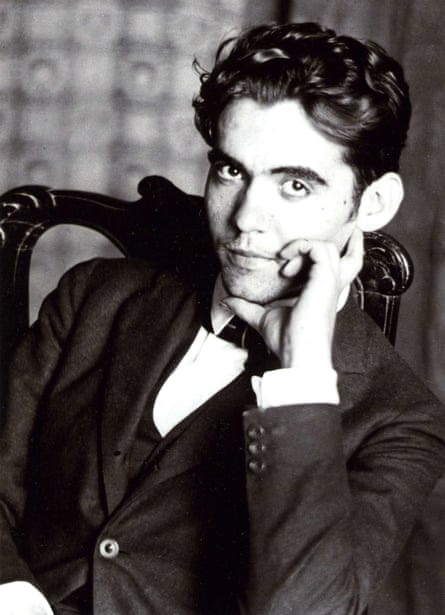
In the decades after Lorca's death, any mention of Lorca's queerness was hushed by his family and Spain's literary circles – academics and writers who feared being denied access to the family's archives and university resources, would pussyfoot around the topic as a result.
"If you went around saying that Lorca was gay, the door was shut," says Ian Gibson, one of Spain's most respected Lorca biographers. Gibson refers to a biography written by Lorca's brother, Francisco, published posthumously in 1980, as an example. "In that book the word homosexual doesn't appear. There is no allusion to his sexuality." Gibson's own groundbreaking biography of Lorca came out in 1985 to critical acclaim. "I put homosexuality in the centre of the picture," he says, "and that was the end of my relationship with the family."
Gibson's subsequent 2009 book, Lorca y el Mundo Gay, delved deeper into the poet's sexuality and has been a key resource for readers looking to uncover more about Lorca's queerness. In Berkana, a queer bookshop in Madrid's gay Chueca district, copies of a pink-tinted reissue of the book from 2026 line the window display. "In Spain, we didn't speak about his sexuality for many years," says the bookseller, who says that the popularity of La Bola Negra, Spain's highest grossing film of the year, has led to a rise in demand for Lorca-related work. La Piedra Oscura, the play by Alberto Conejero on which the film is based, has become an unlikely bestseller.
An Irishman who moved to Spain in the 1960s in pursuit of studying Lorca – and subsequently became a citizen – Gibson is honoured in La Bola Negra through the character played by Glenn Close. True to accounts of the film, his interest in conveying the truth around Lorca's sexuality stems from his own personal circumstance: his brother, Alan, was gay, and died in a psychiatric clinic after a lifetime of trauma growing up in a puritanical methodist family in a wider closeted Irish society.
"[My brother] has influenced my life at a very profound level and obviously is the basis for my fascination with Lorca," says Gibson, who is 87, over a stew in Lavapiés, his longtime home. "I don't think it's the least bit strange that Lorca is now a gay icon, I think he should be. And they'll tell you across the right that he's apolitical, but that's bullshit."
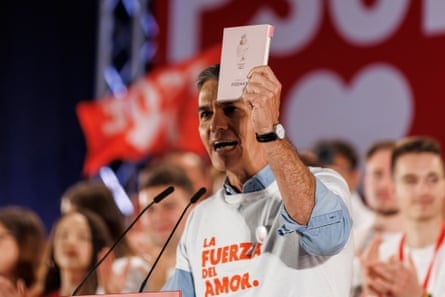
Recently, Lorca's queerness has also entered the Spanish political arena. Encouraged directly by Gibson, Spain's incumbent leftwing prime minister, Pedro Sánchez, has appropriated Lorca's ideals as part of his current political campaign, in the run-up to a tense snap election that will take place this November.
At a campaign speech in Granada on 24 October, Sánchez referred to the success of La Bola Negra, before reciting one of Lorca's poems. "This is the Spain of Lorca, the Spain that embraces the diverse and different," he said, addressing the crowd in a white shirt with the slogan La Fuerza del Amor (The Force of Love). Sanchéz faces tough competition from a unified right, with both the conservative People's Party and far-right Vox having campaigned to roll back LGBTQ+ rights across the country.
The past 40 years have seen Spain reckon with much of the horror inflicted by Franco on the LGBTQ+ community, moving to become one of the most progressive countries on gay rights. (It was the third country in the world to legalise same-sex marriage in 2005.) However, the current rise in far-right homophobic attitudes has sent shock waves through Spain's gay community, which fears a regression to Francoist attitudes.
Lorca's sexuality has become increasingly significant in this current political climate – a point that La Bola Negra confronts directly, addressing the damaging consequences of the intergenerational trauma imprinted on Spain's queer community as a consequence of silence and shame.
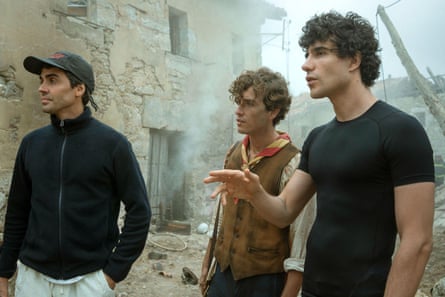
Its star, Álvaro Lafuente Calvo, more widely known as Guitarricadelafuente, wished the film had been released when he was young. "Growing up in Spain there weren't many references," says the gay musician. "Lorca's desire was so profoundly linked to his art, it can't be separated. It was something that we didn't learn in school."
Set across three different timelines, inspired by Lorca's life and work, La Bola Negra focuses on Lorca's intimate relationship with Rafael Rodríguez Rapún, and his unfinished play La Bola Negra – his only work with an explicitly gay protagonist. Meanwhile, La Nieve – the original song Lafuente wrote for La Bola Negra, which reached the Top 10 of the Spanish charts – takes cues from Lorca's Sonnets of Dark Love, which is thought to be dedicated, at least in part, to Rapún.
La Nieve is a favourite for the best original song award at next year's Oscars, and is also the soundtrack to a queer-led viral trend where young Spaniards film themselves at the cinema before watching La Bola Negra and then afterwards in tears
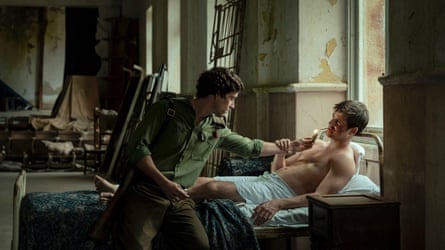
"What this film can shed a light on, and what moved me when I watched it, is acknowledging those stories that weren't able to happen, ever. Those impossible stories hidden in the ground," says Lafuente. "I think this is a testimony of those stories and that it can help people see we cannot go back to that. Even though we think we've achieved so much, we cannot take the freedom that we have for granted."
Langa, who watched the film while visiting her family in Barcelona, was among those in tears – and says the film has reaffirmed her admiration for the poet. "Lorca left us more than his poetry. He left us a way of seeing the world: finding beauty where others see shame, humanity where others see difference, and possibility where others impose limits."