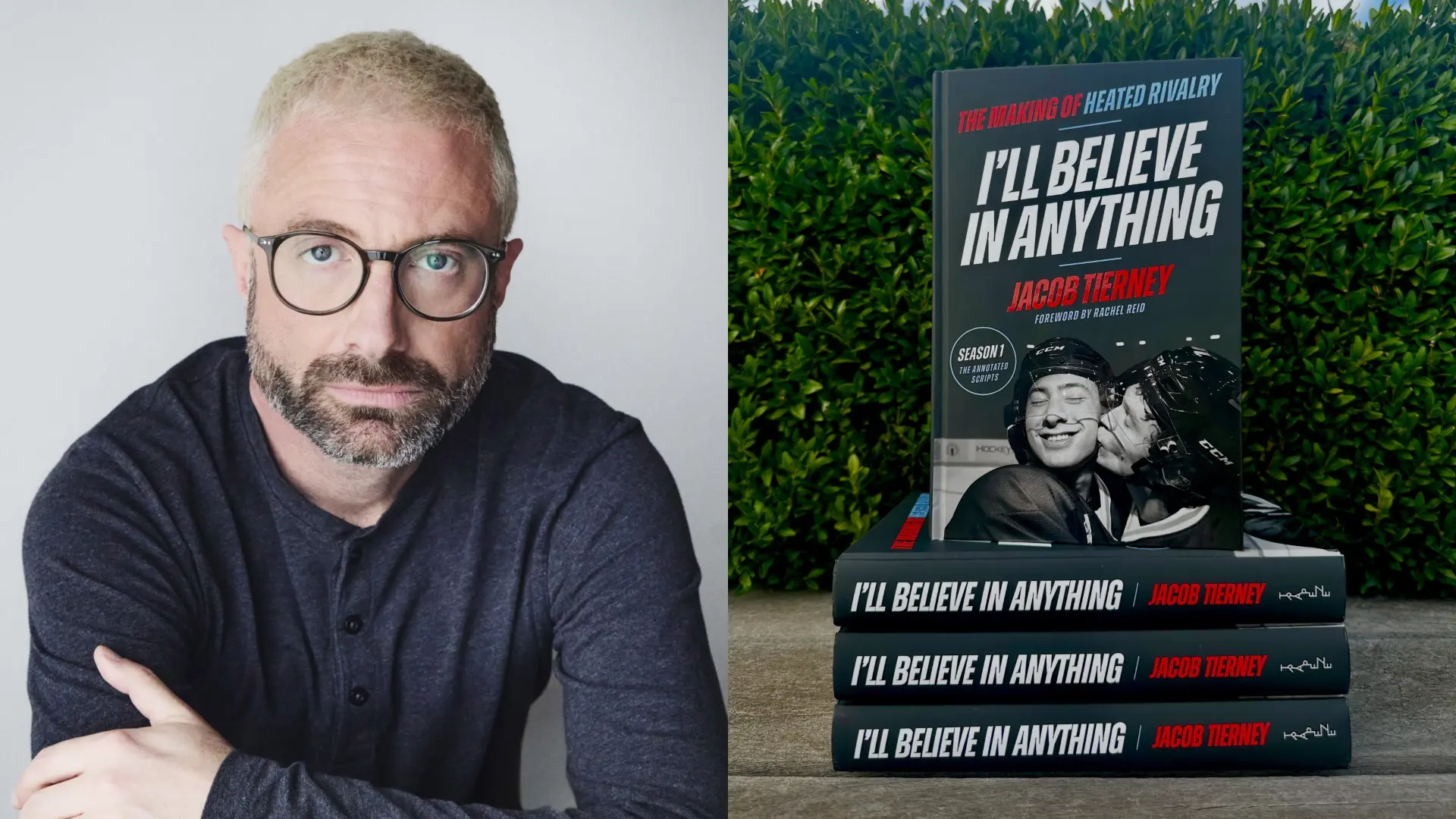
Ice-hockey drama set pulses racing with its electrifying sex scenes while also melting hearts with its authentic portrayal of gay male relationships. As a book of scripts and behind-the-scenes stories is released, we speak to the TV hit’s writer Jacob Tierney about bringing the much-loved novels to the screen
was never supposed to become this big. What began as a six-part adaptation of Rachel Reid’s beloved hockey romance about fictional rival players Shane Hollander and Ilya Rozanov quickly escaped the confines of its source material, turning (Shane) and (Ilya) into breakout stars and transforming the series into a full-blown phenomenon. By the time the series, made for Canadian streaming service Crave and HBO Max, had won a Peabody Award, it was clear that had become considerably more than a television adaptation – it was a cultural moment of its own.
Now, its creator, writer and director is inviting fans back into the world of Shane and Ilya – this time through the scripts themselves. I’ll Believe in Anything: The Making of Heated Rivalry Season 1, The Annotated Scripts is published on 13 October 2026 by Trapeze, with the 368-page book collecting the complete scripts alongside Tierney’s annotations and previously unseen behind-the-scenes material. It is, perhaps, an unusually fitting format for a show whose success has prompted endless discussion about how, exactly, Tierney managed to translate Reid’s hugely beloved novels into a TV hit.
“I wanted [the show] to feel the same way as it feels in the book”
“I like the books. I enjoy them. I’m a fan,” Tierney tells Attitude. “That’s how I started. I love the books. That’s why I wanted to option them.”
For Tierney, adapting was never about attempting to reproduce the novels word for word. Instead, the challenge was preserving what made them work while recognising that television demands something different.
“The truth about adapting is that things have to change,” he says. “They’re just different mediums, and so they require different things.”
One of the biggest differences is the interiority of Reid’s writing. Much of the emotional force of the novels comes from what Shane and Ilya are thinking but cannot say – something that can’t simply be lifted from a page and placed on screen.
“I hope that what [readers] get from this is an enlarged understanding of how many people it takes to make a show like this”
“Especially with a book, there’s so much inner monologue and there’s so much interior life that needs to be expressed in some kind of exterior in a show,” Tierney explains. That process inevitably meant making changes, but Tierney says the relationship at the heart of the story remained his guiding principle. “I wanted it to feel the same way as it feels in the book,” he says. “That means both being faithful to the material and understanding when I do have to make little changes for clarity or for a story that I think will add elements to making an audience understand it.”
offers fans the chance to see exactly how those decisions were made. Its annotations cover everything from costume and production design to intimacy choreography, scene direction and the decision to weave Scott and Kip’s story into Shane and Ilya’s.
But the most important thing Tierney hopes readers take from the book is not necessarily one particular piece of trivia.
And then there is The Fleece
“I hope that what they get from this is an enlarged understanding of how many people it takes to make a show like this,” he says. He points to the wardrobe team, musicians, actors, cinematographer, production designer and editors, among many others. “There are so many people that go into making a TV show,” he says.
And then there is The Fleece.
In episode two, Shane wears a white Team Canada fleece during the scenes set around the 2014 Winter Olympics in Sochi. Featuring red maple leaves on the sleeves and “Canada” across the back, the seemingly ordinary piece of sportswear somehow became one of ’s most recognisable objects.
Fans wanted one of their own so badly that a petition calling for an official version attracted more than 6,000 signatures. The obsession eventually became reality when the show’s production company, Accent Aigu Entertainment, partnered with Canadian clothing company Province of Canada to recreate it.
Yet Tierney insists he never saw the phenomenon coming. “I had no idea,” he laughs. “If you’d told me on the day that we shot that scene, I would have been like, ‘I don’t think you’re right.’” He is, however, perfectly happy that fans have embraced it. “I’m happy people like that fleece so much,” he says. “We have a lot of fleeces here. We live in the cold.”
The scripts also reveal just how fluid the production could be. One of the most significant rewrites happened when filming Shane coming out to his mother, Yuna, in episode six. The shoot was interrupted by rain, giving Tierney an unexpected opportunity to reconsider the scene. “We shot that one day. It started to rain; we had to stop,” he recalls. “We were like, ‘We’re gonna pick the rest of this up tomorrow,’ and I rewrote it that night because I wasn’t happy with what was happening.”
“There’s a version of life where you could fix it in the editing room, but I don’t love doing that”
Tierney quickly realised the problem wasn’t with the actors, but with his own writing. “When you have actors that are as good as Christina Chang and Hudson Williams, and the scene isn’t quite doing what I wanted it to do, I was like, ‘That’s my fault. My writing is not hitting it out of the park.’” His conclusion was blunt: “It was too long… It was just a lot of, like, me having overwritten something and, you know, then when you see it being played out, your mind changes.”
Rather than trying to rescue the scene in the edit, Tierney prefers to fix problems on set. “There’s a version of life where you could fix it in the editing room, but I don’t love doing that. I would rather fix it on the day,” he says. “I think the impact is that they feel a bit more in control of their performances as well. I’m not interested in controlling their performances to that degree.”
The result, he believes, was worth the last-minute upheaval. “They were great and adaptable and we changed it, and I think we made it much better than it was initially conceived.”
That hands-on approach is part of what makes more than a straightforward collection of scripts. It is a record of the decisions, accidents, compromises and creative instincts that transformed Reid’s novels into one of television’s most talked-about queer romances.
And the timing could hardly be better. With season two currently in production and set to continue Shane and Ilya’s story through an adaptation of Reid’s , the story of is far from over.
I’ll Believe in Anything: The Making of Heated Rivalry Season 1, The Annotated Scripts is published on 13 October 2026 by Trapeze.