No one can bring Los Angeles together like David Lynch.
The first posthumous exhibition of the director and artist's photographs went on display at LA's Pace Gallery this weekend, drawing a massive crowd of goths, weirdos and art world observers to celebrate a creative mind that has few equals in American pop culture history.
Lynch's disappearance from this mortal plane last year has not dimmed the public's appreciation for his surrealist, idiosyncratic perspective on American life. The exhibition – featuring photos that are erotic, disturbing and sometimes comically violent – encapsulates all the things that made Lynch one of the city's foremost creative minds.
Photos of mysterious women blowing smoke, multiple exposures of a nude subject on a chaise longue, dissected animals; the work is "radical", said Bill Griffin, managing partner for Pace Gallery. "It dealt with the human condition in a very large way. It dealt with consciousness and unconsciousness." Pace represented Lynch for years, and is spearheading the efforts to maintain and catalogue his fine art work with the David Lynch Foundation.

To be around Lynch's art is to be fully conscious. It requires thought, and introspection. There are never easy answers with anything he created. Aficionados of his films still debate what Blue Velvet or Mulholland Drive were actually about. The decay of American society? Sure. The fallibility of memory? Certainly. Sexual repression? Probably. It's all in there for you to discover, and that's what makes Lynch's art so vital.
Lynch's son Riley is taking the lead on preserving the artist's body of work. Discovery was a huge part of his childhood, Riley said. He remembers driving around LA with his dad, taking photos of whatever it was that moved him and his siblings. "We're gonna go out in the car, and we're just gonna go explore and take pictures and to collect information," Riley said. "It was just like a cycle of inspiration."
It's easy to be inspired by Lynch's photos. The pictures of women in extreme closeup, sporting red lipstick, evoke feelings of mystery and dread. Who is she? What is the smoke emanating from her mouth? There's no cigarette in the frame. Is it her soul? A spirit departing her corporeal body? The woman on the couch, in the multiple exposures, seems to be coming apart. Hands where feet should be. A body without clarity or logic.
Lynch was always a keen observer of the feminine. Laura Palmer, the tragic hero of Twin Peaks, is perhaps his greatest fictional creation. She's abused and murdered by her father, kicking off the twisty detective story of that franchise, but she retains her dignity even in death. Everyone in the town of Twin Peaks felt as if they knew Laura, but through the course of the series and its feature film prequel, the residents realize they didn't know her at all. She was as inscrutable and complex as the portraits on display at Pace Gallery.
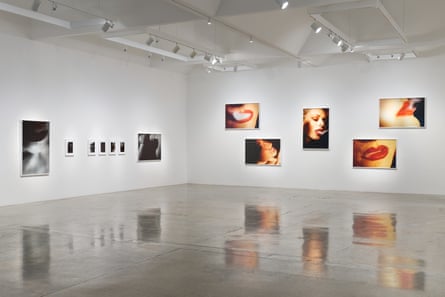
"[The female portraits] feel the most cinematic to me," Griffin said. "But also very much aligned with what he was thinking about in painting." Lynch was not just a photographer. He painted and created sculptures and practical objects such as furniture and lamps, Griffin said. One of his lamps is included in the Pace exhibition – metal frame, red plaster shaped almost like an organ, resin and a wood housing for a satisfyingly tactile switch. It doesn't illuminate much, but it's a striking piece nonetheless. "He lived with these [lamps] in his rooms and they were important to him," Griffin said. "Each one is violently itself, but it's so beautiful." For Lynch, art was not simply a profession. It was a life – an art life, as he put it.
When he woke up, he sought to create. "He made something every single day of his life," Riley said. It didn't matter what it was that he was making, as long as he was working on his craft. He would sketch designs for his lamps and other objects in a yellow legal pad, then set about making them, using the same metal fabricator for years. Life for Lynch was about the doing, the complicated and confusing act of artistic endeavor. He would be unwavering in his pursuit of the vision inside his head. Many of us find creativity a torturous and laborious process, full of self-doubt and procrastination. But Lynch saw it as a necessity, a job to do and a pleasure. To not work is to cease existing.
But work wasn't simply a task to cross off a list. There's a soulful, heavenly quality to what he made. "There's a spirituality to it," Griffin said. Even the darkly humorous photos of dissected fish and chickens from his time in Philadelphia feel sacred. There's care and attention paid to these dead animals, a reverence for what they represent. Each piece of carcass is labeled and categorized, the dark smears of blood acting as a sort of sacrament for the life represented. All things mattered to Lynch; the people, places and creatures he documented in his photos have interior lives that beg to be discovered.

His extreme dedication to his practice is why there's so much work left over after his passing. Riley, his family and Pace Gallery are still in the process of combing through Lynch's voluminous output. In 2028, there will be a retrospective in the Los Angeles County Museum of Art. And that's just the beginning, Riley said. The show will tour around the world, allowing fans and appreciators to interact and be inspired by the fruits of Lynch's labor.
Inside Pace Gallery on Saturday, fans in Twin Peaks T-shirts, chic art world denizens and high-net-worth collectors alike came together to get to the bottom of the eternal mystery of Lynch's work and legacy. There's still a gaping wound in the city of Los Angeles since his death. No one documented the city quite like he did. His beloved daily weather report became part of the city's morning routine, giving us words of wisdom along with our cup of hot, black coffee. No one loved LA the way he did. It's fitting that his artistic output would be shown here, in this place that meant so much to him.
Rarely does LA come together. Even more rare is the city agreeing to revere someone almost without reservation or cynicism. David Lynch might not have been born in LA, but he lived, thrived and died here. And he changed us all through his zest for creation.