here is something about Andrew Lloyd Webber's masterly musical The Phantom of the Opera – celebrating 40 years on the West End this month – which seems to take hold of its fans in a special way. For me, it was the show that first sparked my love of theatre and inspired me to work in the industry. Even today, Phantom is still the memory that gets my heart racing as I sit in the stalls, waiting impatiently for the curtain to come up, hoping for an experience just as intoxicating and all-consuming as that very first experience all those years ago.
It's not just the fans, either. When I talk to a cluster of key creatives, all of whom have a special working relationship with the show, each of them seems a little spellbound by Phantom. Sierra Boggess, who plays Carlotta in the 40th-anniversary production, talks tearfully about the lingering spirits of original director Hal Prince and choreographer Gillian Lynne. Jordan Donica, now starring as the Phantom in the West End, speaks passionately about the power of Lloyd Webber's music ("It feels like heaven to me"), and John Owen-Jones, who has played the Phantom more than anyone else in the West End, talks tenderly about his long-term history with the show: "I've got a picture of me in full Phantom get-up holding my baby daughter. It's an incredible thing to be part of."
Then there is producer Cameron Mackintosh who, if anything, seems even more enthusiastic about the show with each passing year. He just about stays sitting in his chair throughout our interview, yet gives the impression that he's bouncing about the office as we discuss those early days working on Phantom: "Of all my productions, it's the most beautiful show I've ever created, where every individual element contributed to its beauty."
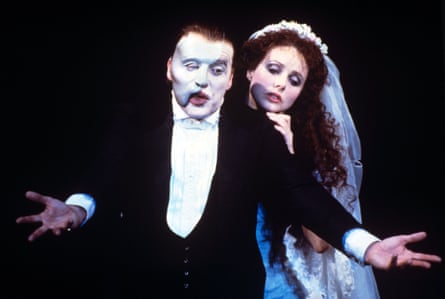
When Mackintosh and Lloyd Webber first started talking about Phantom in 1984, it was only ever meant to be a fun producing project. The two had enjoyed Ken Hill's production at Stratford East theatre and, after rummaging around a few charity shops, tracked down a copy of Gaston Leroux's original novel. They discovered a strange and sinister tale about a disfigured musical genius – with a face like a living corpse – lurking beneath a Parisian opera house (The Palais Garnier), seducing soprano Christine Daaé with the power of his music and causing havoc among the company performing above.
As their research deepened, Mackintosh and Lloyd Webber began to unearth the unique characteristics of their new Phantom. Their new version absolutely wasn't going to be a gothic horror story in the manner of Lon Chaney's striking silent movie. And it definitely wasn't going to be a Rocky Horror Show-esque pastiche. This Phantom was going to be lighter, more beautiful – and a lot more romantic.
It also quickly became clear that the show was going to have to feature the music of Andrew Lloyd Webber. "The score was very much inspired by Sarah Brightman," explains Mackintosh. "Andrew obviously had a very deep relationship with her at the time [the two were married] and it triggered something really special in her. Lots of people have attempted to do Phantom but Andrew's music brought an emotional intensity to the show that had never been there before in any other version."
There was something exciting about the score from the start, but it wasn't until late in the creative process that things came together: "The show only clicked on the first night of previews. I always describe it, up until that point, as a watch running really slowly. But on that night the audience was completely swept into another world. Maria Björnson's incredible design, Hal Prince's brilliant ability to shape pictures on stage; [choreographer and stager] Gillian Lynne inhabiting the real world of the opera house and giving it authentic style. It all came together and looked and sounded as one."
It is amazing to think of all the little tweaks that led to today's production, revamped and revitalised during the Covid theatre closures, but still very much the same beast created more than 40 years ago. In the early days of rehearsals, there were big plans to include a lot more animals. Björnson was determined to have a white horse carry Phantom into the lair but perhaps unsurprisingly – despite the ingenuity of the props team – they just couldn't make it work. At one point, Prince wanted scores of rats scampering beneath the stage, but the manufactured clump of glowing rats proved funny rather than frightening ("Those little red eyes had us in stitches!"). Prince also had his heart set on releasing white doves – played by a flock of seriously unpredictable pigeons – and having them fly up into the theatre boxes above. "It was a lovely idea," says Mackintosh, his eyes sparkling, "except all they did was fly up to a perch and shit all over the audience."
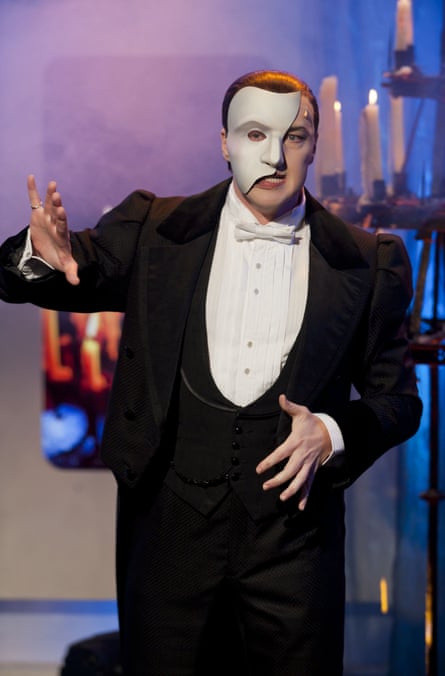
The horse, the rats and the beautiful (but messy) white doves were all scrapped and the show was gradually finessed. Yet Phantom still opened to patchy reviews, with the Independent scoffing: "Starlight Express brought the form to the edge of the abyss. The Phantom of the Opera takes it back a few yards, but we're not out of the woods yet." Nothing about the first few weeks, months or even years working on Phantom screamed box-office gold: "We never tried to put together the most successful musical," reflects Mackintosh. "I think if we had tried to do that it wouldn't have succeeded. It was meant to happen the way it did."
The idea of something almost karmic behind Phantom's success comes up throughout my conversation with Boggess, who first played Christine 20 years ago and went on to become a fan favourite. "For me, playing Christine was a dream come true," she says. "It felt like I was supposed to be there, helping to tell this story. And now here I am playing Carlotta. It feels like it's supposed to be."
For Boggess it's the music, above all, that keeps the fans hooked: "There's no other score in the world like this. People have to hear this music. It's like it's changing something on a cellular level." The acute technical demands of the score are also part of the show's appeal. "There's something dangerous about the music," she says. "The vocal demand is so great and there's a romance in that. People come back to hear the impossible."
There is something about performing in Phantom's first home, His Majesty's theatre (formerly Her Majesty's), that feels particularly special for Boggess: "After all the history I have with this show, I finally get to perform in the place where it all started. And there are ghosts here, too. The spirit world is all around us. I really believe that. They come and help us. It's so much bigger than us all."
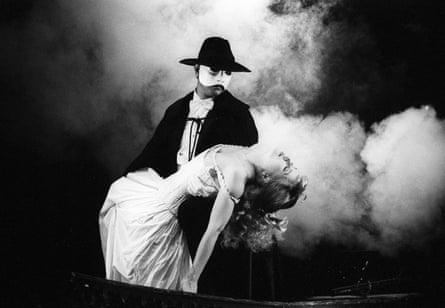
Owen-Jones, who has played Phantom nearly 2,000 times, also believes that the venue itself has an important role to play in the production's extraordinary performance history. He says the show was originally meant to run at the Palace theatre but Les Misérables – the only musical to have a longer West End run than Phantom – was refusing to close. So Phantom opened in the more intimate Her Majesty's.
"At the time, Her Majesty's had the only functioning Victorian understage in London," says Owen-Jones. "So the team were able to use that for things like the candelabra coming up through the floor. People hadn't seen things like that in the West End for a long time." Björnson's design in this particular theatre is a huge part of Phantom's enduring appeal: "When people watch Phantom they see this incredible set with all these old scenic elements. Flies from the top. Flies from below. Trap doors. Yet when the actors come on stage for their final bow, it's just a black box. Maria has put all these incredible elements into the space but in the end there's nothing to look at. It's pure theatre."
Everyone I talk to mentions the simplicity of Phantom's myth-like story, but also its flexibility. It's a simple tale but a robust one too, which allows each actor – despite the powerful legacy of Michael Crawford's haunting inaugural performance – to put his own stamp on the title role. For some that might mean imbuing the Phantom with an air of mystery, but for Owen-Jones the key was always about grounding him in reality: "In my mind the Phantom is a man. He's not a magician. He's not a wizard. He's an incredibly talented engineer who can do all these magical things."
Donica, who began his stage career playing Raoul on Broadway, sees the Phantom through a very different lens: "I felt a kinship to Phantom my whole life. Being a mixed-race kid, raised by a single mum in the south and Indiana. Moving around all the time and being the new kid. The outsider. The person that's always underestimated and made to feel unwelcome in a lot of spaces; having to show a talent that deems me worthy to be a part of society. All of these things and more, for me, very much relate to Phantom."
Donica describes the very first time he encountered the Phantom in the theatre, when a touring production came through Indiana. The actor had just turned nine and, in some strange way, he could literally see the power that Lloyd Webber's music held over the audience: "We were sat in the orchestra level and you hear the Phantom before you see him. I remember hearing 'Brava, brava, bravissima!' and it was like a synesthetic response. I could just see the Phantom's voice hovering over the audience and wrapping around them."
As we talk, Donica cannot help bursting into song. He talks to me about the frequencies contained in the score and, "from a hertz point of view", the way that these frequencies connect with the audience. It's an interesting and unusual way to think about the show; almost as if Lloyd Webber's score is the result of some sort of physics experiment, designed to shock and move us: "The frequencies that Andrew uses in this show are what hit you to your core. You can sit there, being sceptical about the show, but when you hear those tones – 'Da-da da-da daaaaa!' – it automatically makes the hair on the back of your neck stand up. That's why it works."
The Phantom of the Opera is at His Majesty's theatre, London, to 13 March 2027.