ow to stage Haruki Murakami's epic, dual-narrative novel without leaving the audience in a muddle? Director-choreographer Philippe Decouflé goes big, filling the enormous Barbican stage with a kaleidoscope of dream worlds for Ako Takahashi's adaptation. It could have become a scramble of stories and inquiries into memory, technological advances in society and the imagination. Instead, it is turned into one long immaculate coup de théâtre.
There are two versions of the protagonist, Watashi (Tatsuya Fujiwara) – one is in Tokyo, the other in a world comprising dreams. The city is noirish while the latter is beautiful but dangerous, with a complicated storyline involving the sundering of humans from their shadows, a walled city, roaming animals and a professor (Narushi Ikeda) who collects their skulls to channel past experiences through sound.
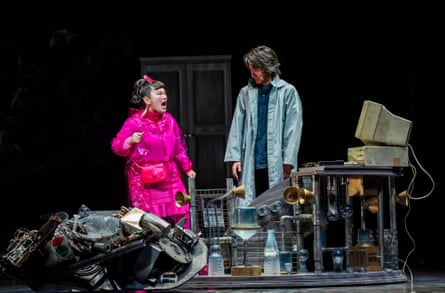
The professor's 17-year-old granddaughter (Miu Tomita) accompanies Watashi in Tokyo and appears like a kitsch version of the prophetess who goes with Aeneas into the underworld. Watashi seeks escape, so he can be reunited with his shadow (Shuntaro Miyao), but is drawn to this strange world too and has a romance with a librarian (Misato Morita).
Initially, it spirals into a rabbit hole of wonderlands, with kooky humour and references to western canonical and pop culture, as is Murakami's way, from ancient myth to Lewis Carroll's Alice and Luis Buñuel's Un Chien Andalou. A playful set, designed by K Ishihara, shows its own theatrical construction with cheeky playfulness.
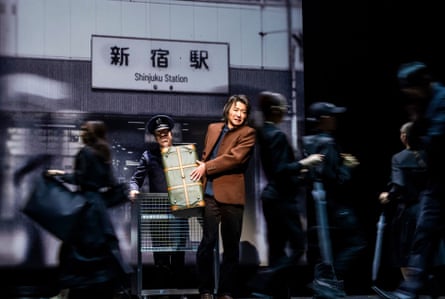
The visual pyrotechnics suck you in, from big projections to the speed, flow and agility of dancing that gestures at anime. They bring forth Murakami's many creatures, from underground "murks", with porcupine spikes, who flip and cartwheel, to a herd of balletic unicorns.
Decouflé's choreography is unsurpassable in its elastic grace and athleticism without seeming circus-like. The aesthetics on the whole are so ravishing that it doesn't matter if the story is not easy to grasp in the first half. At least not for some because, while Murakami fans will know that the unity of the story is to come, initiates to his work may be left punch-drunk and befuddled by the onslaught of worlds and images.
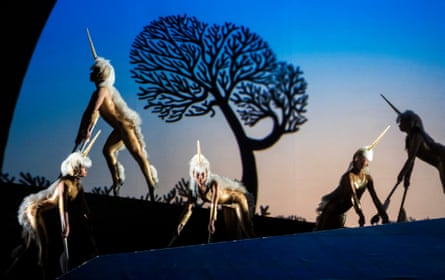
It becomes clear after the interval that this is controlled and deliberate confusion, reflecting Watashi's state of mind. The dance becomes imbued with feeling as Murakami's world reveals its underlying themes of loneliness, grief, the fear of disappearing and of death.
But the story of lost shadows, representing the "true" self, bears bigger socio-political echoes that feel contemporary, and even prescient (the book was published in 1985). This world looks like Neo's in The Matrix, and its technology chimes with ideas in Naomi Klein's book, Doppelganger: A Trip into the Mirror World. The sinister side of the perfectionism that this dream society has cultivated could be a comment on postwar Japan, or on our world of AI, real and fake selves, code and machine-constructed subjectivity.
At almost three hours, it leaves you with the sense that you have been dreaming, collectively, about a world of dead animals, lost shadows and unfeeling humans, but also of unicorns, impossible beauty and an ocean-like imagination. It is both of our world, and other.