When Cristian Mungiu's Fjord was shown in Romania as a one-day preview this June, the reception was extraordinary. Across 53 towns and 96 cinemas, the film reportedly pulled in over 40,000 viewers in a single night, a number arthouse cinema rarely sees in Romania. But the response here had little to do with cinema. It felt instead like a reopening of a familiar fault line about the clash of values within the EU itself.
The film echoes events from 2015, when the five children of Marius and Ruth Bodnariu, a Pentecostal couple from Romania living in Norway – part of a Neo-Protestant minority long viewed with suspicion in Orthodox Romania – were removed from their home by Barnevernet, Norway's child welfare authority, amid concerns over possible corporal punishment and religious indoctrination.
The fallout in Romania stretched on for months, with diplomatic friction, public demonstrations and constant media coverage. The children were eventually returned, and the Bodnarius later resettled in Romania. Mungiu doesn't retell the story beat for beat, but Romanian viewers had no trouble recognising where it came from.
What divided viewers here was what the film did with a well-known story. Some have called it "dangerously confusing", raising questions about abuse, integration and belief without taking a clear position. Others counter that its stance is embedded in form, in how sympathy is distributed, which characters get interiority and which are reduced to function.
To some, it's a brave critique of dogmatic liberalism, while to others, it dilutes a clear moral boundary on corporal punishment while extending undue warmth to religious conservatism. At its most charged, the debate spills into a broader anxiety about whether the EU can sustain its own contradictions.
That tension surfaced again weeks later, when a viral video of a Romanian mother mistreating her daughter in public reignited the same split online (many defended her as exercising necessary discipline, others condemned her outright) suggesting attitudes here may be shifting, but unevenly.
It's worth pausing on how narrow the legal gap between the two countries actually is, because the film's reception treats it as a chasm. Romania criminalised corporal punishment in 2004, Norway in 1987. On paper, both already agree smacking your child is illegal, but the real distance is between law and belief.
A UN human rights body recently noted that despite the ban, Romania still needs to shift the mindset of parents who believe corporal punishment works better than the alternative. The Orthodox church, meanwhile, has never fully shed a folk theology in which strict discipline raises a righteous child, even as doctrine and law increasingly say otherwise.
What's notable is how little agreement there is about what the film actually endorses. Some say the supporting characters – social workers, lawyers, neighbours – are too thin to carry the moral weight asked of them. Others accuse Mungiu of stacking the deck, giving the Christian-conservative family warmth while leaving Norwegian institutions cold and procedural.
Mungiu has spoken of challenging "leftwing fundamentalism", a phrase conservatives have seized on as vindication, though he has equally condemned its rightwing counterpart. Defenders counter that a director sympathetic to victims must be willing to defend a conservative minority in a progressive society just as he'd defend a progressive one surrounded by conservatives, since majorities of any stripe tend to need an "other" to demonise.
Some critics have said that intent stops mattering once a film reaches an audience, so whatever Mungiu meant by refusing to pick a side, the dramatic architecture produces sympathy for the family almost by default.
My own sense is that Fjord is a film about whether a system convinced of its own good intentions can imagine being wrong. It's the same reflex found in churches, homes and government offices from Oslo to Bucharest and across the polarised world we live in – the certainty that one's side only ever needs vindication, never correction.
The flipside of Norway's often lauded "trust society" can manifest as a naive belief in the wisdom of its institutions, but there have long been discussions about Barnevernet, the child protection service: an imperfect system consisting of fallible humans, wielding the power to reach into the inner sanctum of the family.
Systemic mistakes have been made: the European court of human rights ruled against Norway in multiple cases between 2018 and 2021. In a key case, the ECHR found the system in violation by not prioritising family reunification, treating an initial foster home placement as permanent from the start instead of working towards reunification with the biological mother. In another ruling against Barnevernet, the court criticised placing the son of a Muslim mother in an Evangelical Christian family, despite the mother's request for her child to grow up in an environment reflecting his cultural and religious background.
The former case resulted in a series of Norwegian supreme court rulings that made a reunification goal mandatory, ensured a higher level of minimum contact for parents and raised the threshold for forced adoption. The latter resulted in a revision in the country's Child Welfare Act, mandating active steps to preserve a child's cultural, religious and linguistic identity during foster placements. Fjord is a portrait of the system prior to these changes.
A serious public debate about these issues has often been hard to accomplish, partly because discussion of specific cases is inevitably based on one-sided information, as Barnevernet adheres to strict confidentiality for the sake of the children involved. We only get the parents' version, allowing them to form the public narrative, flipping the power dynamic. At the same time it relieves Barnevernet of having to counter concrete allegations of wrongdoing.
There has long been a deep vein of harsh criticism directed at Barnevernet, reaching wide and far; social media groups numbering tens of thousands of furious members, more or less full-time activists (often with personal experience) and street protests in more than a dozen countries. It's a surprising amount of international commotion around the social services of a small nation.
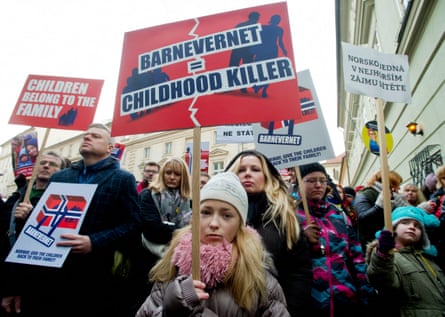
Within the activist circles, the critiques frequently cross from principled concern into radical conspiracy theories: there are claims of adoptions for profit, organ harvesting and organised sex trade of minors, and accusations of being an ultraliberal indoctrination project, or a state-sanctioned eugenics programme. As a result, social workers have experienced harassment and threats.
While the wild conspiracy theories have been debunked, most recently by the major newspaper VG, the reach of dramatic tales far surpasses that of well-documented refutations – not least when amplified by both foreign media with little local insight, and propaganda outlets such as the Russian RT, always happy to present "evidence" of the degeneracy of the liberal west.
Such rampant misinformation (not limited to Norway) can at times hinder necessary debate, with criticism automatically assumed to originate from cranks. But most agree, including within Barnevernet itself, that an ongoing debate about the system is necessary and healthy.
One can see Fjord, and the issue it portrays, as conservatism against liberal leftism, powerless individuals against an arrogant system, or a conflict between prioritising parents' rights over those of the children.
Most parents, myself among them, will insist they know what's best for their own children better than any arm of the state – but some of those parents will also know of families with dangerously unfit parents that hold exactly the same opinion. Norway sees itself as a country that takes the rights of children more seriously than others, aware that while taking action carries the risk of harm, passive inaction and automatic acquiescence to parents can be equally damaging.
Fjord may not be entirely objective or tell the complete story, but it's a more nuanced work than the previous cinematic depiction of Barnevernet, Mrs Chatterjee vs Norway – a sensationalist Bollywood drama based on a mother's account. To balance the film with a sympathetic portrayal of the dilemmas faced by social workers, the award-winning dramedy TV series Pernille, whose eponymous main character works in Barnevernet, is available on Netflix.