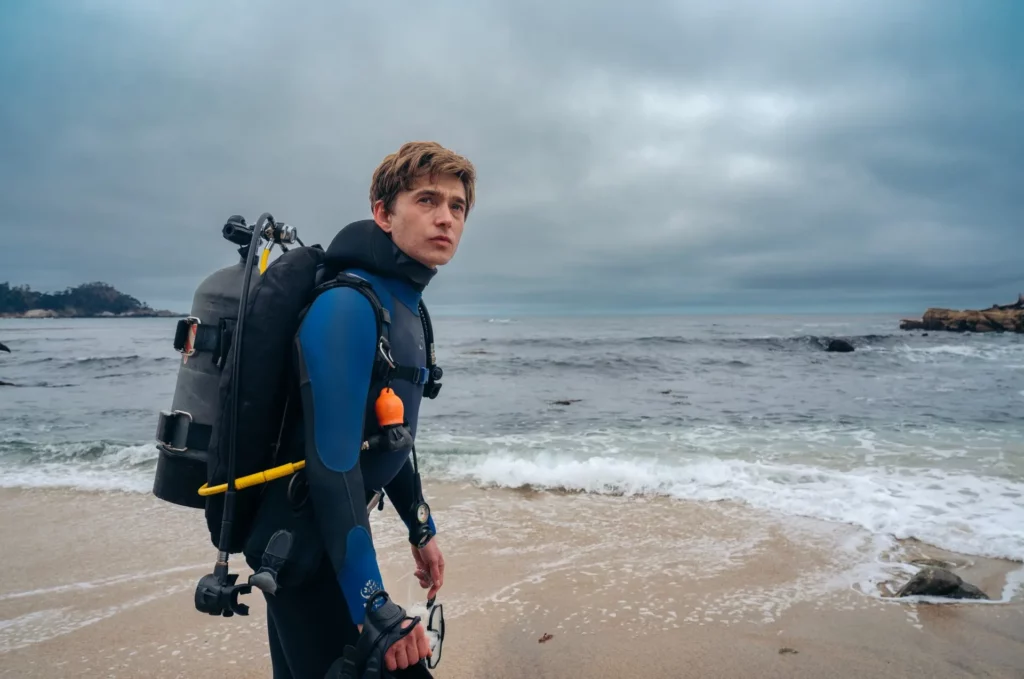
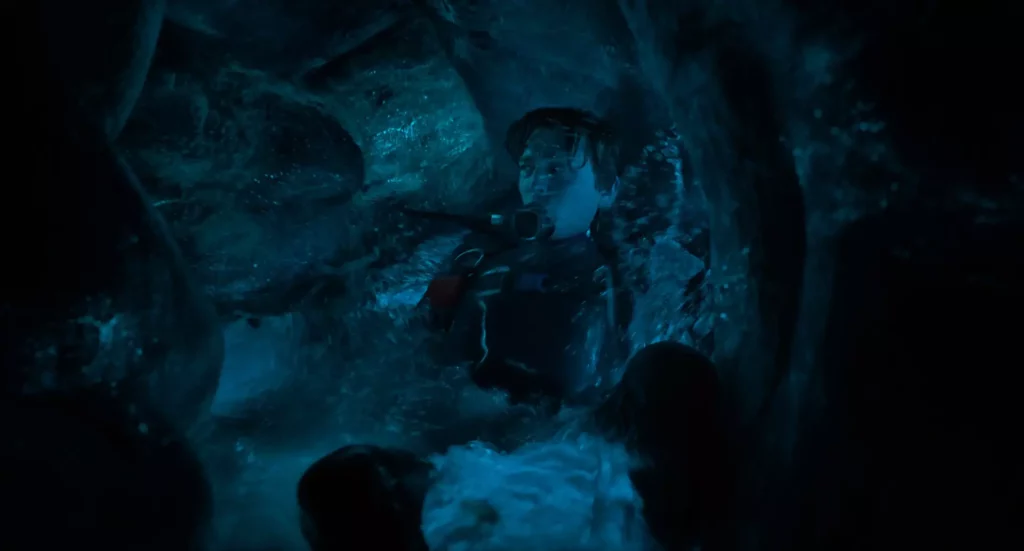
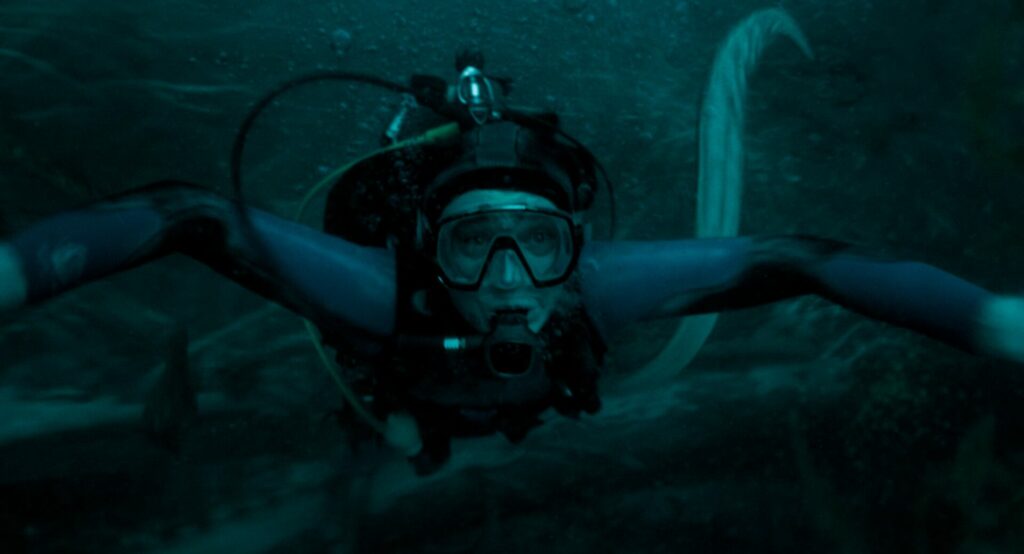
The above image shows Austin Abrams’ exasperated diver Jay being attacked by an octopus, from the stomach of a whale, in mind-blowing new creature feature, . It is one of the most viscerally horrific scenes this film fan has ever seen on-screen.
Suffice to say, Jay is a little pressed. Or rather, with only a 40-minute supply of oxygen left, in absolute extremis. (Latin for at the point of death, but fighting back.)
Thus, he shouldn’t be sweating the small stuff.
Except he is.
Throughout director Brian Duffield’s unforgettable survival thriller, the voice of Jay’s dead father, Mitt, is never far from his mind.
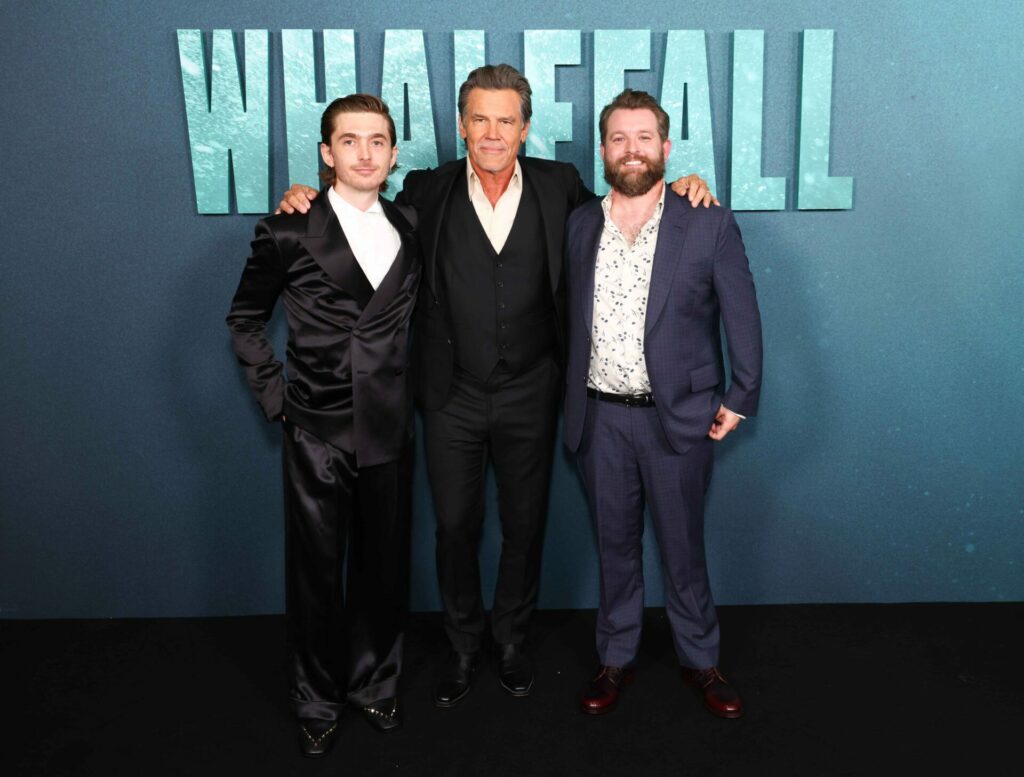
Played by burly Josh Brolin, Mitt is depicted in flashback as a furiously angry scuba instructor and whale watching boat captain who dies by suicide (at sea, naturally) at the film’s start. We also see Mitt verbally berate Jay (“weak lungs!”) from childhood for not being man enough.
Mesmerised though was by the action – we’re scarred for life by the sight of the octopus’s snapping beak, and the paddling pools of stomach acid in the whale – we were initially underwhelmed by the father-son storyline, which seemed by-the-numbers.
did it better,’ we thought. ‘Perhaps has taken all the empathy we can muster for straight men navigating pressures of masculinity this year.’
Then, something unexpected happened.
The ghostly voice of Mitt asks his son, “Do you have a girlfriend?” Jay, rapidly losing consciousness, answers that he doesn’t. “A boyfriend?” Mitt enquires further.
It’s an emotional sucker punch of a moment.
We’ll spoil no further, except to say ’s handling of the question is all the more powerful for its brevity and lightness of touch, as opposed to the sometimes frustratingly soft queer-coding (or outright queerbaiting) of other blockbusters.
It also highlights how even gay journalists like yours truly can fall victim to heterosexist assumptions: namely, that Jay is straight, despite a complete lack of confirmation of this.
We haven’t read Daniel Kraus’s source novel of the same name, and perhaps we’re projecting our own experiences onto the film (as any director worth their salt invites audiences to do) but, for us, the question reframes the story.
It is possible that both Jay and his father’s frustration with his son’s softness – his emotionality, his slightness of frame, his “weak lungs” – has pushed Jay’s queerness so deep inside that showing only a fleeting, ambiguous flicker would be authentic for the story.
That it comes at a moment of extreme crisis is telling, and reveals what’s going on in the depths of Jay’s psyche.
‘Q’ for questioning is perhaps the most under-examined letter in the LGBTQIA+ acronym, but also the most universal: demonstrates that anyone has the capacity to question their truth at any time.
Whatever the extent of Jay’s psychological state – remember, he’s not only grieving his father, but grappling with manhood and possibly his sexuality, while crawling through the throbbing chambers of a whale’s insides – from this point onwards, his hellish environment becomes a metaphor for his mind.
Whether it’s the closet, the belly of the beast, or his own head, Jay has to get .
Thus, while transcending B-movie cliches, proves an elegiac meditation on not just physical survival – but mastering mental health and personal truth.
Whalefall is in UK cinemas now.