uring the intermission of Midnight, an off-Broadway musical about a doomed interracial love affair during US slavery in the 1860s, a woman sitting behind me lauded the show and compared it to Hamilton. On the surface, she was correct. Midnight also has a diverse cast with stunning vocals and a story that reimagines a time within American history. The difference, however, is that Hamilton's creator, Lin-Manuel Miranda, used source material – a 2004 biography on Alexander Hamilton by Ron Chernow – to develop his original work, something the Midnight creator and star, Todrick Hall, eschewed entirely. Therein lies the issue. Midnight aims to focus on the intimate lives of enslaved people and deviates so far from the mark that it seemed the bull's eye was somewhere outside the theatre.
Midnight's premise is that an enslaved man named Rail, played by Hall, who wrote and directed the musical, falls in love with Richard, a member of the wealthy planter class. They grow close after Richard "rents" Rail from Rail's owner, Charlotte. Rail is in a relationship with Lily Rose, an enslaved woman, and Richard is engaged to Scarlet, a southern belle who needs to secure her family's financial future through marriage. It's a formulaic and recognizable story about star-crossed lovers – updated to explore a queer relationship during the time of enslavement. For years, Hall, a singer, choreographer and theatre actor, has repurposed classics like Cinderella and Beauty and the Beast through a queer lens. He deftly remixes the originals with modern cultural references, such as Beyoncé's music or the tensions within current-day gay communities. But in Midnight, Hall reworks the past and creates his own fantasy that neglects the social realities of its characters.
In Hall's Midnight universe, white people and enslaved people shake hands with one another, the enslaved never avert their gazes away from whites (as was required as a sign of deference) and enslaved people can marry and travel off their plantations. Romantic fairytales often have no fixed time attached to them, freeing creators to shape them however they choose. Slavery, however, was an institution with consequences that stretch to the present day. Hall's artistic liberties within an actual historical era read as lazy rather than innovative.
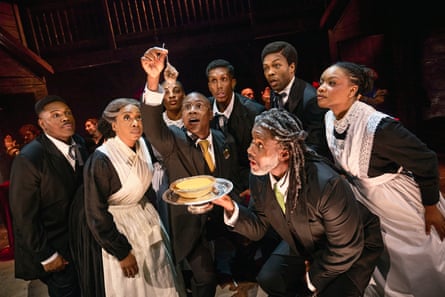
In one scene, Rail sings to Richard with a mention of "40 acres and a mule", a reference to an unkept promise of land distribution to freed Black people, which is anachronistic given that the play is set in 1863, two years before the promise was made by the Union general William Tecumseh Sherman. As an epilogue, the cast fast-forwards and lists the dates of the 13th amendment ratification and the supreme court ruling of legal same-sex marriage in order to convey that Rail and Richard could've been together in a different time. What's particularly notable about this conclusion is that this is the only moment in the play where Hall pays close attention to chronological accuracy, making his time-bending feel uneven and disorganized.
Black queer intimacy in the antebellum south is an emerging subject on which records are still being sought out. "A heavy amount of homoeroticism is alleged in certain slave narratives but there is no documented proof of relationships between male enslavers and the Black men who they enslaved," said Beau Lancaster, an adjunct history professor at the City University of New York. This dearth of information isn't a dead end but rather a portal, and some artists have been able to work through archival omissions with a balance of imagination and historicity.
For her 2016 novel Homegoing, Yaa Gyasi used her research at Ghana's Cape Coast Castle, where enslaved people were held, to describe the cries and awful smells her Black female characters may've experienced. The author Robert Jones used oral histories of continental Africans to write about two enslaved men who fall in love on a Mississippi plantation in his 2021 novel, The Prophets. Through his own research, Jones imagines what sex might have been like between two men on a haystack, where the "muffled sounds" of other enslaved people in shacks were nearby. In both instances, the authors' creativity springs forth from a historical foundation.
Because Hall does not use any source material to anchor his story, his imagination is unfocused. In Midnight, despite Rail telling Richard that a literate, enslaved person could wind up dead, Richard not only teaches Rail how to read but they also go further by regularly exchanging love letters without the audience ever seeing how they accomplish this while remaining safe. The characters act as though they do not take heed to the seriousness of their dynamic even if their dialogue states that they do. Instead of developing how their secret love affair perseveres despite its multilayered illegality, Hall treats anti-literacy laws as an aside rather than a key obstacle in how they would be able to communicate with each other when apart.
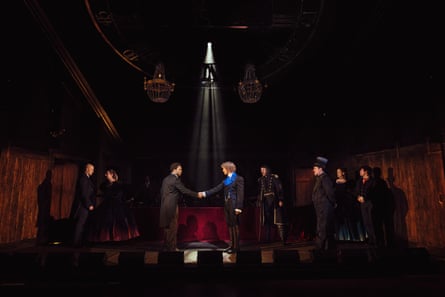
Historians Treva B Lindsey and Jessica Marie Johnson navigated this terrain in their 2014 landmark essay, Searching for Climax: Black Erotic Lives in Slavery and Freedom. "Enslaved people had complex ideas about the world and complex identities," Johnson said. "They had histories, and they also had sex that they enjoyed." It is an extremely difficult endeavor to craft a story where intimate violence – an essential element for perpetuating slavery – and sexual self-autonomy exist alongside each other. Hall is more devoted to the optics of an interracial romance and removes all friction and tension that would've required a Black male character to navigate his own desires within a world of complete subjugation.
Hall has said that Midnight is a "completely original story from start to finish, so the only way an audience can experience it is to go watch the show". But slavery is not an original story and enslaved people, who did yearn, love and have physical intimacy, are not figments of his own imagination. The result is that Midnight is made through Hall's own image, a self-centered distortion of the past that ultimately weakens the musical's plot and trivializes his characters' passions.