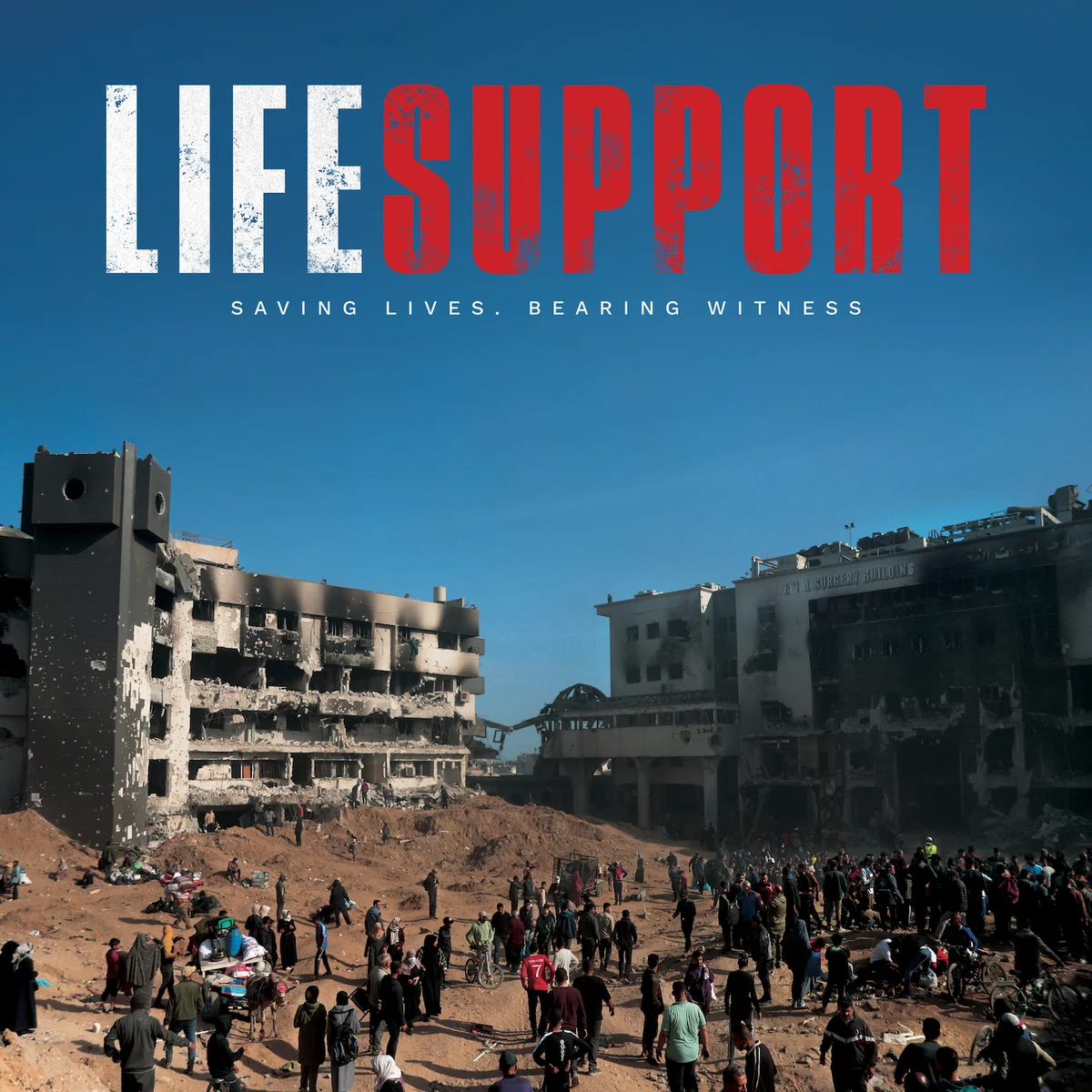
With the Israeli government barring international journalists from entering the territory, those medics became some of the few independent witnesses to what was taking place there, and still continues to take place. The soundtrack, curated by the film's producers and 3D (aka Robert Del Naja of Massive Attack), combines original compositions by Del Naja and Palestinian composer Habib Shehada Hanna with previously released tracks and an excellent new remix.
Star Wars star Denise Gough, who narrates the documentary, says that on a project like this, the duty of artists is "to offer and use whatever skill we have to amplify the very real work being done on the ground." Both composers seem to have taken that to heart in building the score. Their pieces are built on space and breath, leaving room for reflection. Yet that space is always loaded with a density that borders on suffocating.
Hanna opens the record with "Sleeping is a Privilege", a title that on its own says almost everything about the context. Sparse, melancholic guitar lines, drawn from Arabic tradition, float over low, heavy frequencies, sketching an anxiety that endlessly searches for a comfort it never quite finds. "Missing" is brief but vigorous: a piano converses with strings in a gradual build, each note pressing like a finger on a wound until the pain finally dissipates. "Gaza Gaza" returns to that pairing to create something rawer still. Here, Hanna treats Arabic melody not as mere ornament but as structure.
Del Naja's instrumentals lean more towards ambient and contemporary film scoring. "Explosives of the Future" points at the ghosts the present terror is already leaving for what comes next. "Perfect Victims" layers synths into a slow, restless haze. "House of Healing" settles into a melancholy of a more classically cinematic kind. But it's Del Naja's remix of Kneecap's "Palestine", featuring Ramallah-based rapper Fawzi, that provides the record's high point. Dry, heavy drums and dense synths carry an aggressive verse over a beat that speeds up, edging towards grime, but in a more experimental direction.
The curated tracks here share an instinct for translation and connection: experimental, independent projects that turn aspects of Palestinian reality into sounds that are also recognisable to Westernised ears. Yasmine Hamdan's "Thirteen Kilometres" is the standout. With open vocals and an enveloping atmosphere, it draws on trip hop with touches of noise, showing exactly why she is considered a legend of the Arabic underground.
Massar Egbari's "Ana Mawgoud" is a hopeful pop song with a hard rock guitar solo that fits in surprisingly well, while British–Somali singer Aar Maanta offers, with "Sahnuuni", perhaps the album's only invitation to dance. Siba and Monkyman's "Dounana" delivers rap over hard beats, and 47Soul close the album with "Ya Kho", steering their shamstep here towards reflection rather than the dancefloor. "Resistance in the Dark", from David Holmes' collective The Five Techniques, featuring Paul Weller and Róisín El Cherif, is where the album comes closest to indie rock.
As an album that alternates between original score and standalone songs, can't entirely avoid the feel of a compilation. Yet that quality suits its purpose, given its clear intention to represent many voices, from many places, that stand behind the same political position. As Rugo himself puts it, "the music composed for strikes a very difficult balance: it honours words and images without overpowering them, whilst adding real emotional depth that makes the film land even harder." That seems the right role for music in the face of such barbarity.
All profits from the vinyl release (via Del Naja's own Battle Box label) will go to the Health Workers 4 Palestine solidarity fund.