The drummer Clem Cattini, who has died aged 86, had the distinction of playing on more than 40 No 1 singles. Largely unknown outside the music business, he was revered inside it as one of the best session musicians of his generation.
Over a 45-year period from 1960 to 2005, Cattini provided the backbeat for dozens of British No 1s, including The Sun Ain't Gonna Shine (Anymore), by the Walker Brothers, You Don't Have to Say You Love Me, by Dusty Springfield (both 1966), and Everlasting Love, by Love Affair (1968), as well as many other top 20 hits. He also played with the Kinks, the Yardbirds, the Bee Gees, Roy Orbison, Paul McCartney, the Hollies and Lou Reed.
Not everything Cattini touched turned to gold, and not all of his No 1s were necessarily of lasting value – he also appeared on Chirpy Chirpy Cheep Cheep, by Middle of the Road (1971), Grandad, by Clive Dunn (1970) and Ernie, by Benny Hill (1971) – but he had no time for snobbery, and as a self-proclaimed "musical navvy" was as happy to receive his fixed fee for a turkey as a prize bird. "I'm not ashamed or embarrassed to admit that I played on anything," he said. "In the end it was all just work."
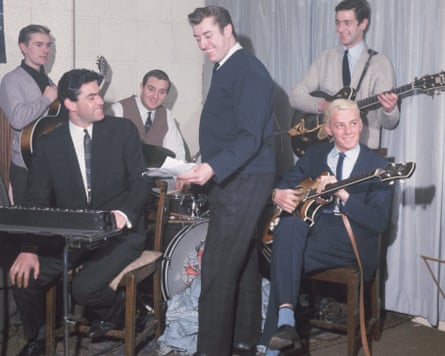
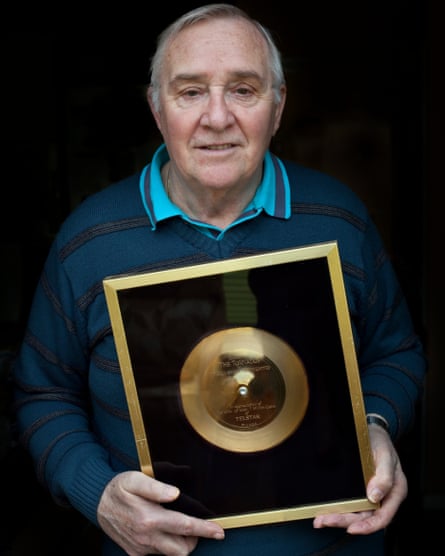
Cattini began his career as a rock'n'roller, and two of his early chart-topping singles were as a real-life band member – first as the drummer for Johnny Kidd and the Pirates, with whom he released the quivering Shakin' All Over in 1960, and then the Tornados, whose other-worldly 1962 instrumental, Telstar, not only reached No 1 in the UK but made them the first British group to top the US singles chart.
Eventually, however, he tired of life on the road and settled into the more structured existence of studio work, where his economical and utterly reliable style made him the go-to drummer for hard-pressed producers. Doggedly down to earth, wryly humorous and unfussy, Cattini possessed a chameleon-like ability to fit in with whoever, or whatever, was thrown at him.
At the peak of his involvement in the British pop scene, from 1966 to 1971, he was averaging about four No 1s a year, from Green, Green Grass of Home, by Tom Jones (1966), and Something in the Air, by Thunderclap Newman (1969), to Love Grows (Where My Rosemary Goes), by Edison Lighthouse, in 1970, and I'd Like to Teach the World to Sing, by the New Seekers, in 1971.
The run continued well into the mid-1970s as he played on When Will I See You Again, by the Three Degrees (1974), and So You Win Again, by Hot Chocolate (1977), before he gave up session work to tour with the Kids from Fame show and a re-formed version of the Tornados. His last No 1 came in 2005, when he featured on the Comic Relief single (Is This the Way to) Amarillo, by Tony Christie and Peter Kay.
Born in Stoke Newington, north London, Clem was the son of Lena and her husband, Clemente Sr, who ran a cafe, having emigrated from Italy. He left St Ignatius grammar school in Tottenham at 15 to work with his father, serving cups of tea and working the till.
The move into music came when he and a friend, Terry Kennedy, saw Bill Haley playing Rock Around the Clock in the film Blackboard Jungle (1955). They immediately formed a skiffle band, Terry Kennedy's Rock and Rollers, with the self-taught Cattini on washboard and drums. Initially playing in pubs around London, they eventually upgraded to a residency at the 2i's coffee bar in Soho, where Cattini also picked up work as the house drummer. After a late stint there one night, he overslept for work at his father's cafe and was sacked, prompting a move into music fu time.
In 1957 the Rock and Rollers were signed for a six-month tour supporting the comedian Max Wall, after which they became the touring band for the singer Terry Dene. In 1959 Cattini married Anna, who was also of Italian stock. Shortly afterwards he joined the Beat Boys, a backing band for, among others, Billy Fury.
Johnny Kidd and the Pirates followed in 1960, and he quickly found himself in the studio recording Shakin' All Over. Months of exhausting touring followed, but by the middle of 1961, with the band unable to repeat its chart success, he abandoned Kidd to play a tour of Italy with the Cabin Boys, providing backing for the singer Colin Hicks.
On his return he became the house drummer in the producer Joe Meek's ramshackle north London studio. In 1962 the band were named the Tornados before recording the Meek-penned hit Telstar, one of the few instrumentals to make the UK's No 1 spot. It briefly shot them to fame, but after soldiering on through a number of band changes, Cattini quit in 1965.
Tired of the grind of touring, he began to hang around the Gioconda coffee bar in Soho, where a small group of musicians would pick up work in the studios. As a drummer Cattini found he was in special demand: many of the fresh-faced bands on the scene might have had vitality and songwriting talent, but they were often barely competent musicians, and the man behind the kit was usually the weakest link. "Most of the groups at that time were inexperienced in the studio," he said. "It wasn't a slight on their abilities, more a question of time means money."
Crisscrossing London to the Decca, EMI, Regent Sound and Pye studios, he found himself playing on up to three sessions a day, making contributions to many hundreds of singles and thousands of recordings. So thick and fast did the work come that often the sessions blurred into one. It could be that he played on more No 1s than is currently reckoned.
With the arrival of punk in the late 70s, Cattini shifted focus. Largely abandoning session work, he became the resident drummer at Caesar's Palace nightclub in Luton, Bedfordshire, where for a decade he played with visiting artists such as Shirley Bassey, the Four Tops and Gene Pitney. In 1982 he joined cast members from the American TV series Fame on a Europe-wide Kids from Fame tour, and later played in the touring Rocky Horror Show musical. In 1988 he re-formed the Tornados with a new lineup, playing various 60s revival dates until 2000.
A lifelong Arsenal fan, he and Anna also spent many years providing homely lodging for young players coming through the club's academy.
After a surprise return to No 1 with Amarillo in 2005, Cattini was portrayed by James Corden in the 2008 film Telstar: The Joe Meek Story. Two years later, in his early 70s, he was called into the studio by Paul Weller, a longtime admirer, to play on a track, No Tears to Cry, for the album Wake Up the Nation, characteristically nailing the part in just two takes. "Paul was lovely," he reported. "But I had to tell him to stop calling me Sir."
He is survived by Anna, his daughters, Giulia, Daniella and Victoria, and grandchildren, Tomas, Louis, Freddie and Isobel.