y father, Sergiu Celibidache, loved children more than anything because they are free and true to themselves. And yet, he once made a young boy wet himself when he dared to ask for an autograph, shouting at the poor child as if he had committed a federal crime because he knew there was a black market selling his signature behind his back.
I grew up a privileged child with presents from all around the world. I was spoiled – to the despair of my mother, who always tried to keep my feet on the ground. But the gifts were part of my father's way of making up for his long absences – he was often away touring with his orchestras.
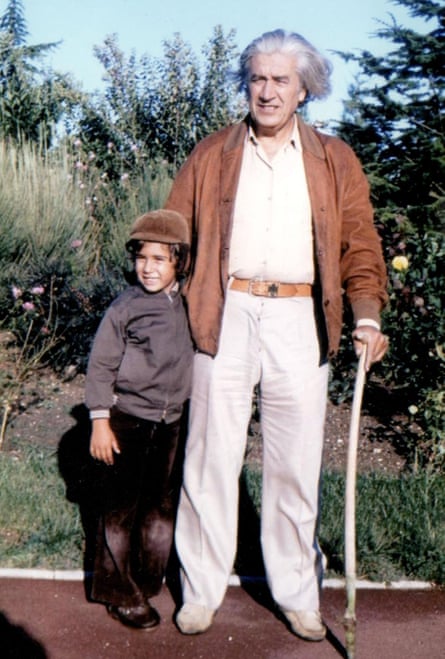
As a young boy I had very little understanding that my father was a world-renowned conductor. I always missed him terribly when he was away, and yet he was nonetheless always very present in my life, and we were close. He was generous and attentive. There were frequent speeches about the less privileged and our duty to do something for them, and he was always eager to share stories of his picturesque childhood in Iași, Romania and his many adventures after leaving home to pursue music, without any support from his family.
Those tales – some of which would eventually become part of The Yellow Tie – were fascinating. And he was such a good storyteller that I could hardly wait for my bedtime stories whenever he was around.
But as much as I had a generous and entertaining father I also had an intransigent and demanding one.
Whatever the school activity, whatever the situation at home, he expected me to be the best version of myself. If I received a disappointing grade or disrespected my mother in any way, I would have to explain myself. I was not to begin a sentence unless I knew where it was leading. If the structure of your thought was not clear, silence was a much better choice, he said.
My father could not accept doing anything half heartedly. You had to be completely immersed in whatever you were doing at that very moment, fully invested in the "now". Looking back, I remember the joy he found in preparing food for the four St Bernards at our country house, or in feeding the wild ducks at the river with such patience and dedication. So much life invested in the simplest activities. And he expected me to treat life as he did: with that drive, that indestructible belief in God and in oneself, and that absolute dedication.
This pursuit of perfection was present throughout our daily lives. Even if only on a subconscious level, the pressure was constant for all of us – family, friends, colleagues and students. Oh, the poor students! As much as he was a phenomenal musician, my father's approach to teaching remains questionable to this day. "Teaching is the most noble activity to which one can dedicate oneself," he said; he loved it and considered it his duty to pass knowledge on to the next generation, in the manner of Socrates.
Yet he was a highly demanding teacher who spared no one's feelings. I remember one masterclass in Paris, at the Schola Cantorum. I was filming the session in which experienced students were invited to conduct the student orchestra in front of a live audience. Almost none of the trainee conductors escaped his harsh criticism – for an unjustified and perhaps overly expansive gesture or – God forbid – a forgotten background musical phrase. Sometimes, he would even ridicule them, to the audience's amusement and their evident humiliation. I hid behind my camera, thanking God I had decided not to pursue a musical career. But I also knew that he loved them as he loved me, and wanted them to become the best versions of themselves. His intentions were pure but did his methods work? It's debatable.
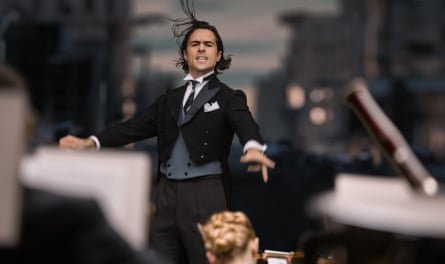
His uncompromising perfectionism mixed with a deep sense of integrity led him to develop, over time, a profound disdain for recordings, which were, in his view, a dangerously false representation of live music experienced in a concert hall. Refusing lucrative offers from the four corners of the globe, he remained faithful to his conviction that music can only be experienced live.
With no recordings of my father available, my thirst for knowledge drove me to discover the classical repertoire through the recorded music of the conductor who, judging by the music store shelves lined with his name seemed, at the time, to be the most widely acclaimed – Karajan. In my quest to absorb the masterworks, I was turning to the ultimate commercial recording figure as a substitute for a conductor who rejected recordings entirely! Still, I eased my conscience, remembering my father saying that when they first met in Berlin, Karajan was a genuine talent. (What happened later is another story …)
As a small act of provocation, I would occasionally play a piece louder than necessary to provoke a reaction from my father. I found it difficult to accept that he would not make "his music" available to everyone – that he would not leave behind something of his extraordinary musical vision. In fact it infuriated me. So much so that, upon my return from NYU, I did exactly what you see in the film: I played a bootleg recording of one of his performances and pretended to him it was by a new conductor I'd discovered ... Needless to say, that conversation didn't end well.
I believed that even if a recording was not authentic music in his sense of the word, it would still have been the memory of a musical moment – and that, in itself, had value. I was so convinced of this that I agreed to let some of the orchestras he conducted in his later years record his concert performances without his knowledge. It was never about money, but about the genuine value of the documents themselves. He knew nothing about it, and, of course, I could not tell him. But today, I feel blessed that these "memories" exist.
I grew up in awe of my father, but I did not agree with all that he did. That distance helped me find the courage to approach a biopic about his life. The goal was never to put him on a pedestal. The opening scene – where Japanese record company executives offer him a lucrative recording deal alongside a concert tour – does more than just show his aversion to recorded music. It introduces him as an impetuous and unpredictable man who wasn't afraid of confrontations.
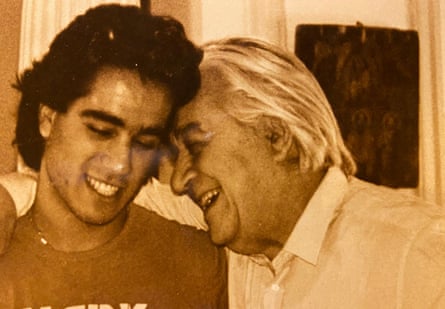
I and my co-writer James Olivier tried to remain faithful to the man we knew. The Yellow Tie is not only a story about music, love and integrity. It is a story about sacrifice, survival and identity. Beyond my father's devastating exile from his familial roots, his is a deeply inspirational true story about an immigrant trying to succeed in a country that is largely hostile.
All I can hope is that my father's story may inspire those who sometimes struggle to find and define their own path. If he could do it against all odds, perhaps we can too.