y any reckoning, 21 years is a very long gestation period. Beethoven wrote his first eight symphonies (and was stuck into the ninth) in less time. But it's how long it took Brahms to complete his First Symphony. He initially sketched it in the mid-1850s, in his 20s, and he was 43 by the time it was premiered, exactly 150 years ago on 4 November 1876 in Karlsruhe.
Earlier that summer had seen the premiere of Wagner's Ring cycle in Bayreuth – another project that had taken more than 20 years to bring to fruition. But in contrast to the 15 hours and four operas of the Ring, all Brahms had to do was compose four movements, lasting about 45 minutes in performance. Why did it take him so long?
Mostly because of Beethoven. Where Wagner took the inspiration of Beethoven's Ninth Symphony as an excuse to reject the concept of the purely instrumental symphony – the voices of the choral symphony in the Ode To Joy were the start of Wagner's development of a new kind of music-drama – Brahms grappled with the question of how to write a symphony with "that giant", as he's said to have called Beethoven, on his back.
As if that self-administered pressure weren't enough, he risked even greater comparisons with Beethoven: his First Symphony is brought to its conclusion by a tune that virtually quotes Ode to Joy. "Any ass can see that," as Brahms said – by which he meant that his homage was of course conscious.
In short, the essence of his work is profoundly personal. This symphony's subject is his battle with and transcendence of all those centuries of influence, the history of his anxieties in coming to terms with them. The music's journey from C minor to C major – the same as Beethoven's Fifth – is staged not as a search for a humanity-encompassing utopia, as it is with Beethoven, but as something more intimate. It is a struggle to find an individual voice, a quest for a territory that's new and yet connected to all of that weighty history.
With this work, Brahms wasn't trying to change the world – he was trying to keep it going, and to find his place within it. The conductor and pianist Hans von Bülow called the symphony "Beethoven's Tenth", which might seem like the greatest of compliments, but to me was really a misunderstanding of the unique intensity and intimacy of expression that Brahms finds in his First Symphony – a symphony that Beethoven could not, and would not, have written.
ver, now, to Berlin, with a story that seems incomprehensibly trivial to anyone not involved in the finer points of orchestral disposition, but bear with. Conductor Iván Fischer cancelled this week's planned concerts of Mahler's Fifth Symphony with the Berlin Philharmonic (Andrés Orozco-Estrada has replaced him) because the double-basses would not be moved from their usual placement in the Philharmonie, their concert hall home. They usually sit to the conductor's right, with one of the angled walls of the hall behind them.
Fischer wanted to move them to the back of the orchestra, in a single line, behind the woodwinds, citing Mahler's example and, above all, his own ears and experience. In Fischer's putative placement, the basses can't see each other, and only have the audience in the choir stalls behind as their acoustic reflector. The orchestra did play in this way in 2022, when Fischer conducted them in Mahler's First Symphony, but the players weren't, apparently, fully on board with the result – and weren't prepared, at short notice, to change their setup for this forthcoming performance.
Fischer refused to compromise, and so withdrew from the concert. He apologised and explained on Instagram – "I cannot compromise because the seating arrangement is so important for the sound and for the unity of this wonderful piece …"
It looks like orchestral intransigence in the face of conductorly adventure. But it's not that simple: first, because the Berlin Phil is used to changing its lineup when conductors and directors ask for it, whether swapping string sections around, or atomising itself into groups for Peter Sellars's semi-stagings of Bach's St Matthew Passion with Simon Rattle; and second, because Fischer has his own house band, the Budapest Festival Orchestra, with whom he tests out new orchestra configurations for the repertoire he plays, often with thrilling results. (Here's a unique performance of Bruckner's Ninth, with all of the horns sitting in front of the conductor, turning them into a gigantic solo section.)
Fischer spoke to Van magazine about the cancellation. The tradition of principal players leading their sections, essentially acting as sub-conductors – how most orchestras manage their performances – is a flawed concept, he said: "Old-fashioned, mistrustful, and cumbersome." But why? "As a conductor, you can't communicate subtleties. With my orchestra, [the Budapest Festival Orchestra] I can move one finger and the sound will change immediately, because I'm in direct contact with all the tutti players. But when my gesture is filtered through different layers of interpretation, all that gets lost."
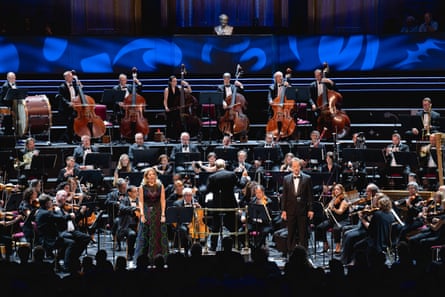
That sounds just a wee bit like having all the cake, and reinstating a less collaborative kind of authority over the whole ensemble from the podium. (But, Fischer also says, "I understand the beat as something that's not mechanical, but creative – an encouragement for their own musicality. That way, a large orchestra can really make music together: beautifully, creatively, with lots of freedom and yet in total harmony.")
It's not looking likely that Fischer and the Berlin Phil will be making music anytime soon: "I'll focus on other orchestras and they'll focus on other conductors. It's for the best."
This week Tom has been listening to: Oliver Leith's Doom and the Dooms. A miasma of improbable musical pasts and even more impossible futures, it's a supposed transcription of a supposedly lost concert by a little-known rock band that slips between all known categories of genre and soundworlds. It's magnetic, hyperreal and I love it.