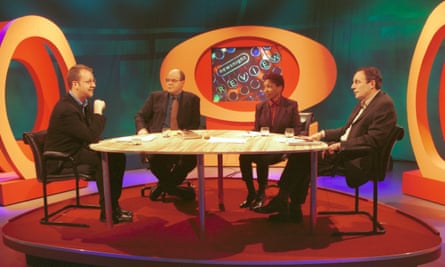
The writing and broadcasting of Bonnie Greer, who has died aged 77, were driven by divided perspectives. Her technical experience across an unusual range of genres – drama, fiction, biography, memoir, documentary – informed her work as a wry and lively critic, especially on the late-night BBC2 cultural programmes Late Review and Newsnight Review from the 1990s onwards.
And, having spent the first half of her life in the US and the second in the UK, she was also perfectly positioned – in an era when British writers, movie-makers and artists were making much work about and for America – to adjudicate on such creative duality, as well as the escalating Americanisation of British politics. Another asset was her connections: reviewing a David Mamet play or a Madonna album, she had worked with the former in Chicago theatre and met the latter as a young music wannabe in a Manhattan apartment share.
Bonnie's most successful play, Marilyn and Ella (2008), emblematically explored black and white culture through a dramatised encounter between Ella Fitzgerald and Marilyn Monroe.
The television persona that brought Bonnie a niche, but serious, celebrity had two essential elements: a sharp, inquisitive, generous brain – never outweighed on discussion shows that often became rhetorical boxing contests – and a warm, throaty laugh that charmed those who were drawn to her, and disarmed the suspicious or resistant. Having heard that signature sound for years next to me on BBC studio sofas, and before and afterwards in hospitality rooms, it came immediately to my mind on hearing of her death. One of her declared aims was to "bring people together", and her inclusive, empathetic personality greatly helped.
Bonnie's ability to mix and thrive in what might have been hostile environments – reflecting this, her 2014 memoir was called A Parallel Life – was shaped by her early years. She was born in Chicago, one of seven children of Ben Greer, a sharecropper turned factory hand, and Willie Mae (nee Randolph). Her father was a teenage GI at the end of the second world war. Later, though a committed cinephile, Bonnie struggled to watch Saving Private Ryan, Steven Spielberg's film about the terrible death toll among young men in that conflict.
Ben was stationed in England as part of the D-day landing forces and, having grown up in then segregated Mississippi, was astonished by a society in which discrimination was tacit rather than mandated. His love of Britain passed by osmosis to his daughter. Her unusual first name was, in different accounts, either a tribute to Bonnie Prince Charlie, seen by her parents as a heroic resister to the status quo, or a reference to the now King Charles III, born two days before Bonnie and dubbed in newspaper headlines at the time Bonnie Prince Charlie. She became a British citizen in 1997 and when she was appointed OBE in 2010, she dedicated it to her father.
Bonnie described her childhood as "quiet and sheltered", which was exactly what her Roman Catholic parents would have wanted. But her life became notably noisier from 19 when, while she was a student at DePaul University, a gay friend introduced her to a bohemian group of Chicago actors and writers who unlocked another self: "They would put me in vintage dresses and take me to parties. They made me see life another way."
Through them she met Ivan, who worked at the UN in New York, and cajoled Bonnie to move there in 1978 to live with him and his boyfriend in Manhattan's West Village. She loved their careless lives there, and began to write plays until the Aids epidemic brutally reduced the group. After nursing Ivan until his death, she moved to London in 1986.
There she was introduced to a person, David Hutchins, and an institution, the BBC, who would change and shape her adult life. Although she was surprised to find herself in love with a "British white public schoolboy", her marriage in 1993 to David, a solicitor turned teacher, proved to be the most successful of her many cross-cultural encounters. As well as her great love, he was her amanuensis, chauffeur and a huge encourager of her writing and developing broadcasting career.
Critics risk their opinions becoming predictable, although the format of those arts "shout shows" reduced this risk by asking the panel to judge, in a brisk 10 minutes each, a subtitled movie, a sitcom, a Broadway musical and the latest novel by a Nobel literary laureate. It was impossible to guess what Bonnie's take on any of these would be. She loved Fight Club for its unflinching realism about masculinity, but Amélie for its whimsical artificiality, because she loved "fairytales".
And, while what critics fear is acclaiming a critical disaster as a masterpiece, or vice versa, Bonnie immediately identified Sean Penn's The Pledge (2001), in which Jack Nicholson's retired detective takes an appalling risk to catch a child killer, as a great American movie. I think she had even read the German novella that was the obscure source material. She was also movingly acute on Aids stories such as the film Philadelphia and the novels of Edmund White.
When Bonnie's TV career began in the 90s, her surname was already taken by Germaine, one of the world's best-known cultural figures. I called them on air "the Greer sisters" and, generally seated next to each other by a canny studio director, they played up to this, becoming a double act, eyes widening in not completely mock surprise at what the other had just said, and continuing their arguments over wine and nibbles afterwards. It is a very modern compliment to say that they should have had a podcast.
Bonnie had wrecking-ball energy – among her listed recreations was "the gym" – and an enduringly youthful enthusiasm. At a time when people of colour were shamefully rare on arts and news programmes – largely because contributors were drawn from monochrome political and cultural establishments – she was of a black generation forced to be pioneers and role models.
Live TV shows like to get guests there early for makeup and to mitigate erratic city traffic. In those pre-digital days, we would be handed, on arrival at BBC Television Centre, our fan and hate letters. For Bonnie, the first quickly formed by far the bigger stack, but the second were disgracefully, often frankly, racist. She would crease her face in unsurprised dismay, and focus on the positive correspondence. To my naive shock, this was often from young black women who had never before seen someone who resembled them given such television prominence. Dry-eyed at what the bigots wrote, Bonnie would sometimes well up then.
Increasingly, as British institutions began to address their lack of diversity, the mail included invitations of trusteeships. Bonnie served diligently and with familiar sparkle at the British Museum (as deputy chair 2005-13), the Serpentine Gallery, the Royal Opera House and the London Film School. From 2013, she was chancellor of Kingston University. In 2015, though, she suddenly resigned as president of the Brontë Society, exhausted by the egotistical squabbles that can afflict volunteer cultural bodies, after an ill-tempered public meeting in which she used the heel of her Jimmy Choo shoe as an impromptu gavel.
Bonnie's long experience of racial politics in two nations – one of her later books, Obama Music (2009), anatomised a transformative presidency – informed the biggest non-arts moment of her TV career when, in 2009, she was chosen as a panellist on BBC One's Question Time alongside the British National party leader, Nick Griffin. The broadcast prompted protests. Because Bonnie was so naturally charming on air, it was clear that she was withholding her charm from Griffin, though, crucially, without losing her temper or being openly rude in a way that might have justified his supporters in their views. After another Question Time appearance, opposing Brexit, Bonnie was offered the freedom of numerous Irish villages.
Bonnie's one regret about her broadcasting success was that it overshadowed her writing, and she was particularly proud of Entropy, a 2009 experimental novel on which she worked for many years.
She is survived by David.