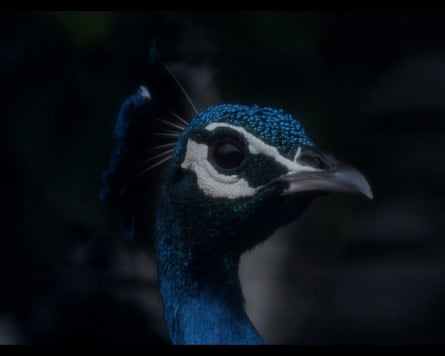
he exhibition begins in darkness. A darkness so complete, in fact, that I'm forced to wait at the threshold while my eyes adjust to it. To my left, images flash up on screens that seem to float in the gloom: a peacock preens its wet feathers; dried flowers in a wooden bowl; sunlight scatters on water. When the room has resolved to the point that I can identify a chair to sit on, I realise that these pictures are combined with snippets of text telling stories like parables: about a landlord punished for breaking a promise to a beggar; about two friends who survive a massacre because they are down by the river, arguing over the moon.
Welcome to the world of Amar Kanwar: if you want to find beauty and truth, you must be prepared to step into the darkness. Over 40 years making increasingly lyrical films about stories ranging from the collapse of empire to endemic sexual brutality, the Indian artist has developed a method that neither reproduces the violence of these histories as spectacle nor glosses it over. Instead he trains his focus on those parts of the story that normally escape attention: the shadows, the neglected, the blind spots. He does not find revelation there, at least not of the kind that suddenly lights up the world and makes sense of it. But there are enough flashes of light to guide us through the darkness.
This idea finds its most literal expression in Such a Morning, a feature-length film installed within one of the enclosed spaces that make this old gunpowder store so well suited to Kanwar's play with darkness and light, secrets and disclosure (the whole exhibition is superbly staged). It tells the story of a mathematics professor who retreats into an artificial darkness in the hope of finding another way to understand the world around him. Through a characteristic combination of exquisite images – a woman sits in a rattan chair clutching an antiquated rifle as her house is dismantled around her – with overlaid text and a trancelike piano soundtrack, the film conjures an atmosphere of commingled crisis and possibility.
Like much of Kanwar's work, Such a Morning makes demands on your patience. Anyone attempting to make simple sense of the film is likely to sympathise with the professor groping blindly around in the dark. But it is worth putting in the time, because Kanwar's commitment to doubt as a precursor of knowledge carries a political charge in the present. If you are inclined to feel, on reading the news, that we have recently entered a new dark age, then Such a Morning proposes that we have been blinded by the lights. Overwhelmed by images masquerading as reality and opinions posing as fact, we might follow the professor's example and commit to a period of reflection on what we choose to see and how we interpret it. He comes to a simple conclusion: we must all learn to attend to the darkness if we are to change the course of "self-destruction" on which humanity is presently set. It's a lesson worth heeding.
The degrees of darkness the professor identifies are represented by illuminated paper screens that protrude from the wall like torches. It's a brilliant piece of theatre design that leads you through the prevailing gloom to the final work in the show, another film to combine archive footage with fragments of text. The subject of the evocatively titled The Charcoal Man is the 1947 partition of India. Events from the assassination of Mahatma Gandhi to the mass migrations are told from the perspectives of people who might seem incidental to the action: an absent-minded window maker, a boy who dreams of becoming a drummer.
The tension here is between forgetting and remembering, both of which are figured as essential to reconciliation, and The Charcoal Man suggests they might be fused through various kinds of alchemy or transference. In one story, for example, a father instructs his son to remove the circuit boards from the computers in his shop and, through a complex chemical process, to aggregate the gold they contain into a bracelet that could be pawned in the event that he needs at short notice to flee. Memories of a violent past are by these means transformed into insurance against the future. Is this what art might do?
The same narrator inherits from his grandfather, a professional photographer, an archive of images documenting the violence of Partition. The seemingly paradoxical condition of the bequest is that these photographs should be conserved for ever but never shown. Instead they might continue to exist in the shadows, alluded to (but never revealed) by the kind of stories that preserve the horrors of the past without restarting the cycles of violence. These, after all, are the kind of stories that Amar Kanwar tells.